
Chinese Destroyer Live-Fire in Japan EEZ Near Okinotorishima
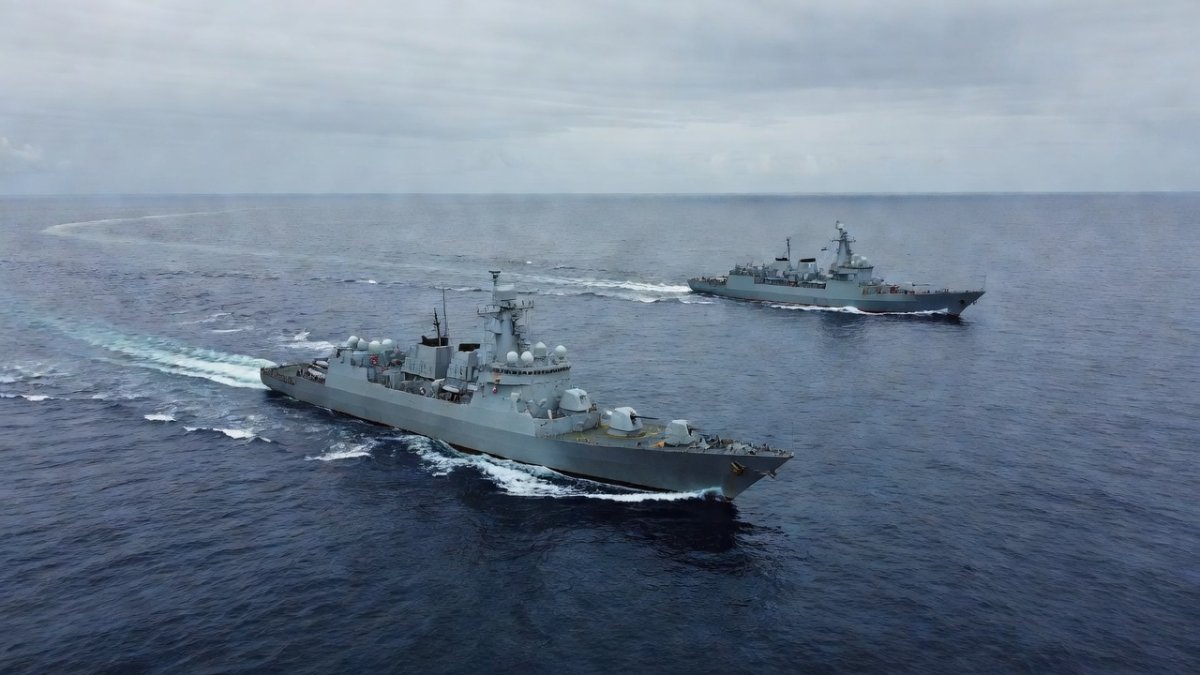
What Happened A Chinese Type 052D missile destroyer conducted live-fire machine gun drills inside Japan's Exclusive Economic Zone near Okinotorishima island during the weekend of July 19-20, 2026. Two Chinese destroyers sailed alongside a Russian frigate and a Chinese supply ship roughly 330 kilometers southwest of the island at approximately 2:00 AM Japanese time on July 19. Japan's Maritime Self-Defense Force destroyer tracked the group and collected intelligence data.
What Happened
A Chinese Type 052D missile destroyer conducted live-fire machine gun drills inside Japan's Exclusive Economic Zone near Okinotorishima island during the weekend of July 19-20, 2026. Two Chinese destroyers sailed alongside a Russian frigate and a Chinese supply ship roughly 330 kilometers southwest of the island at approximately 2:00 AM Japanese time on July 19.
Japan's Maritime Self-Defense Force destroyer tracked the group and collected intelligence data. This marks the first occasion on which Japan's Defense Ministry has publicly acknowledged and disclosed a foreign navy vessel firing live rounds inside the country's EEZ.
Japan's Response
Defense Minister Shinjiro Koizumi, in office since October 2025, publicly highlighted the incident and warned of deepening China-Russia military ties. Tokyo lodged a formal protest through diplomatic channels and released images showing the Chinese destroyer firing its machine gun.
Japan's Joint Staff assessed that the activity did not violate international law. The Maritime Self-Defense Force maintained continuous surveillance of the vessels throughout the period.
The Okinotorishima Dispute
China disputes Japan's claim of an EEZ around Okinotorishima, maintaining that the feature is a reef or atoll rather than an island and therefore cannot generate an exclusive economic zone under the United Nations Convention on the Law of the Sea. Japanese authorities have consistently treated the area as part of the national EEZ.
Chinese naval and research vessels have entered these waters on previous occasions, including a carrier transit and a research ship deployment in 2025, yet no live-fire activity had been publicly confirmed until the July 19-20 event.
Under UNCLOS Article 121, only naturally formed islands capable of sustaining human habitation or economic life generate exclusive economic zones, while rocks do not. Japan has maintained that Okinotorishima meets the island criteria through concrete breakwaters and navigational facilities installed since the 1980s, yielding roughly 400,000 square kilometers of EEZ. China’s position, reiterated by Foreign Ministry spokesperson Wang Wenbin in multiple 2025 statements, classifies the feature as a reef, denying any EEZ entitlement and asserting high-seas freedoms for its naval operations. The July 19, 2026 machine-gun live-fire by the Type 052D destroyer at 02:00 JST therefore moves beyond survey activity into active weapons employment inside waters Japan regards as sovereign resource zones.
This escalation fits a documented pattern of Chinese challenges to Japanese maritime claims that began with hydrographic survey vessels dispatched in 2004 and intensified after 2016. Research ships from the State Oceanic Administration routinely loitered near Okinotorishima between 2018 and 2024, prompting repeated diplomatic protests by then-Defense Minister Nobuo Kishi. The introduction of live-fire drills by People’s Liberation Army Navy units, now publicly confirmed by Defense Minister Shinjiro Koizumi, raises the operational threshold from presence to kinetic signaling. For Tokyo, preserving the Okinotorishima EEZ is not merely legalistic; it underpins one of Japan’s largest maritime resource domains, including potential rare-earth and fisheries reserves that directly affect long-term energy security calculations.
China-Russia Military Coordination
The joint live-fire drills inside the zone underscore expanding operational coordination between Beijing and Moscow. Recent patterns include coordinated bomber flights over waters surrounding Japan and combined naval movements in the region.
Defense Minister Koizumi noted that such synchronized activity increases pressure on Japanese surveillance and response resources, particularly in remote southern areas.
Joint China-Russia air activity around Japan began with coordinated bomber flights through the Miyako Strait in 2019 and expanded to include the Sea of Japan by 2022. The July 2026 presence of two Chinese destroyers, one Russian frigate, and a Chinese supply ship conducting live-fire inside Japan’s EEZ represents the first combined surface-group operation of this scale in that specific area. Russian Pacific Fleet commander Admiral Sergei Lipilin has publicly stated that Moscow seeks to maintain forward presence despite constraints from the Ukraine conflict, which has reduced operational surface combatants by an estimated 30 percent since 2022. China, for its part, uses these serial exercises to accustom Japanese forces to higher-tempo naval activity and to probe response times of JMSDF destroyers monitoring the formation.
The synchronized deployment signals a maturing strategic partnership rather than episodic alignment. Joint statements issued after the June 2025 St. Petersburg summit between Presidents Xi Jinping and Vladimir Putin explicitly referenced “coordinated actions in the Asia-Pacific.” For Japan’s defense planners, this means contingency modeling must now incorporate simultaneous multi-axis pressure from two peer navies, including potential electronic warfare coordination and shared logistics at sea. The psychological effect on the Japanese public is amplified by the first official acknowledgment from Minister Koizumi that foreign live-fire has occurred inside an EEZ, shifting the domestic debate from hypothetical scenarios to documented operational reality.
Broader Regional Context
The Okinotorishima incident coincides with heightened tensions in the South China Sea, where Manila and Beijing recently summoned envoys after a violent encounter involving a Filipino sailor and a Chinese Coast Guard vessel. These parallel developments illustrate the interconnected nature of maritime friction across the Indo-Pacific.
Japan's position as a key U.S. ally places additional weight on its ability to monitor and respond to activities that test established maritime boundaries.
Hours after the Okinotorishima exercise, a Chinese Coast Guard vessel rammed a Philippine fisheries boat near Second Thomas Shoal, severing a sailor’s finger and prompting Manila to summon Ambassador Huang Xilian on July 19. The temporal proximity suggests deliberate multi-front pressure calibrated to remain below mutual-defense thresholds. ASEAN states have responded with coordinated diplomatic statements; Singapore’s Foreign Minister Vivian Balakrishnan and Indonesia’s Retno Marsudi issued a joint call on July 21 for adherence to UNCLOS without naming China. Australia and South Korea have increased joint patrols with US forces in the Philippine Sea, while Taiwan’s Ministry of National Defense reported heightened PLA Navy transits through the Bashi Channel on the same day.
China’s gray-zone playbook—employing both naval gunfire and Coast Guard ramming—aims to create cumulative facts on the water that complicate alliance decision-making. The US-Japan-Australia-Philippines “Squad” grouping, formalized in the June 2025 Honolulu declaration, is now testing rapid information-sharing protocols established after the 2024 RIMPAC exercise. Whether these mechanisms can translate shared awareness into collective pushback without triggering escalation remains the central unresolved question for regional stability.
What This Means for Japan
The acknowledgment of live-fire activity inside the EEZ reinforces the need for sustained Maritime Self-Defense Force presence in distant southern waters and supports ongoing discussions within the Ministry of Defense regarding force posture and intelligence capabilities. Japanese government ministries, including the Ministry of Foreign Affairs, continue to coordinate diplomatic messaging while the Prime Minister's office monitors implications for national security.
The event also highlights the importance of the U.S.-Japan alliance in maintaining situational awareness across expansive maritime domains.
The live-fire incident has accelerated internal discussions on constitutional reinterpretation, with Liberal Democratic Party Secretary-General Toshimitsu Motegi arguing in a July 22, 2026 press conference that Article 9 must be clarified to permit preemptive strike options against naval concentrations. Public polling conducted by NHK immediately after the event showed support for increased defense spending rising to 68 percent, up from 51 percent in January. The government’s existing plan to reach 2 percent of GDP by fiscal 2027, already advanced under the Takaichi administration, now faces pressure to front-load procurement of longer-range Type 12 anti-ship missiles and additional P-1 patrol aircraft equipped with extended underwater surveillance suites.
These capability gaps were highlighted in a classified JMSDF after-action report leaked to Sankei Shimbun on July 23, which noted insufficient real-time tracking of submerged contacts during the incident. The US-Japan Security Treaty framework is also under renewed scrutiny; while the Biden-Harris administration reaffirmed extended deterrence in a joint statement on July 20, Japanese officials privately question whether Washington would authorize kinetic responses to gray-zone naval activity short of an armed attack on Japanese territory. Minister Koizumi’s public expression of alarm therefore serves both diplomatic signaling and domestic political preparation for accelerated acquisition programs.
What to Watch For
Future indicators include the frequency of additional joint China-Russia transits near Okinotorishima and any adjustments to Japan's defense budget allocations for long-range surveillance assets. Diplomatic exchanges between Tokyo and Beijing will likely continue through established channels, while the Maritime Self-Defense Force maintains its monitoring posture.
Observers will also track whether similar live-fire acknowledgments occur in other disputed maritime zones.
Tags: Chinese warship EEZ, Okinotorishima, live-fire exercise, Japan Defense Ministry, China-Russia coordination, Shinjiro Koizumi, JMSDF, UNCLOS, Indo-Pacific security
By Kenji Tanaka, Staff Writer
This article was produced with AI-assisted research and editorial support. Reporting is based on sources cited in the article.
What's Your Reaction?
 Like
0
Like
0
 Dislike
0
Dislike
0
 Love
0
Love
0
 Funny
0
Funny
0
 Wow
0
Wow
0
 Sad
0
Sad
0
 Angry
0
Angry
0

Japan Correspondent at Global1.News. Tokyo-based voice covering Japanese politics, technology, economy, and culture. Tracks the intersection of tradition and innovation in one of the world's most dynamic societies.













Comments (0)