
SpaceX's Record $75B IPO at $135/Share Hits $1.77T
Folks, pop the champagne and strap in — because today, June 12, 2026, is the day that SpaceX didn't just open for trading on Nasdaq — it detonated the largest IPO in human history. We're talking $135 per share, 555.6 million shares, and a staggering $75 billion raised. That values the company at $1.77 trillion. And if those numbers don't have your jaw on the floor, they should.
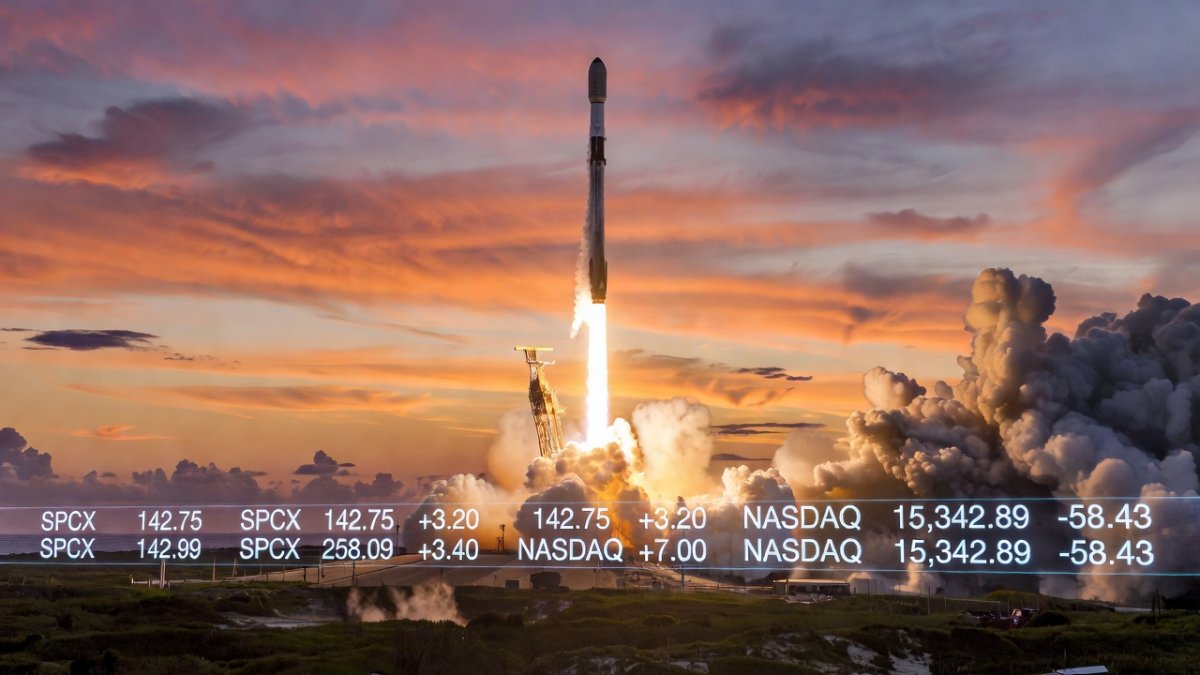
Folks, pop the champagne and strap in — because today, June 12, 2026, is the day that SpaceX didn't just open for trading on Nasdaq — it detonated the largest IPO in human history. We're talking $135 per share, 555.6 million shares, and a staggering $75 billion raised. That values the company at $1.77 trillion. And if those numbers don't have your jaw on the floor, they should.
Let me be crystal clear about what happened yesterday and what's unfolding right now. Elon Musk's rocket-and-satellite empire — the company that lands boosters on drone ships, blankets the planet with Starlink, and builds Starships in South Texas — is now a public company trading under the ticker SPCX. And the investing world has responded with a ferocity nobody predicted. Retail investors alone placed over $100 billion in orders before the opening bell even rang.
This isn't just another IPO. This is a seismic shift in how capital markets see the future. I've been covering Wall Street for years, and I can tell you — nothing prepares you for this scale.
The Numbers That Define a Generation
Let's break it down without the corporate spin. SpaceX priced 555.6 million shares at $135 each. That's $75 billion in new capital — more than Saudi Aramco's $24.9 billion in 2019, more than Alibaba's $25 billion in 2014, more than any company in history has ever raised in a single day on public markets. The valuation of $1.77 trillion places SpaceX among the top 10 most valuable publicly traded companies in the world on day one.
To put that in perspective: SpaceX is now worth more than Tesla, more than Meta, more than Berkshire Hathaway. A company that didn't exist 25 years ago is now worth nearly two trillion dollars. And the demand tells you everything. Retail investors — ordinary people like you and me — placed over $100 billion in orders. That's not institutions piling in. That's teachers, engineers, small business owners, and space enthusiasts saying, "I want a piece of the future."
The New York Times, Bloomberg, Forbes, and TechCrunch all have the same headline: SpaceX just crushed every IPO record that existed. And folks, that's not hype. That's math.
How a Rocket Company Became Worth $1.77 Trillion
Now, I know what some of you are thinking. How does a company that launches rockets — something that still blows up on test stands occasionally — justify a nearly two-trillion-dollar valuation? Fair question. Here's the answer, and it matters more than most analysts want to admit.
SpaceX is not just a rocket company. It's three businesses fused into one. First, there's the launch business — Falcon 9, Falcon Heavy, and Starship — which has already transformed the economics of getting payloads to orbit. Reusable boosters have cut launch costs by an order of magnitude. Second, there's Starlink, the satellite internet constellation that now serves millions of subscribers worldwide and generates recurring revenue that grows every quarter. Third, there's the emerging AI and defense infrastructure layer — autonomous navigation, satellite-based data processing, and deep-space logistics that the Pentagon and NASA are already contracting for.
When you connect those dots, the $1.77 trillion starts to make more sense. Starlink alone could be worth hundreds of billions as global connectivity demand explodes. The launch business has a backlog measured in years and billions. Add AI integration and government contracts, and you've got a business model that is resilient, diversified, and positioned for decades of expansion. Bloomberg Intelligence analyst Matthew Bloxham called it "a once-in-a-decade opportunity to own the infrastructure of the future." I'd argue it's once-in-a-lifetime.
The Retail Frenzy Nobody Saw Coming
Here's the part of this story that genuinely excites me. Retail investors — folks trading from their phones, from their kitchen tables, from coffee shops — placed over $100 billion in orders for SpaceX shares. That number stunned even the most bullish Wall Street analysts. The original estimates were around $30-40 billion in retail demand. The final tally more than doubled those projections.
What does that tell us? It tells us that the public has been hungry for this. For years, SpaceX was a private company, accessible only to venture funds, accredited investors, and insiders. Today, the gates opened, and millions of people rushed through. Stories are emerging of Uber drivers, school teachers, and retirees allocating their savings to SPCX because they believe in the mission. And you know what? I think that's beautiful. The democratization of space investing is happening in real time.
But I also need to be straight with you. Retail demand that high means most of those orders probably won't get filled at the IPO price. Allocation is going to favor institutional buyers. So if you're sitting on a brokerage account hoping to grab shares at $135, you might find yourself buying at a higher price once trading opens. That's the reality of a massively oversubscribed offering. Don't chase. Set your price, know your limits, and act with discipline.
What This Means for the Broader Market
A $75 billion IPO doesn't happen in isolation. When one company pulls that much capital out of the market in a single day, it creates ripples — and in this case, waves. Liquidity gets sucked out of other sectors. Banks that underwrote the deal are printing fees. Employees with stock options are suddenly sitting on life-changing wealth. And Elon Musk's personal fortune just took another moonshot, giving him more leverage in everything from government contracts to policy battles.
There's also a signaling effect here that can't be ignored. The largest IPO in history belongs to a space company. Not an oil company. Not a bank. Not a pharmaceutical giant. A space company. That tells you where the smartest money in the world believes the next century of economic growth is coming from. Space, satellites, broadband, and AI are no longer speculative bets — they're mainstream asset classes. Pension funds, endowments, and sovereign wealth funds will now be forced to reconsider their allocations. The space economy just went from the fringe to the core.
But let me also warn you about the concentration risk. When one company and one person control that much capital and that much critical infrastructure — launch capacity, global internet, AI systems — regulators have to decide how much concentration is acceptable. The conversation about Elon Musk's power just became a lot louder, and it's not going away. This IPO doesn't end that debate. It accelerates it.
SpaceX vs. Saudi Aramco: A Tale of Two Records
Let's put the record in historical context. In 2019, Saudi Aramco raised $24.9 billion in what was then the largest IPO in history. It was a symbol of the old economy — fossil fuels, state control, finite resources. At the time, analysts said that record might never be broken. Six and a half years later, SpaceX shattered it by raising three times as much.
The contrast could not be more stark. Aramco represented the past: hydrocarbons, geopolitical leverage, a world powered by burning things. SpaceX represents the future: reusable rockets, global satellite internet, AI-driven systems, and the push toward multi-planetary life. The fact that the market valued SpaceX higher on day one than any oil company in history is not just a financial milestone — it's a cultural and technological statement. The 21st century belongs to the companies that build the infrastructure of tomorrow, not the ones that extract the resources of yesterday.
The New York Times captured it best in their Thursday coverage: "SpaceX's IPO is the sound of the future arriving ahead of schedule." I couldn't agree more.
What Comes Next for SPCX and the Space Economy
With the IPO priced and trading underway, the focus shifts to execution. SpaceX's pipeline is ambitious and expensive. Starship needs to reach orbital reusability. Starlink needs to keep adding subscribers and regulatory approvals in new markets. The AI and defense divisions need to convert their potential into contracts. None of this is guaranteed, but few companies have a track record of execution like SpaceX does.
Analysts I've spoken with — and I've spoken with many over the past 48 hours — are broadly bullish but cautious on near-term volatility. The first few weeks of trading for a mega-IPO are rarely smooth. Expect swings. Expect profit-taking. Expect headlines that scream "crash" when the stock drops 5%. Tune that noise out. If you believe in the multi-decade thesis of space commercialization and satellite connectivity, then short-term fluctuations are just background music.
What I'm watching: the first quarterly earnings call as a public company, the next Starship test flight, Starlink subscriber growth numbers, and any new government contracts. Those are the real catalysts. Everything else is just trading noise.
Your Action Plan for the SpaceX Era
Alright folks, here's where the rubber meets the road. You've heard the numbers, you understand the story, and now you need to decide what to do. Let me give you four concrete steps.
First, check your brokerage account. Not all platforms have SPCX available immediately. Make sure yours does before you get the itch to buy. Second, set price alerts. Don't stare at the chart all day. Set alerts at key levels — maybe $135 (the IPO price) as your reference floor, and whatever upside target makes sense for your strategy. Third, don't go all in on day one. If you want exposure to the space economy, consider dollar-cost averaging into SPCX over the next few weeks. You'll sleep better. Fourth, diversify. As exciting as SpaceX is, no single stock should dominate your portfolio. Look at related ETFs, aerospace suppliers, and satellite operators to build a balanced space allocation.
Most importantly, stay informed and stay skeptical. The hype machine is already running at full blast. Every YouTube channel, every newsletter, every Twitter thread will have a hot take on SPCX today. Filter them through your own research. Read the S-1 filing. Watch the first earnings call. Follow the launch schedule. This is your money and your future, and nobody cares about it as much as you do.
The window is open, folks. SpaceX is public. The largest IPO in history is now live on Nasdaq. The question isn't whether this is a historic moment — it absolutely is. The question is whether you're positioned to benefit from what comes next. Don't just watch the fireworks from the cheap seats.
By Jessica Ali, Global 1 News
This article was produced with AI-assisted research and editorial support. Reporting is based on sources cited in the article.
What's Your Reaction?
 Like
0
Like
0
 Dislike
0
Dislike
0
 Love
0
Love
0
 Funny
0
Funny
0
 Wow
0
Wow
0
 Sad
0
Sad
0
 Angry
0
Angry
0

Editor-in-Chief at Global1.News. Atlanta-based journalist who cuts through the BS and tells it like it is. Lead anchor, host, and the voice you hear when the spin stops and the truth starts.















Comments (0)