
Quad Axis Emerges to Challenge Washington-Centered Middle East Order
The U.S.-Israeli war against Iran that began in late February 2026 triggered a notable realignment among four regional powers. Türkiye, Saudi Arabia, Egypt and Pakistan have expanded earlier trilateral ties into a quad framework marked by repeated ministerial consultations. This development reflects their shared exposure to a regional order they cannot shape individually, parti
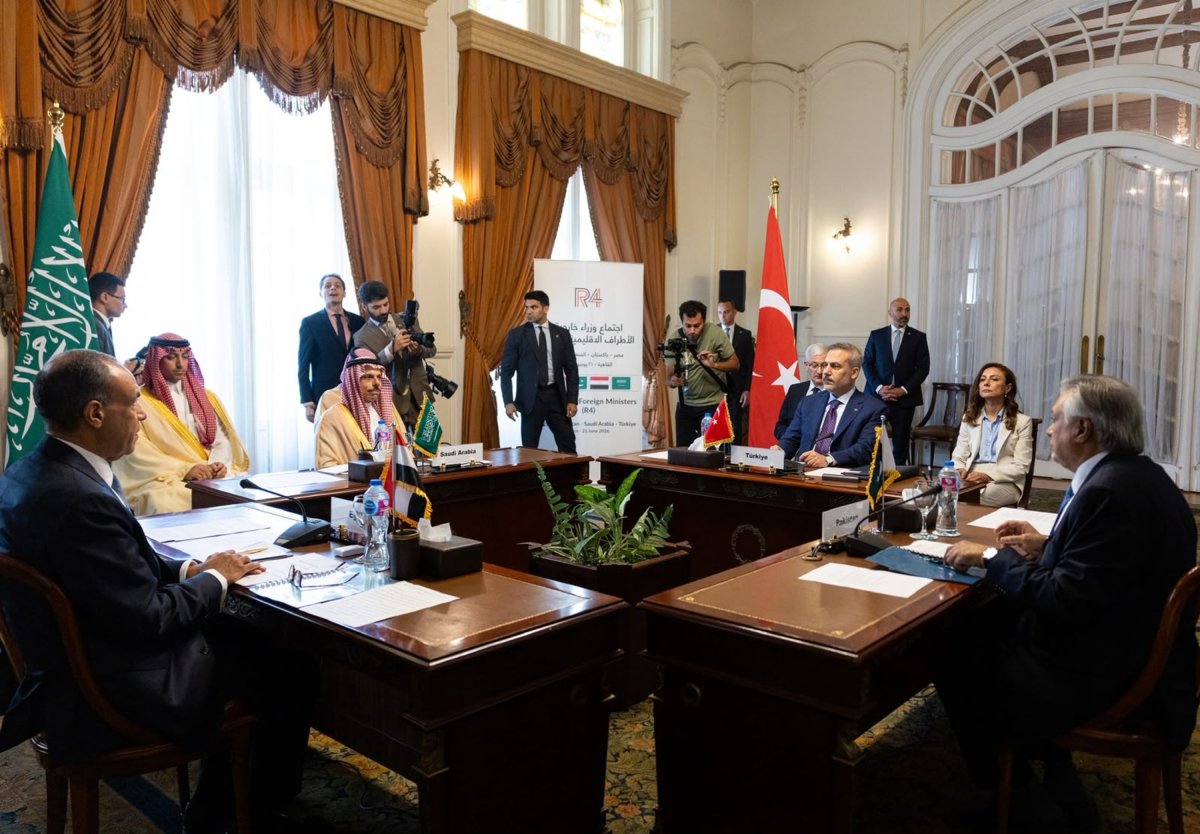
The U.S.-Israeli war against Iran that began in late February 2026 triggered a notable realignment among four regional powers. Türkiye, Saudi Arabia, Egypt and Pakistan have expanded earlier trilateral ties into a quad framework marked by repeated ministerial consultations. This development reflects their shared exposure to a regional order they cannot shape individually, particularly after the Strait of Hormuz was closed first by Iran and later subjected to a U.S. naval blockade.
Quad Axis Emerges to Challenge Washington-Centered Middle East Order
Beirut, Lebanon – July 5, 2026 — The U.S.-Israeli war against Iran that began in late February 2026 has triggered a notable realignment among four regional powers, reshaping the security architecture of the Middle East in ways that few analysts anticipated at the outset of the conflict.
Origins of the Four-Country Consultative Platform
Relations among Türkiye, Saudi Arabia and Egypt had already been improving in recent years. The outbreak of the February 2026 conflict accelerated this trend by drawing Pakistan into the circle. The resulting quad has conducted ministerial-level meetings that now occur with greater frequency than before. These engagements have given the loose arrangement an institutional presence that observers did not expect at the outset.
Effects of the Strait of Hormuz Closures
The dual closure of the Strait of Hormuz exposed vulnerabilities that Gulf capitals had previously viewed as protected by Washington. American and Israeli strikes reached areas long considered secure, prompting Riyadh to explore alternatives to its traditional security guarantees. A mutual defense pact signed with Pakistan in September illustrated this search for new partners. No collective defense treaty has yet emerged among the four states, yet the pace of their diplomacy has begun to lend the framework practical weight.
Sequence of Diplomatic Meetings
Between 19 March and 18 April the four countries held three rounds of talks. The first took place in Riyadh, the second in Pakistan and the third on the margins of the Antalya Diplomacy Forum. These sessions focused on coordinating positions ahead of any major decisions. The pattern of consultation itself now serves as the main mechanism for aligning threat perceptions without requiring formal commitments.
Deliberate Exclusion of the United Arab Emirates
The quad has taken shape without the United Arab Emirates, Riyadh's former closest Gulf partner. Abu Dhabi's withdrawal from OPEC and its broader drift from GCC positions appear to have contributed to this exclusion. Riyadh has therefore chosen partners that share its current threat assessment rather than those linked only by geography or past association. This choice underscores a willingness to recompose alliances around functional alignment rather than inherited relationships.
Drivers of Türkiye-Egypt Rapprochement
The convergence between Türkiye and Egypt gained momentum after a decade of political disagreements began to ease. A military cooperation agreement concluded in February was followed by a $350 million Turkish arms deal with Cairo's defense ministry. These steps have redirected attention toward common concerns in Gaza, Sudan, Libya and the Horn of Africa. Gaza remains the most visible focus, yet the cooperation extends beyond any single file and touches on multiple theaters of regional competition.
Positions on Gaza and Regional Stabilization
Ankara has combined its mediation efforts with Egypt, Qatar and the United States by signaling readiness to contribute troops to any future international stabilization force in Gaza. It has also reiterated its willingness to support reconstruction "as soon as conditions allow," a stance shared by Riyadh and Cairo. The quad's coordinated rejection of an Israeli-imposed regional order now links their approaches to Gaza, Iran and Sudan, creating a unified bloc on multiple dossiers.
Strategic Calculus Behind Reduced U.S. Dependence
The four capitals view the Washington-centered security framework as having failed to prevent escalation. By widening the circle of states they consult, they aim to lessen that dependence. The U.S.-Israeli operations against Iranian military infrastructure and Tehran's subsequent retaliation demonstrated that Gulf economic interests remain exposed. This experience has reinforced the conviction that only a genuinely regional arrangement can address persistent vulnerabilities in a sustainable manner.
Prospects for Institutionalization
Despite the rapprochement, a formal treaty-based platform remains distant. The quad operates as a consultative arrangement among states that share threat perceptions without adhering to a single ideology. Its strength lies in the regularity of meetings rather than in binding obligations. Over time this pattern may produce a Middle East security framework shaped primarily by the participating regional powers themselves, rather than imposed from outside.
By Malik Hassan, Staff Writer
This article was produced with AI-assisted research and editorial support. Reporting is based on sources cited in the article.
What's Your Reaction?
 Like
0
Like
0
 Dislike
0
Dislike
0
 Love
0
Love
0
 Funny
0
Funny
0
 Wow
0
Wow
0
 Sad
0
Sad
0
 Angry
0
Angry
0

Middle East Correspondent at Global1.News. Based in Beirut, covering politics, conflict, energy, and society across the Middle East. Brings context and depth to a region often reduced to headlines.












Comments (0)