
London protesters demand freedom for Palestine's 'real hostages'
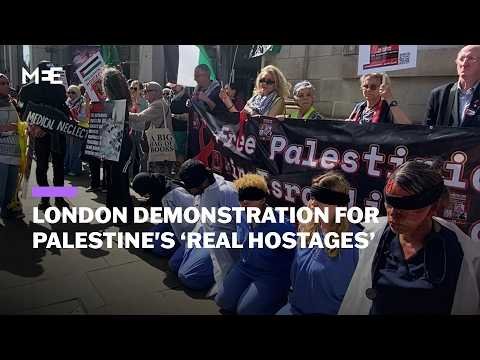
In a recent Middle East Eye report, hundreds of activists gathered outside the Israeli embassy in London on Saturday as part of the international Red Ribbons Campaign, demanding the release of Palestinians held in Israeli prisons and condemning Israel's actions in Gaza. The demonstration highlighted the plight of more than 9,000 Palestinians imprisoned by Israel. London Protest
In a recent Middle East Eye report, hundreds of activists gathered outside the Israeli embassy in London on Saturday as part of the international Red Ribbons Campaign, demanding the release of Palestinians held in Israeli prisons and condemning Israel's actions in Gaza. The demonstration highlighted the plight of more than 9,000 Palestinians imprisoned by Israel.
London Protest Scene Description
The atmosphere outside the Israeli embassy in London was charged with determination as protesters assembled under a steady drizzle. Red ribbons fluttered from jackets, signs, and makeshift banners, creating a visual sea of solidarity that stretched along the pavement. Chants echoed through the street, with voices calling for freedom for those held without charge and an end to the suffering in Gaza. Participants held placards reading "Free the Real Hostages" and "Release Palestinian Prisoners Now," while others waved Palestinian flags that caught the wind.
Organizers moved through the crowd distributing red ribbons and information sheets detailing the names and conditions of specific detainees. Medical workers in white coats stood alongside families who had traveled from across the United Kingdom. The protest remained peaceful yet resolute, with speakers addressing the crowd through a portable sound system. One demonstrator described the gathering as a necessary act of witness, noting that the prisoners' stories must reach beyond the embassy walls. The event concluded with a moment of silence for those in solitary confinement, followed by renewed calls for international intervention.
Red Ribbons Campaign Background and Global Reach
The Red Ribbons Campaign emerged as a coordinated international effort to spotlight the detention of Palestinians by Israeli authorities. Activists in multiple countries have adopted the red ribbon as a symbol of remembrance and urgency, tying it to demands for transparency and release. The London action formed one link in a chain of demonstrations scheduled across Europe and beyond, with similar events reported in cities where Palestinian communities maintain active networks.
Campaign materials emphasize the distinction between those held under administrative detention and any formal legal process. Participants stress that the ribbons represent individuals whose cases receive little international scrutiny. The initiative draws support from human rights networks and diaspora organizations that coordinate messaging to pressure governments. While the campaign continues to expand, its core message remains consistent: the scale of imprisonment requires sustained public attention rather than isolated responses.
Scale of Imprisonment and Administrative Detention
More than 9,000 Palestinians remain imprisoned by Israel, according to the figures highlighted during the London demonstration. This total includes individuals held under administrative detention orders that allow imprisonment without charge or trial for renewable periods. The practice has deep roots in policies applied across the occupied territories, where military orders permit detention based on secret evidence that detainees and their lawyers cannot access.
Administrative detention has been used for decades, affecting generations of Palestinians. Many detainees complete their terms only to face new orders, creating cycles of incarceration that disrupt families and communities. The London protesters pointed out that this system operates with minimal external oversight, leaving thousands in a state of legal limbo. Historical patterns show spikes in detentions during periods of heightened conflict, yet the underlying framework persists regardless of specific events. The absence of due process remains a central grievance voiced by families and advocates alike.
Children in Detention
Over 400 children are included among those held in Israeli prisons. Reports from the demonstration noted that many of these minors face the same administrative detention procedures applied to adults, with limited access to family or educational support. Cases documented by advocacy groups describe arrests occurring during nighttime raids, followed by interrogations that can extend for hours without parental presence.
The psychological impact on detained children includes documented effects such as anxiety, sleep disturbances, and difficulties reintegrating upon release. Legal standards under international agreements require special protections for minors, yet the application of military law in the occupied territories often overrides these safeguards. Protesters in London carried photographs of young detainees to personalize the statistics, underscoring that each child represents a family navigating prolonged uncertainty. The pattern of juvenile detention continues to draw criticism from organizations monitoring compliance with child rights conventions.
Medical Workers and Dr. Hussam Abu Safiya
Among the imprisoned are more than 150 medical workers, whose detentions have drawn particular attention during the Red Ribbons actions. The case of Palestinian doctor Hussam Abu Safiya stands out, as he has spent six months in solitary confinement after being taken from Gaza by Israeli forces. Demonstrators in London specifically called for his immediate release, describing his isolation as a form of additional punishment beyond standard detention.
Medical personnel in conflict zones are entitled to protections under established humanitarian norms, yet accounts from released detainees suggest these standards are frequently disregarded. Dr. Abu Safiya's prolonged solitary confinement has been cited as an example of how health workers face targeted measures that impair both physical and mental health. Families and colleagues have appealed for independent medical assessments, but access remains restricted. The London protest amplified these appeals, linking individual cases to broader patterns affecting the medical community in Gaza and the West Bank.
Torture and Abuse Allegations
Israel is accused of operating a system involving torture, starvation, medical neglect, and abuse against Palestinian prisoners. Human rights organizations have compiled reports detailing conditions inside facilities where overcrowding, inadequate nutrition, and denial of care contribute to deteriorating health. Testimonies from former detainees describe interrogations accompanied by physical coercion and prolonged stress positions.
These allegations extend to the treatment of both long-term prisoners and those recently arrested. Organizations monitoring prison conditions have urged the international community to end its silence and pursue independent investigations. The London demonstrators referenced these reports to argue that the scale of documented harm requires more than diplomatic statements. Patterns of medical neglect, in particular, have been linked to preventable deaths inside detention centers, adding urgency to calls for external monitoring mechanisms.
International Law and Accountability
The Geneva Conventions establish clear obligations regarding the treatment of detainees in occupied territories, including prohibitions on collective punishment and requirements for humane conditions. Administrative detention without charge conflicts with these standards when applied systematically over extended periods. Despite repeated documentation by monitoring bodies, enforcement mechanisms have proven ineffective in altering Israeli practices.
Failure of accountability stems from the absence of binding consequences for violations. Palestinian families affected by the detention system have pursued legal avenues through Israeli courts with limited success, while international forums have issued resolutions that remain unimplemented. The London protest reflected a broader frustration that legal frameworks exist yet lack the political will necessary for consistent application. Without sustained pressure, the gap between stated international norms and on-the-ground realities continues to widen.
Action Steps for the International Community
Human rights organizations participating in the Red Ribbons Campaign call for concrete measures including independent inspections of detention facilities, suspension of arms transfers that enable ongoing operations, and support for legal challenges to administrative detention. Governments are urged to condition diplomatic relations on verifiable improvements in prisoner treatment and to facilitate family visits currently blocked by policy.
Advocates emphasize that public pressure through sustained demonstrations and parliamentary advocacy can shift policy where quiet diplomacy has not. Specific recommendations include funding for legal aid organizations representing detainees and support for medical access programs. The London event concluded with a commitment to continue weekly actions until measurable releases occur, underscoring that accountability requires coordinated, persistent engagement rather than episodic responses.
By Fatima Al-Rashid, Staff Writer
This article was produced with AI-assisted research and editorial support. Reporting is based on sources cited in the article.
What's Your Reaction?
 Like
0
Like
0
 Dislike
0
Dislike
0
 Love
0
Love
0
 Funny
0
Funny
0
 Wow
0
Wow
0
 Sad
0
Sad
0
 Angry
0
Angry
0
Gulf/MENA Correspondent at Global1.News. Based in Doha, covering Gulf politics, energy markets, diplomacy, and development across the Middle East and North Africa. Tracks the economic transformation of the Gulf states.













Comments (0)