
The Yazidi Doctor Healing Wounds No Medicine Can Cure: Inside Dr. Nagham Nawzat's Mission to Save Survivors of IS Captivity
The Invasion That Shattered Lives in Sinjar On 3 August 2014 Islamic State militants entered the northern Iraqi town of Sinjar and abducted nineteen-year-old Shireen while she studied for a high school examination. She was taken from her family and sold as a sex slave to a militant in Tal Afar. Three months later she was sold again to Abu Omar in Mosul, where she became his thi
The Invasion That Shattered Lives in Sinjar
On 3 August 2014 Islamic State militants entered the northern Iraqi town of Sinjar and abducted nineteen-year-old Shireen while she studied for a high school examination. She was taken from her family and sold as a sex slave to a militant in Tal Afar. Three months later she was sold again to Abu Omar in Mosul, where she became his third wife. Abu Omar already had two Iraqi wives who lived separately yet beat Shireen whenever they met. He told her he loved her, yet forced her into repeated rape. Shireen tried to stop him but her pleas were ignored. Two younger Yazidi girls, aged six and ten, were later brought to the same house and forced to clean while Shireen herself was confined indoors for more than two years with guards posted at the entrance.
Yazidis revere Melek Tawwus, the Peacock Angel, yet Islamic State militants told Shireen that this figure was the devil and compelled her to convert to Islam. She was not permitted to leave the house or even step into the garden for fresh air. She cooked, washed dishes and cleaned daily under constant surveillance. Her uncle and many friends were killed. Her father and one sister remain missing since 2014. When Iraqi forces liberated her in 2016 during the battle for Mosul, Shireen returned with severe depression and recurring nightmares that destroyed her sleep.
Dr Nagham Nawzat Offers More Than Medical Care
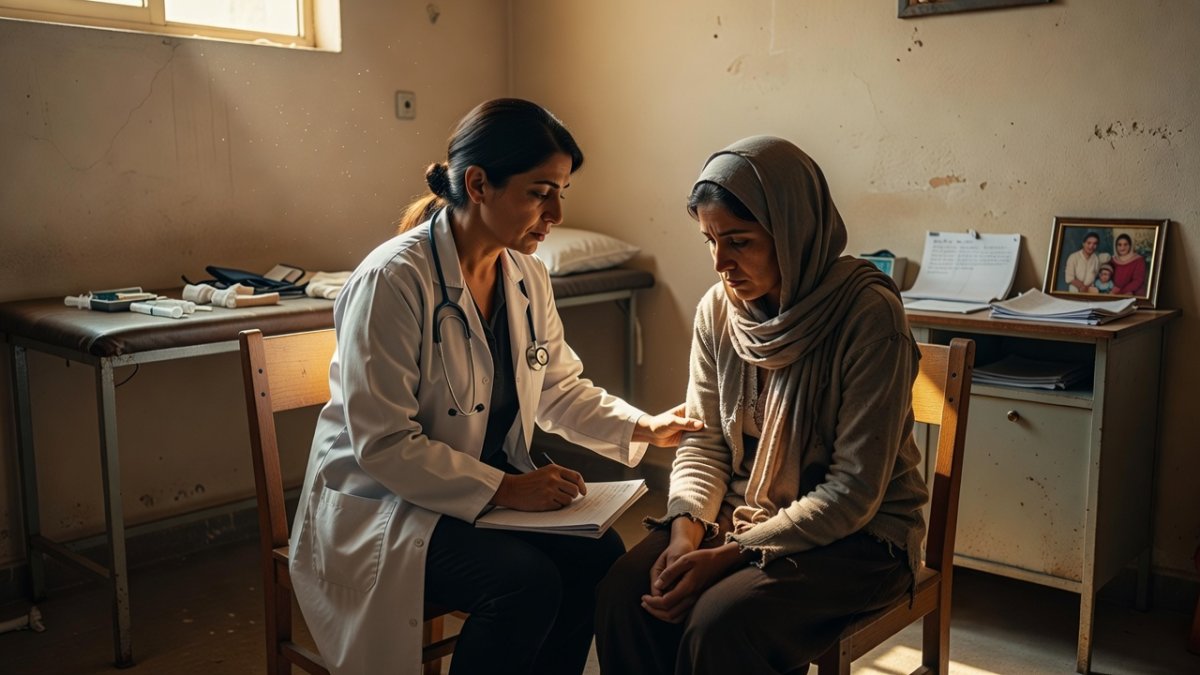
Upon release Shireen visited Dr Nagham Nawzat, a Yazidi gynaecologist based in Duhok, for a physical check-up. Nawzat examined her and then sat with her to listen. She told Shireen she was brave. Shireen later said that without this support she would not be alive today and that she loves Nawzat deeply. Nawzat treats each survivor with the same attentive presence, combining a thorough physical examination with patient listening and positive reinforcement. She describes her role as that of a big sister in whom survivors can confide, and she remains available whenever former patients request further psychological support.
Hussein al-Qaidi, director of the Kidnapped Affairs department at the Kurdistan Regional Government in Duhok, reported that 2,023 Yazidi women had been liberated from Islamic State territories as of July 2018. Nawzat has provided life-saving support to more than half of them, an estimated 1,200 women. Her approach addresses both the physical consequences of captivity and the lasting trauma that no medicine alone can heal.
A Yazidi Woman’s Path to Medicine
Born in Mosul in 1976 to a Yazidi family, Nawzat held a lifelong ambition to study medicine. From an early age she was concerned with women’s issues. She graduated with a degree in gynaecology from Mosul’s Medical College in 2002. Her goal was to understand women’s health more deeply, teach women about health care and provide them with direct support. When Islamic State seized almost a third of Iraq in 2014, at least 12,000 Yazidis were killed or kidnapped in what the United Nations has described as an ongoing genocide against the religious minority.
In 2015 Nawzat joined the Duhok Survivors’ Centre, where she volunteers to deliver health care and psychological support to women who survived Islamic State captivity. The centre, funded by the United Nations Population Fund, is the only facility in Iraq that specialises in gender-based violence. Nawzat conducts post-traumatic medical care that begins with a complete physical check-up and continues with attentive listening to each woman’s fears and experiences.
Inside the Work of the Duhok Survivors’ Centre
Every woman who reaches the centre carries a distinct account of captivity. Nawzat meets each one with the same methodical care: first the physical examination, then sustained attention to the emotional wounds. She offers encouragement and remains ready to meet survivors again whenever they seek further support. Shireen’s testimony illustrates the effect of this method. After more than two years of forced labour, repeated rape and isolation, the simple act of being heard and affirmed helped her begin to rebuild her life.
The centre operates in Iraq’s Kurdish region, serving women whose families were torn apart and whose communities continue to search for missing relatives. Nawzat’s presence there connects medical expertise with the cultural understanding of a Yazidi doctor who shares the same heritage as those she treats. Her work documents the human cost of the genocide while providing immediate, practical assistance to those who have returned.
International Recognition and Lasting Community Trust
In March 2016 Nawzat received the International Women of Courage Award from then-US Secretary of State John Kerry. The award recognised her psychological support for traumatised Yazidi survivors and her efforts to combat gender-based violence. Within the Yazidi community she is widely respected. Al-Qaidi’s figures confirm that her direct involvement has reached more than 1,200 liberated women, a scale that reflects both the extent of the violence and the depth of her commitment.
Survivors such as Shireen continue to speak of the difference Nawzat made. The doctor’s combination of clinical skill and personal presence has become a model of care that addresses wounds no medicine alone can cure. Her story remains tied to the broader reality of Yazidi women who endured captivity, forced conversion and loss, and who now seek to rebuild their lives with the support of dedicated professionals like Nawzat.
By Fatima Al-Rashid, Staff WriterThis article was produced with AI-assisted research and editorial support. Reporting is based on sources cited in the article.
What's Your Reaction?
 Like
0
Like
0
 Dislike
0
Dislike
0
 Love
0
Love
0
 Funny
0
Funny
0
 Wow
0
Wow
0
 Sad
0
Sad
0
 Angry
0
Angry
0

Middle East Correspondent at Global1.News. Based in Beirut, covering politics, conflict, energy, and society across the Middle East. Brings context and depth to a region often reduced to headlines.









Comments (0)