
Putin's Ballistic Strike on Kyiv Defence Exhibition Kills 10 — Is This a New Phase?
Russian ballistic missile strike on Kyiv region defence event kills 10 and injures nearly 100; separate attack hits Sloviansk. Ukraine targets Wildberries warehouses in economic warfare. Romanian F-16 downs drone; Ukraine fortifies Belarus border. Political protests erupt in Kyiv over defence minister dismissal. Zelensky explores US talks amid troop loss reports and ceasefire proposals, with direct consequences for UK NATO commitments and European security.
Putin's Ballistic Strike on Kyiv Defence Exhibition Kills 10 — Is This a New Phase?
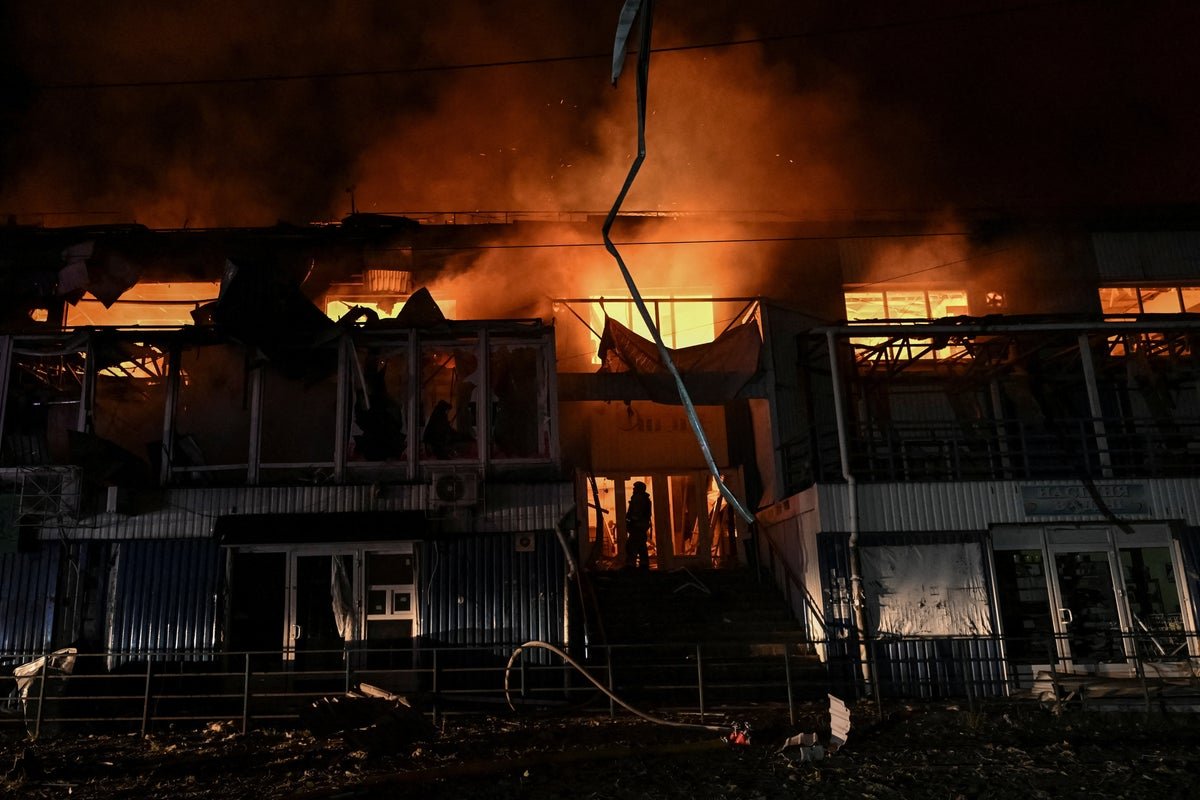
Kyiv, Ukraine — A Russian ballistic missile has struck a defence industry exhibition north of Kyiv, killing at least ten people and wounding nearly one hundred in what appears to be Moscow’s most precise attack on the capital region in months. The strike, launched from Belarusian territory during peak attendance, targeted exhibitors showcasing drones, electronic warfare systems and artillery software. It raises urgent questions about Russia’s growing ability to fuse intelligence with long-range weapons and the risks now facing Western technology transfers inside Ukraine.
Ballistic strike hits Kyiv region defence exhibition
Russian forces launched a ballistic missile at a defence industry event north of Kyiv on Friday, killing at least ten people and wounding close to one hundred, according to Ukrainian prosecutor general Ruslan Kravchenko. Emergency services completed rescue operations at the site hours later. Moscow has offered no public comment on the strike, which targeted infrastructure linked to Ukraine’s military production.
The targeting of a defence industry exhibition north of Kyiv underscores Russia’s improving ability to fuse intelligence with precision ballistic systems. Exhibitors were showcasing unmanned aerial vehicles, electronic warfare suites and artillery fire-control software, all of which directly support Ukraine’s deepening strike campaign. An Iskander-M missile, launched from Belarusian territory, arrived during the event’s peak attendance, indicating that Russian planners had tracked both the schedule and the presence of senior industry figures. The resulting casualties—reportedly the highest in the Kyiv region for several months—reflect not only the weapon’s accuracy but also the deliberate choice to strike when civilian and military attendees were concentrated.
Such timing raises questions about the threshold Russia now applies to dual-use gatherings. While the exhibition was not a purely military installation, its role in accelerating Ukrainian drone and missile production makes it a legitimate target under the laws of armed conflict. The strike nevertheless signals to Western suppliers that even temporary, high-profile events inside Ukraine carry elevated risk, potentially complicating future technology-transfer discussions.
Further Russian strikes in the east
Separate Russian aerial bombing in Sloviansk killed five civilians and injured nine others, regional governor Vadym Filashkin reported. These attacks form part of sustained pressure on Ukrainian positions in Donetsk oblast, where Russian forces continue to probe for advances amid heavy losses.
Economic warfare targets Russian logistics
Ukraine struck warehouses belonging to Russian online retailer Wildberries in St Petersburg and Crimea, marking the fifth such operation since 18 July. The company confirmed it had halted operations at two logistics sites and evacuated staff from its Crimea facility. Kyiv described the warehouses as supporting Russian military supply chains; the strikes have now disrupted roughly ten per cent of Wildberries’ national capacity.
Ukrainian long-range drones striking Wildberries warehouses form part of a sustained campaign against Russian rear-area logistics that now reaches deep into European Russia. A reported 10 per cent disruption to parcel and freight flows translates into delayed military resupply, higher insurance premiums for commercial carriers and measurable shortages on regional retail platforms. The choice of facilities near St Petersburg is particularly significant: the city’s role as a hub for both civilian e-commerce and defence-related components demonstrates Ukraine’s capacity to impose costs far from the front line without requiring manned aircraft.
Debate continues over whether civilian economic infrastructure constitutes a proportionate target. Ukrainian officials argue that these nodes sustain the war economy and that their degradation shortens the conflict; critics counter that the civilian harm, including lost wages for warehouse staff, risks eroding domestic and international support. In practice, the strikes have already forced Russian logistics firms to reroute shipments and invest in additional dispersal measures, adding friction to an economy already strained by sanctions.
Romanian F-16 engagement and NATO's eastern flank
A Romanian F-16 fighter jet intercepted and destroyed a second drone that entered the country’s airspace, underscoring the expanding security challenges along NATO’s eastern border. The incident highlights how the conflict is drawing in alliance members beyond Ukraine’s immediate neighbours, with direct implications for UK and European air defence planning.
Romania’s second confirmed interception of a Russian drone over its territory illustrates the incremental hardening of NATO’s air-policing posture along the Black Sea coast. The F-16 engagement, conducted under national rules of engagement but within Alliance coordination channels, shows how member states are adapting peacetime procedures to persistent low-altitude threats. For the United Kingdom, whose Typhoon detachments rotate through Romania and Poland, the incident reinforces the requirement for rapid identification and, where necessary, kinetic response without triggering wider escalation.
The legal framework rests on each state’s sovereign right to defend its airspace, yet operational practice varies. Poland has repeatedly tracked but not always engaged similar incursions, citing escalation concerns. Romania’s more assertive posture may reflect both geography—closer to Ukrainian strike corridors—and a political calculation that demonstrated resolve strengthens deterrence. The UK’s own air-defence planning must now account for the possibility that its aircraft could be drawn into comparable engagements during future rotations.
Ukraine strengthens defences along Belarus border
Ukrainian forces continue to fortify the 1,084-kilometre frontier with Belarus, installing anti-drone netting, razor wire and concrete anti-tank barriers. Kyiv has demanded that Minsk dismantle Russian-installed communications relay stations near the border. These measures reflect persistent concerns that Belarus could serve as a staging ground for further Russian operations.
Political crisis deepens in Kyiv
Protesters in the capital have begun an open-ended rally demanding the reinstatement of ousted defence minister Mykhailo Fedorov following a poorly explained government reshuffle. Acting defence minister Yevhenii Khmara and new Commander-in-Chief Mykhailo Drapatyi met US ambassador to NATO Matthew Whitaker in Kyiv, while President Zelensky discussed renewed peace talks with US envoys Steve Witkoff and Jared Kushner.
The dismissal of Mykhailo Fedorov, the minister who moved from digital transformation to defence procurement, has triggered visible street protests at a scale rarely seen during wartime. Thousands marched in central Kyiv demanding his reinstatement, citing his role in streamlining drone acquisition and anti-corruption measures within the ministry. Restoring him would signal to both domestic reformers and Western donors that technocratic competence remains valued over political loyalty.
Parallel command changes, with General Syrskyi reportedly ceding ground responsibilities to General Drapatyi, point to a broader recalibration of Ukrainian strategy. Drapatyi’s experience in defensive operations in the east suggests an emphasis on attrition management rather than ambitious counter-offensives. President Zelensky must balance these military adjustments against public discontent and the expectations of NATO capitals that continue to tie further aid to demonstrable governance standards.
Prospects for talks and UK strategic interests
Officials in Kyiv are awaiting confirmation of Donald Trump’s schedule before any potential visit to Washington. Discussions continue over a proposed air ceasefire that could be presented to Russian counterparts. Ukrainian drone and missile strikes on Russian economic targets are viewed by some Western officials as a means of increasing pressure on Moscow’s war economy. For Britain, these developments reinforce the need to sustain defence commitments to NATO’s eastern flank and to coordinate sanctions policy through Whitehall and the Bank of England’s financial oversight mechanisms.
Proposals for an air ceasefire have centred on mutual restrictions on long-range strikes against energy and logistics targets, with each side required to withdraw certain missile and drone assets from forward positions. US envoys Witkoff and Kushner have reportedly explored verification mechanisms involving third-party monitoring, though Moscow’s insistence on retaining strike capacity against Ukrainian rear areas remains a sticking point. Senator Rubio’s cited figure of 5,000–6,000 Russian casualties per week, if accurate, indicates unsustainable attrition that Ukrainian deep strikes on refineries and warehouses are designed to exacerbate by constraining fuel and spare-parts availability.
Britain’s contribution—continued Storm Shadow integration, pilot and maintainer training, and sanctions enforcement—positions it as a key enabler of Ukrainian staying power. Any negotiated pause would therefore need to preserve Kyiv’s ability to reconstitute air defences and maintain intelligence flows, areas where UK support has proved difficult for Russia to interdict. The government’s calculations will weigh the risk of premature concessions against the fiscal and political costs of indefinite high-intensity assistance.
By Erica Thornton, Staff WriterThis article was produced with AI-assisted research and editorial support. Reporting is based on sources cited in the article.
What's Your Reaction?
 Like
0
Like
0
 Dislike
0
Dislike
0
 Love
0
Love
0
 Funny
0
Funny
0
 Wow
0
Wow
0
 Sad
0
Sad
0
 Angry
0
Angry
0

US Politics and Policy Correspondent at Global1.News. Based in Washington DC, covering American politics, policy, elections, and the courts. Knows how the system works and tells you what it actually means.














Comments (0)