
Khamenei's Funeral Tests Iran's Post-War Diplomatic Standing
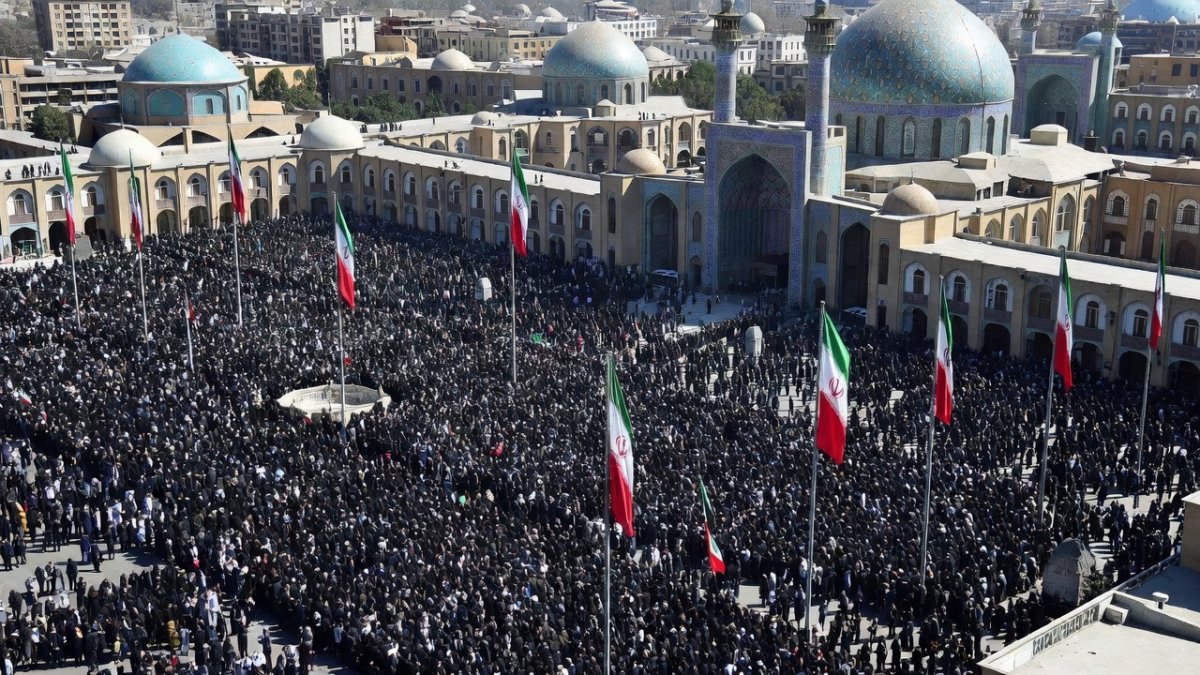
Khamenei's Funeral Tests Iran's Post-War Diplomatic Standing In a recent CGTN report titled "On the ground from 3 a.m.: Reporting from the Ayatollah's funeral," correspondents captured the scale of public mobilization in Tehran as mourners gathered at the Grand Mosalla for ceremonies that began on July 3-4. The footage highlighted orderly processions and the presence of foreign
The Significance of International Attendance
The composition of foreign delegations at the funeral reveals distinct strategic priorities among participating states. China's Ministry of Foreign Affairs dispatched a measured representation that underscored Beijing's interest in maintaining channels with Tehran while avoiding entanglement in active conflict zones. This approach aligns with China's broader emphasis on stable energy supplies and the continuation of infrastructure projects under the Belt and Road Initiative. Russia's delegation, by contrast, focused on defense and energy coordination, reflecting Moscow's need to secure Iranian cooperation on Caspian Sea routes and arms-related technology transfers amid its own regional commitments.
Gulf participants approached the event as an opportunity to test the durability of recent normalization efforts. Turkey, Qatar, Oman, Pakistan, Tajikistan, Armenia, and Georgia each sent representatives whose presence signaled a desire to preserve trade corridors and avoid isolation from emerging multipolar arrangements. Their attendance contrasted sharply with the absence of most Western governments, underscoring persistent geopolitical fault lines that separate NATO-aligned capitals from non-Western networks. These choices illustrate how states calibrate visibility at high-profile Iranian events to balance domestic constituencies with external leverage.
China's delegation calculus was shaped by the 14th Five-Year Plan's explicit targets for diversified crude imports and the Dual Circulation strategy's focus on securing overseas energy nodes that feed domestic manufacturing. Beijing has long viewed Iran as a critical node in the Belt and Road Initiative's western corridor, with projects such as the Tehran-Mashhad electrification and Chabahar port upgrades already embedded in bilateral memoranda. By sending a mid-level Foreign Ministry team rather than senior leadership, China signaled continuity without inviting secondary sanctions that could disrupt these investments. Russia, for its part, calculated that visible attendance would reinforce the 2021 comprehensive strategic partnership treaty, particularly clauses on joint Caspian energy exploration and licensed production of drones that have proven decisive in Ukraine.
Historical precedent underscores these calculations. After the 2015 Joint Comprehensive Plan of Action, China and Russia both expanded diplomatic footprints in Tehran while Western capitals oscillated between engagement and withdrawal. The 2020 assassination of Qasem Soleimani similarly tested attendance patterns, with Beijing and Moscow maintaining low-profile contacts that later facilitated Iran's accession to the Shanghai Cooperation Organisation. The 2026 funeral thus repeated a familiar pattern: non-Western powers use Iranian ceremonies to lock in long-term access while Western governments remain absent.
The funeral therefore functioned as an early post-conflict diplomatic litmus test. Delegations assessed Iran's capacity to project continuity while gauging whether bilateral interests could withstand the shocks of recent escalation. Such calculations extend beyond symbolism to practical questions of sanctions relief, port access, and technology cooperation that will shape the coming years. Analysts such as Li Guofu of the China Institute of International Studies have warned that any renewed U.S. maximum-pressure campaign could force Beijing to choose between protecting BRI assets and preserving its image as a neutral mediator.
Saudi Arabia's Calculated Presence and the 2023 Rapprochement
Saudi Deputy Foreign Minister Waleed Al-Khuraiji's attendance stood out given the recent history of direct exchanges between Riyadh and Tehran. Despite Iranian airstrikes on Saudi targets during the conflict, the decision to participate reflected a deliberate effort to keep open the framework established by the 2023 China-brokered agreement. That accord had already produced restored diplomatic ties, resumed flights, and limited security consultations; its survival through months of warfare demonstrated that both sides retained incentives to prevent total rupture.
China's role as mediator lent additional credibility to the process. Beijing's Northwest University analyst Wang Jin has noted that the agreement's resilience stems from shared economic interests rather than ideological alignment. Riyadh continues to seek diversified partnerships beyond traditional security guarantees, while Tehran requires stable relations with Arab neighbors to reduce isolation. The funeral provided a low-cost venue for Riyadh to signal that these calculations remain intact.
Saudi Arabia's calculus is rooted in Vision 2030's need for regional stability to attract foreign direct investment into NEOM and other giga-projects. Riyadh calculates that renewed confrontation with Iran would spike insurance premiums on Red Sea shipping and deter Chinese contractors already committed to joint petrochemical ventures. At the same time, the kingdom seeks to avoid appearing overly conciliatory to domestic hardliners who still recall the 2016 diplomatic rupture following the execution of Nimr al-Nimr and the subsequent storming of Saudi missions in Iran.
The implications for China's mediation profile are significant. Successful stewardship of the 2023 deal has positioned Beijing as a credible interlocutor in a region where previous US-led initiatives often produced uneven results. Continued adherence to the framework could encourage further quiet diplomacy on issues such as Yemen de-escalation and Red Sea shipping security, even as underlying rivalries persist. Should the 2023 accord hold through 2027, Beijing may propose trilateral working groups linking Iranian reconstruction financing to Saudi sovereign wealth fund outflows, thereby embedding the Dual Circulation strategy's overseas investment arm deeper into Gulf markets.
Iran's Internal Cohesion Under New Leadership
Mojtaba Khamenei's assumption of the Supreme Leader role in March 2026 occurred against the backdrop of national mourning and external pressure. The funeral ceremonies served as a public demonstration of unity within the Shiite clerical establishment, with senior figures from Qom and other centers participating in coordinated processions. This visible solidarity aimed to convey institutional continuity at a moment when external actors might have anticipated fragmentation.
Wang Jin's analysis emphasizes Iran's demonstrated mobilization capacity during the ceremonies. Large-scale attendance across multiple cities indicated that core support structures within the clerical and security apparatus remained functional. Such displays matter for domestic stability because they reinforce the narrative that the leadership transition enjoys broad elite backing rather than resting on narrow factional control.
The 1989 transition from Ayatollah Khomeini to Ali Khamenei offers a useful historical benchmark. That earlier succession was managed through the Assembly of Experts and backed by the Revolutionary Guards, preventing the factional violence that many analysts had predicted. Mojtaba Khamenei appears to be replicating this playbook, drawing on the same institutional levers while navigating a younger generation of IRGC commanders shaped by the 2024-2026 conflict. Expert commentary from Iranian political scientist Sadegh Zibakalam highlights that the new leader's legitimacy will ultimately rest on delivering tangible economic relief rather than ceremonial displays alone.
The longer-term implications for Iran's internal politics hinge on how Mojtaba Khamenei balances competing centers of power. The funeral's orderly execution suggests that immediate challenges to succession have been contained, yet sustaining this cohesion will require careful management of economic grievances and regional security commitments. Observers will watch whether the new leadership can translate ceremonial unity into policy coherence on sanctions relief and reconstruction priorities. One plausible scenario involves accelerated negotiations with China over expanded credit lines tied to the 14th Five-Year Plan's energy security chapter, potentially easing domestic inflation before the 2028 parliamentary elections.
Geopolitical Realignment: A Multipolar Middle East Emerges
Non-Western powers used the funeral to advance influence in a region where unilateral US leverage has visibly declined. China's and Russia's calibrated participation illustrated their preference for incremental engagement that avoids direct confrontation while expanding economic and security footprints. Gulf states similarly positioned themselves to benefit from diversified partnerships rather than exclusive alignment with any single external actor.
This shift carries second-order effects for the Global South and ASEAN. Countries seeking alternatives to traditional security architectures now observe that regional diplomacy can proceed without Western endorsement. Trade routes linking the Persian Gulf to Central Asia and the Indian Ocean stand to gain from reduced polarization, potentially accelerating infrastructure projects that bypass older chokepoints.
China's approach is explicitly guided by the Belt and Road Initiative's 2025-2030 implementation guidelines, which prioritize overland corridors through Iran to circumvent maritime vulnerabilities exposed during the 2024-2026 conflict. Russia, meanwhile, seeks to integrate Iranian ports into its International North-South Transport Corridor, a project first conceptualized in 2000 but accelerated after Western sanctions on Moscow intensified in 2022. These overlapping interests create a de facto Eurasian economic architecture that marginalizes older U.S.-centric arrangements.
The funeral therefore marked an early indicator of how post-conflict Middle East diplomacy may evolve. States are testing new combinations of economic cooperation and security dialogue that reflect multipolar realities rather than bipolar legacies. These patterns are likely to influence negotiations over energy markets, maritime security, and technology transfers in the years ahead. Should the current trajectory hold, analysts anticipate a 2027 trilateral summit in Beijing that could formalize joint financing mechanisms linking Iranian reconstruction to both Chinese and Russian capital markets.
What Comes Next: Succession, Diplomacy, and Regional Stability
The durability of the 2023 Saudi-Iran framework will be tested by upcoming decisions on reconstruction financing and security guarantees. Iran's diplomatic trajectory under Mojtaba Khamenei will depend on whether the new leadership can convert funeral-era goodwill into concrete agreements on sanctions easing and investment inflows. Early signals suggest continued emphasis on relations with China, Russia, and select Gulf partners.
US-Iran relations remain the most uncertain variable. Absent direct Western representation at the ceremonies, channels for de-escalation are narrower than before the conflict. Both sides will need to identify confidence-building measures that address immediate concerns over nuclear activities and regional proxy dynamics without triggering renewed escalation.
Regional stability will hinge on whether the multipolar diplomatic architecture that emerged at the funeral can absorb further shocks. Continued adherence to existing mediation formats, particularly those involving Chinese facilitation, offers one pathway. Observers should monitor upcoming bilateral meetings and economic initiatives for evidence that the post-war environment is producing durable rather than merely symbolic realignments. Three distinct scenarios appear plausible: a managed détente anchored in Chinese-brokered economic packages, a renewed shadow conflict if hardline factions in Tehran or Washington prevail, or a hybrid outcome in which limited sanctions relief coexists with proxy competition in Yemen and Iraq. The 14th Five-Year Plan's emphasis on diversified energy partnerships suggests Beijing will favor the first scenario, using Belt and Road financing as both carrot and stabilizer.
This article was produced with AI-assisted research and editorial support. Reporting is based on sources cited in the article.
What's Your Reaction?
 Like
0
Like
0
 Dislike
0
Dislike
0
 Love
0
Love
0
 Funny
0
Funny
0
 Wow
0
Wow
0
 Sad
0
Sad
0
 Angry
0
Angry
0

World Politics Analyst at Global1.News. Based in Beijing, covering US-China relations, global trade, and geopolitical strategy. Brings deep analytical perspective to the power dynamics shaping international affairs.









Comments (0)