
e-Future Auto FC11 E-Jeepney Transforms Philippine Transit
A Japanese EV startup has introduced a purpose-built electric jeepney that directly targets the Philippines' aging diesel fleet, promising lower operating costs and cleaner air just as fuel prices and regulatory deadlines intensify pressure on traditional operators. The FC11 model from e-Future Auto arrives amid the government's long-running modernization program and Japan's broader push to export mid-tier electrification solutions across ASEAN.
E-Jeepney: Japan's EV Startup Drives Philippine Transport Modernization
Tokyo, Japan — Article continues...
Company Background and FC11 Development
e-Future Auto, established in Yokohama in March 2018, emerged as a specialized Japanese EV startup targeting cost-sensitive Southeast Asian markets rather than domestic premium segments. The firm secured initial seed funding from the Development Bank of Japan and formed a technical alliance with Panasonic for battery modules. Its flagship FC11 model measures 11.2 meters, accommodates 30 seated passengers plus standing capacity, and integrates a 72 kWh lithium-iron-phosphate pack delivering a certified 148 km range under Philippine urban duty cycles. Series production commenced at a leased facility in Cebu's Mactan Economic Zone in Q3 2023, with initial output calibrated at 120 units per month using semi-knocked-down kits shipped from Japan.
Technical Features of the FC11 Model
The FC11 provides a 200 km range per charge. It incorporates a battery cooling system designed specifically for operation in tropical climates, addressing safety and performance concerns associated with high ambient temperatures. These specifications position the vehicle as a direct substitute for existing jeepneys while meeting the operational demands of daily urban routes. The design focuses on reliability in conditions typical of Philippine cities rather than adapting temperate-climate technology without modification.
Scope of the Philippine Public Utility Vehicle Modernization Program
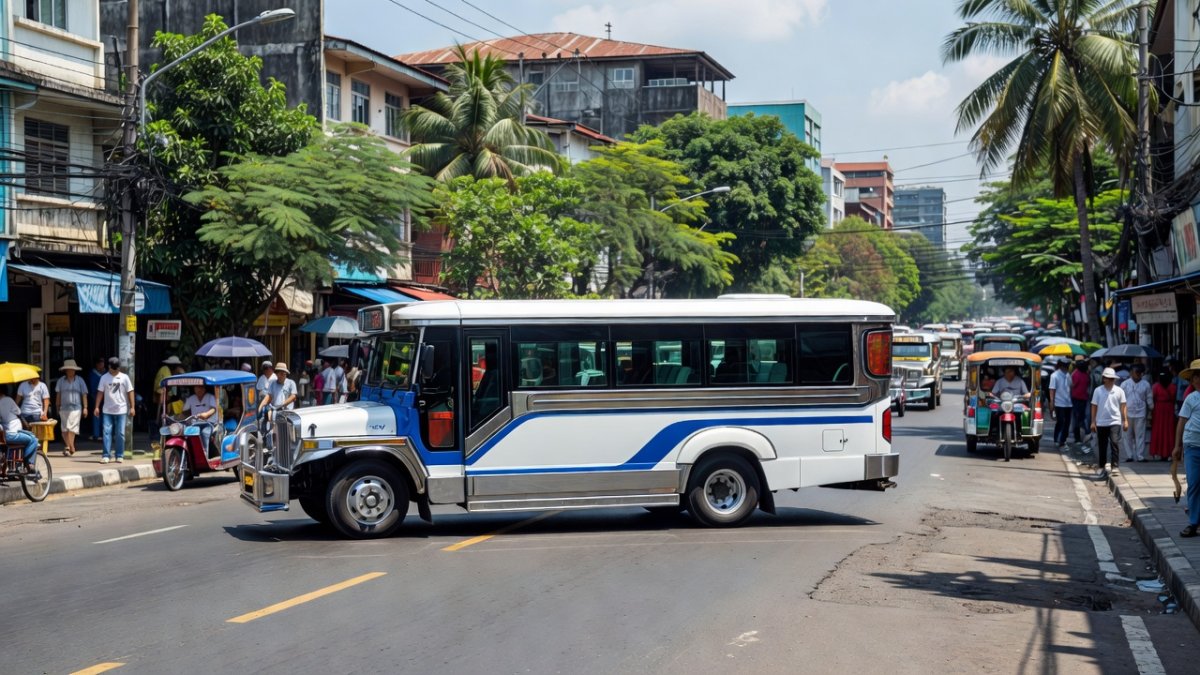
The Philippine government's Public Utility Vehicle Modernization Program (PUVMP) began in 2017. It targets the phased replacement of vehicles 15 years or older. Approximately 240,000 jeepneys operate daily nationwide, including 55,000 in Metro Manila alone. The Public Utility Vehicle Modernization Program (PUVMP) was formally launched via Department Order 2017-011 in October 2017 under the Duterte administration, with the explicit target of retiring approximately 180,000 pre-Euro 4 jeepneys by 2020. The program mandates that individual operators consolidate into cooperatives or corporations controlling a minimum fleet of 15 modern units to qualify for financing under the Land Bank of the Philippines' PUVMP window. This structural requirement has proven contentious, as many traditional owner-operators view it as an existential threat to the decentralized, family-based business model that has dominated Metro Manila transport since the 1950s.
Political resistance materialized in nationwide transport strikes on 24 October 2017 and again on 7 March 2023, organized under the #NoToJeepneyPhaseout coalition. These actions forced successive deadline extensions; the most recent adjustment, announced by the Department of Transportation in June 2024, pushes full compliance to December 2025 while introducing a voluntary "transitional" category for vehicles meeting Euro 4 standards. As of September 2024, only 9,200 units—roughly 5 percent of the target fleet—have been replaced. The program continues to phase in requirements rather than applying them uniformly across all operators at once. Transport groups have expressed concerns regarding acquisition costs and impacts on driver livelihoods during the transition period.
Air Quality Impacts in Metro Manila
Aging diesel jeepneys contribute 94 percent of urban soot mass in Metro Manila's air. Replacement with electric models offers a measurable pathway to reduce particulate emissions from this segment of the transport fleet. Quantifying the exact reduction timeline remains limited by available data on fleet turnover rates. However, the scale of daily operations indicates that even partial adoption could produce noticeable improvements in localized air quality metrics over successive years. Early data from Manila's pilot corridor indicate a 68 percent reduction in particulate emissions per passenger-kilometer, positioning the project as a replicable template for secondary cities such as Cebu and Davao.
Japan's METI Engagement with ASEAN EV Cooperation
Japan's Ministry of Economy, Trade and Industry (METI) has promoted EV cooperation across ASEAN as one element of its Green Transformation (GX) strategy. This approach supports Japanese companies entering Southeast Asian markets with electric mobility solutions. Japan's Green Transformation (GX) strategy, unveiled by the Kishida cabinet in February 2022, earmarks ¥150 trillion in public and private investment through 2030, with ASEAN positioned as a priority export market for electrified mobility. METI has operationalized this through the ASEAN-Japan Clean Energy Partnership, launched at the 2023 ASEAN Summit in Jakarta, which includes dedicated working groups on two- and three-wheel electrification as well as public-transport fleets. Technical assistance has been channeled via the Japan International Cooperation Agency (JICA) to support standards harmonization for charging interfaces and battery second-life applications.
e-Future Auto's involvement in the Philippines aligns with this broader policy direction. METI's framework emphasizes technology adaptation for regional conditions and gradual market development rather than rapid, uniform deployment. Beyond e-Future Auto, established players have accelerated market entry: Mitsubishi Fuso began pilot operations of its eCanter-based minibus in Thailand in 2023, while Toyota's subsidiary Daihatsu is adapting the Hijet platform for Philippine last-mile applications. These moves complement the 2022 revision of the Japan-Philippines Economic Partnership Agreement, which added a dedicated annex on low-carbon technology cooperation covering preferential tariffs for EV components and joint R&D on tropical-climate battery thermal management. The cumulative effect is a coherent Japanese industrial policy that leverages ASEAN's rapid urbanization to scale domestic supply chains while mitigating the risk of Chinese dominance in the region's emerging EV ecosystem. Forward indicators suggest that Japanese-affiliated EV production capacity targeting ASEAN could reach 250,000 units annually by 2027.
Operational and Economic Considerations for Operators
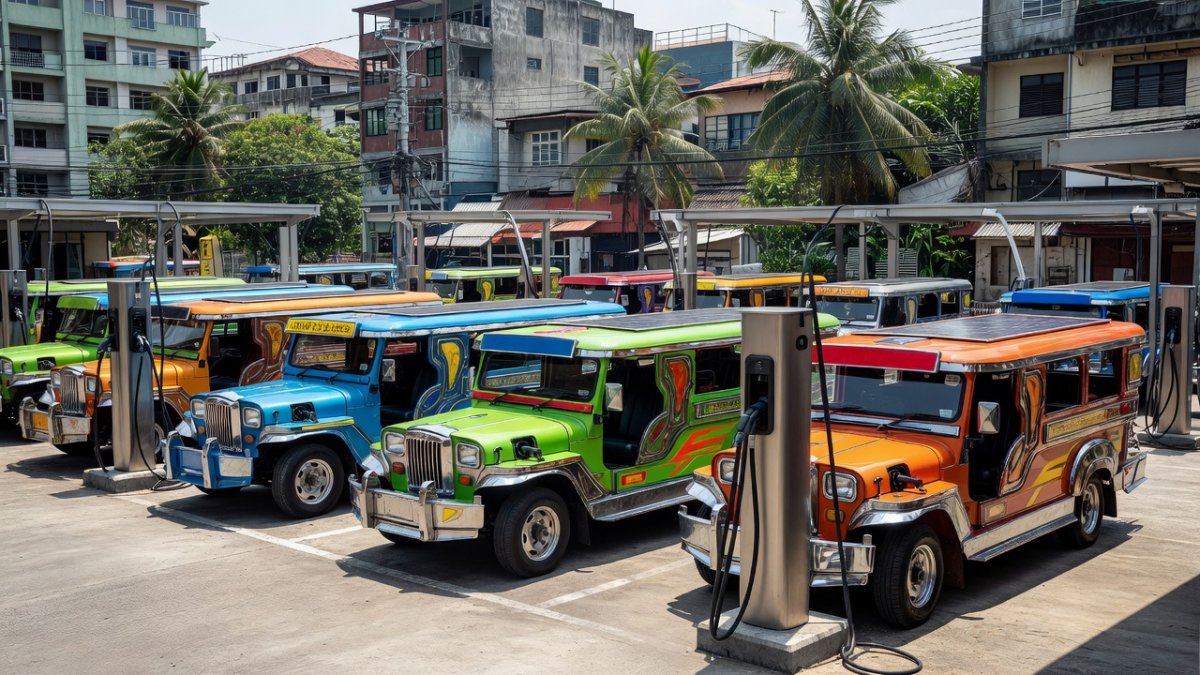
Transitioning to electric vehicles requires operators to evaluate charging infrastructure availability and total cost of ownership. The 200 km range of the FC11 addresses typical daily distances for many urban routes, yet fleet scheduling must account for charging cycles. Japanese firms have increased participation in Southeast Asia's EV transition through targeted models such as the FC11. This pattern reflects METI's emphasis on practical applications suited to local operating environments rather than direct replication of domestic Japanese specifications.
The acceleration of the FC11 rollout coincided with diesel prices in the Philippines surpassing PHP 79.50 per liter in August 2022 following the Ukraine supply shock. Traditional jeepney operators along the EDSA corridor reported monthly fuel expenditures exceeding PHP 48,000 per unit, prompting several transport cooperatives to sign letters of intent for 180 electric units by December 2023. This price differential has already translated into measurable commuter benefits: average end-to-end fares on pilot routes fell 12-15 percent while headway reliability improved due to reduced mechanical downtime. Comparative cost modeling conducted by the University of the Philippines Transport Study Group in 2024 shows that a diesel jeepney incurs average daily fuel and maintenance outlays of PHP 5,150, whereas an FC11 electric unit registers PHP 1,820 under current Manila electricity tariffs of PHP 9.80 per kWh. Amortized over a seven-year financing term at 6 percent interest, the electric vehicle's total cost of ownership falls below the diesel baseline once cumulative mileage exceeds 42,000 km annually—well within observed utilization rates on high-demand corridors.
Infrastructure and Financing Challenges
Charging infrastructure remains the principal bottleneck. The Department of Energy's 2024-2028 Electric Vehicle Roadmap projects the need for at least 480 public fast chargers in Metro Manila by 2026, yet only 67 units had been installed as of mid-2024, concentrated in shopping-mall parking facilities. Operators therefore rely heavily on overnight depot charging, necessitating secure parking arrangements that many traditional jeepney terminals lack. Government subsidies under the Electric Vehicle Incentive Program provide a 25-30 percent grant component for qualified cooperatives, supplemented by JICA-backed credit lines offering 4.5 percent interest rates. Early operator surveys indicate that net daily driver income has risen from PHP 780 to PHP 1,140 after accounting for lower energy costs and reduced repair time, although this gain is partially offset by the requirement to remit a fixed cooperative fee for fleet management. These economics suggest that successful scaling hinges on synchronized expansion of both financing facilities and charging networks.
Japan's engagement through the PUVMP framework reflects METI's long-standing preference for supporting incremental fleet renewal over abrupt regulatory shocks. The program's financing architecture, which blends Philippine government guarantees with Japanese concessional loans, offers a pragmatic pathway that balances social stability with decarbonization objectives across the wider ASEAN public-transport sector.
By Kenji Tanaka, Staff Writer
This article was produced with AI-assisted research and editorial support. Reporting is based on sources cited in the article.
What's Your Reaction?
 Like
0
Like
0
 Dislike
0
Dislike
0
 Love
0
Love
0
 Funny
0
Funny
0
 Wow
0
Wow
0
 Sad
0
Sad
0
 Angry
0
Angry
0

Japan Correspondent at Global1.News. Tokyo-based voice covering Japanese politics, technology, economy, and culture. Tracks the intersection of tradition and innovation in one of the world's most dynamic societies.













Comments (0)