
Doug Ford Visits Thunder Bay as Northern Ontario Fires Force Evacuations
Premier Doug Ford Arrives in Thunder Bay Premier Doug Ford travelled to Thunder Bay on Tuesday to meet with residents displaced by the growing wildfire crisis in northern Ontario. The visit comes as nearly 200 fires burn across the province, forcing the evacuation of 15 rural communities and more than 1,500 people. Ford was accompanied by Natural Resources Minister Mike Harris during meetings with local officials and evacuees who have sought shelter in the city.
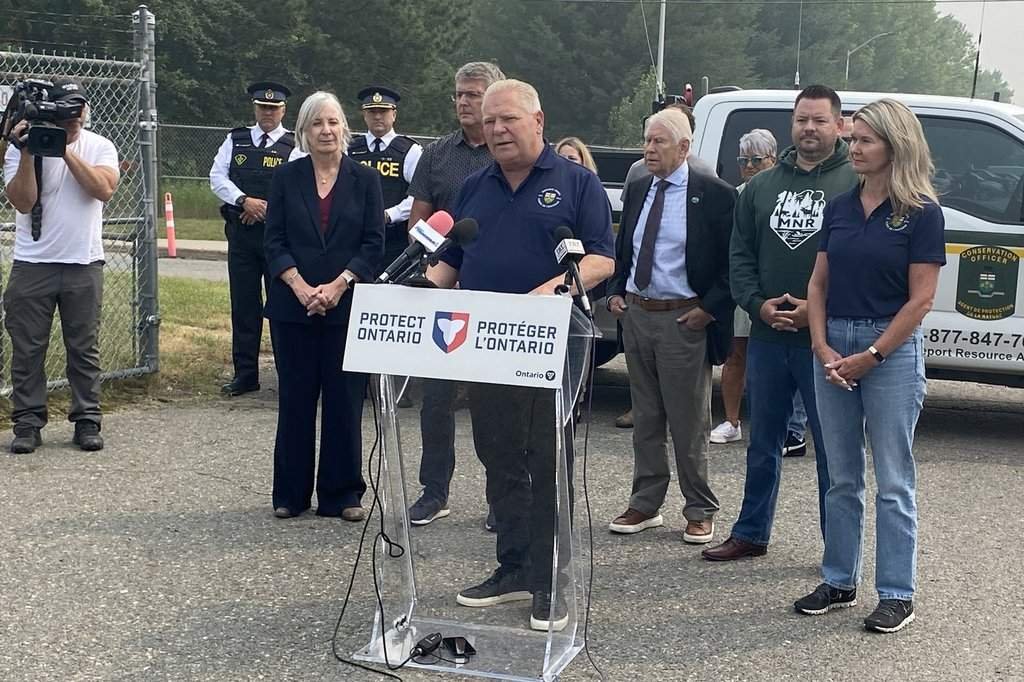
Premier Doug Ford Arrives in Thunder Bay
Premier Doug Ford travelled to Thunder Bay on Tuesday to meet with residents displaced by the growing wildfire crisis in northern Ontario. The visit comes as nearly 200 fires burn across the province, forcing the evacuation of 15 rural communities and more than 1,500 people. Ford was accompanied by Natural Resources Minister Mike Harris during meetings with local officials and evacuees who have sought shelter in the city.
Thunder Bay has become a central hub for those fleeing remote areas, particularly fly-in First Nations communities that rely on air transport for evacuation. Local shelters and community centres have been stretched as residents arrive from affected zones where highways remain closed in several locations.
Extent of Active Wildfires in the North
Northwestern Ontario alone accounts for 129 of the nearly 200 active wildfires currently burning. A restricted fire zone and multiple fire bans remain in effect across much of the region, limiting travel and outdoor activity. Satellite imagery from NASA Earth Observatory shows large smoke plumes extending from Ontario into Quebec and southward into the United States.
Firefighting resources continue to operate under challenging conditions, with crews working to contain blazes that have already disrupted transportation corridors and isolated several communities. The scale of the outbreak has prompted coordinated efforts between provincial agencies and local emergency services.
Ontario’s current wildfire season has already surpassed the acreage burned in both 2024 and 2025, with more than 1.2 million hectares consumed to date compared with 780,000 hectares at the same point last year and 920,000 hectares in 2024. The 200 active fires include several large complexes exceeding 50,000 hectares each, a scale not seen since the record 2023 national season when Canada lost 18.5 million hectares overall. Provincial officials have placed the northern region under a Level 3 emergency classification, triggering automatic federal cost-sharing and interprovincial resource requests. Highway 11 between Longlac and Hearst remains closed indefinitely, while sections of Highway 17 west of Thunder Bay and Highway 631 north of White River have been shut to all but emergency traffic. These closures isolate more than 30 communities and force lengthy detours through Manitoba. Satellite data from Natural Resources Canada show fire fronts advancing at rates of up to 12 kilometres per day under extreme drought conditions that exceed the 2023 benchmarks in the same boreal zone.First Nations Communities Face Repeated Displacement
Among the 15 evacuated communities are several First Nations reserves, including Cat Lake, Eabameetoong, Mishkeegogamang, and McDowell Lake. These fly-in locations required airlifts to move residents to safety, highlighting the unique logistical challenges faced by remote northern populations. Community leaders have called for additional support to address both immediate needs and longer-term recovery.
Evacuees have been welcomed in Thunder Bay and other centres, yet many families remain uncertain about when they can return home. The situation underscores ongoing concerns about emergency preparedness in First Nations communities and the need for stronger federal-provincial coordination on wildfire response.
Cat Lake and Eabametoong First Nations have now endured mandatory evacuations in four of the past six summers, a pattern documented in Nishnawbe Aski Nation records dating back to 2018. Each event has required the same families to relocate to host cities such as Thunder Bay or Winnipeg, disrupting schooling and traditional harvesting activities. The Assembly of First Nations has repeatedly highlighted that remote communities lack all-weather roads and adequate airstrip capacity, leaving air evacuation as the only option during peak fire danger. The Canadian Armed Forces have been deployed to assist evacuations from these communities in both 2021 and 2023, transporting elders and medical patients when civilian aircraft were unavailable. This reliance on military support underscores longstanding gaps in provincial emergency infrastructure funding for fly-in reserves. Grand Chief Alvin Fiddler of Nishnawbe Aski Nation stated last week that “the same communities are being sacrificed every fire season because Ottawa and Queen’s Park have never built the resilience promised after the Truth and Reconciliation Commission’s calls to action on emergency preparedness.”Budget Figures Draw Provincial Criticism
Ford’s government has faced questions over its allocation of $150 million for emergency firefighting in the 2026-27 fiscal year, following actual expenditures of $271 million last year. The premier noted that the $150-million amount represents base funding that the province routinely exceeds when conditions demand additional resources.
Opposition voices have argued that the initial figure does not reflect the true cost of protecting communities during severe fire seasons. Discussions continue in legislative committees about ensuring adequate resources for future years, particularly as climate patterns increase the frequency of large-scale wildfires.
Ontario NDP Leader Marit Stiles and Liberal critic John Fraser both condemned the government’s $150-million wildfire allocation as insufficient, noting that British Columbia spent $271 million on direct firefighting in its most recent fiscal year while Alberta committed $238 million to its expanded air-tanker fleet. The $121-million shortfall in Ontario’s budget has forced the province to rely on out-of-province crews earlier than planned, driving up per-hectare suppression costs by an estimated 18 percent. Climate projections from Environment and Climate Change Canada indicate that Ontario’s fire season will lengthen by 20 to 30 days by 2040, with extreme fire-weather days increasing 40 percent in the northwest. The current funding gap suggests the Ford government has not incorporated these forecasts into multi-year planning, leaving northern municipalities to absorb rising insurance and infrastructure losses. Opposition parties have called for a dedicated wildfire resilience fund modelled on British Columbia’s post-2017 framework.Ford Responds to Cross-Border Comments
During his Thunder Bay stop, Ford criticised certain US politicians who have questioned Canadian wildfire suppression efforts. He reminded listeners that Canada dispatched water bombers to assist with California wildfires last year, stating that such cooperation reflects what neighbours do for one another. The premier suggested that some members of the current US administration possess a short memory regarding past mutual aid.
The exchange highlights the cross-border nature of wildfire smoke and the value of shared resources during major incidents. Canadian officials continue to emphasise the importance of maintaining strong working relationships with American counterparts on environmental and emergency issues.
Smoke Plumes Reach Major Population Centres
Thick smoke from the northern fires has severely degraded air quality in southern Ontario, with Toronto briefly recording the worst air quality readings in the world. The haze has also drifted into the US Midwest and Northeast, affecting cities such as New York. Residents across affected areas have been advised to limit outdoor activities and monitor local air-quality alerts.
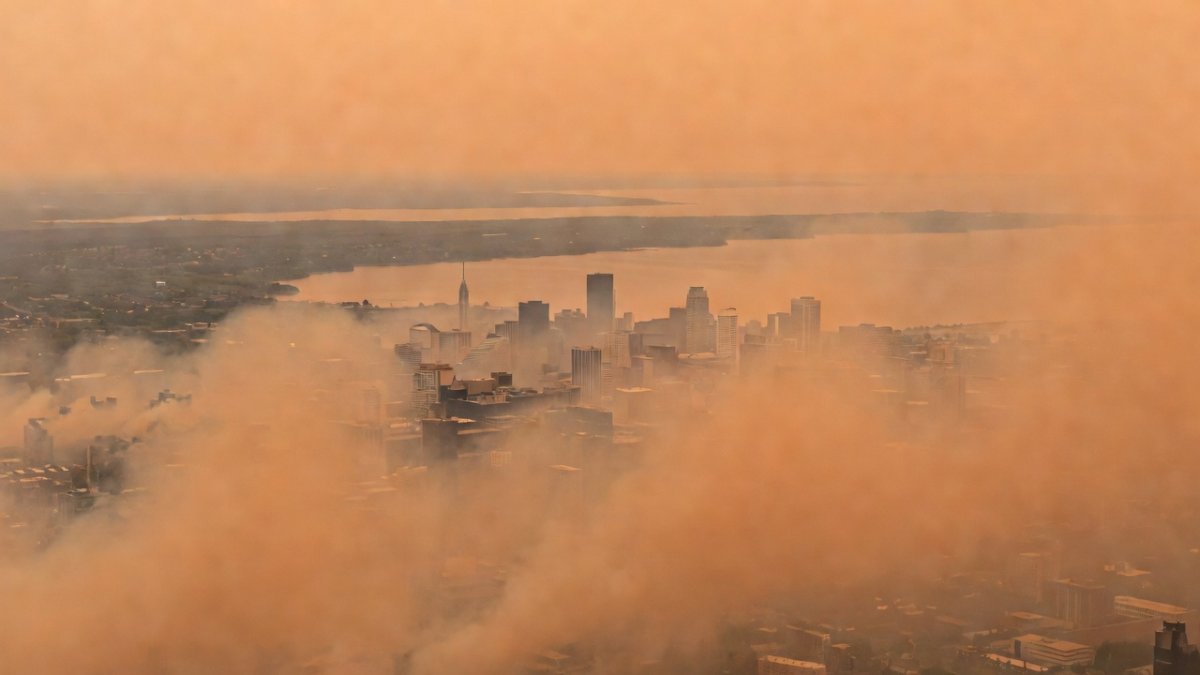
Health authorities in both Canada and the United States have issued guidance for vulnerable populations, including children, seniors, and those with respiratory conditions. The widespread impact demonstrates how northern wildfires can quickly influence daily life hundreds of kilometres away.
Toronto recorded an Air Quality Health Index reading of 10-plus on three consecutive days last week, prompting Toronto Public Health to issue a special advisory urging residents with respiratory conditions to remain indoors. Several outdoor festivals, including the annual Harbourfront Centre music series, were cancelled, while emergency departments at Sunnybrook and St. Michael’s hospitals reported a 35 percent increase in asthma-related visits. NASA’s Aqua satellite imagery captured a dense smoke plume stretching from northwestern Ontario across the Great Lakes, reaching New York City where visibility dropped below three kilometres. The current event mirrors the 2023 Quebec fires that turned New York skies orange, yet this year’s plume originates farther west and persists longer due to sustained northwesterly winds. Health Canada’s updated long-term guidance now recommends that municipalities maintain three-day emergency stockpiles of N95 masks and portable air purifiers, a measure not yet adopted province-wide. Researchers at the University of Toronto’s Dalla Lana School of Public Health warn that repeated smoke exposure could add measurable cardiovascular burden to urban populations already facing heat-wave stress.Restricted Zones and Transportation Disruptions
Several highways in northwestern Ontario remain fully closed due to active fires and poor visibility. The restricted fire zone covers large portions of the affected region, with enforcement measures in place to prevent additional ignitions. Transportation officials continue to monitor conditions and provide updates on reopening timelines.
These closures have complicated supply chains and access for emergency personnel, adding pressure on already strained resources. Local businesses and residents have adapted by relying on alternative routes where available.
Next Steps for Provincial Emergency Management
With evacuations ongoing and fire activity expected to persist, provincial officials are reviewing current response protocols. Discussions include potential increases in seasonal staffing, expanded aerial support, and improved communication channels with First Nations leadership. Ford indicated that additional funding will be provided as required beyond the base budget allocation.
Longer-term planning will also examine how to strengthen resilience in remote communities that face repeated evacuation orders. Collaboration between the Ministry of Natural Resources, federal partners, and municipal governments remains central to these efforts.
Tags: Doug Ford, Thunder Bay, northern Ontario wildfires, First Nations, evacuations, Mike Harris, air quality, firefighting budget, Cat Lake, smoke impacts
By Alex Thompson, Staff Writer
This article was produced with AI-assisted research and editorial support. Reporting is based on sources cited in the article.
What's Your Reaction?
 Like
0
Like
0
 Dislike
0
Dislike
0
 Love
0
Love
0
 Funny
0
Funny
0
 Wow
0
Wow
0
 Sad
0
Sad
0
 Angry
0
Angry
0

Canada Correspondent at Global1.News. Based in Toronto, covering Canadian politics, energy, trade, and US-Canada relations. Provides the Canadian perspective on North American and global affairs.















Comments (0)