
China and North Korea Deepen Diplomatic Engagement as High-Level Visits Accelerate
Historical Foundations of the Sino-North Korean Alliance The relationship between China and North Korea traces its roots to the Korean War of 1950-1953, when Chinese forces intervened on behalf of the North under the banner of "volunteers" to counter United Nations forces led by the United States. This conflict cemented a blood alliance often described in official rhetoric as "lips and teeth." The 1961 Treaty of Friendship, Cooperation and Mutual Assistance, which marks its 65th anniversary in
Historical Foundations of the Sino-North Korean Alliance
The relationship between China and North Korea traces its roots to the Korean War of 1950-1953, when Chinese forces intervened on behalf of the North under the banner of "volunteers" to counter United Nations forces led by the United States. This conflict cemented a blood alliance often described in official rhetoric as "lips and teeth." The 1961 Treaty of Friendship, Cooperation and Mutual Assistance, which marks its 65th anniversary in 2026, formalised mutual defence obligations and has remained the cornerstone of bilateral ties despite periodic strains.
Throughout the Cold War, Beijing provided Pyongyang with critical economic and military support, even as ideological differences emerged during the Sino-Soviet split. Following China's reform and opening under Deng Xiaoping in the late 1970s, relations cooled as Beijing normalised ties with South Korea in 1992. Yet the collapse of the Soviet Union in 1991 and North Korea's subsequent famine in the 1990s reinforced Pyongyang's dependence on Chinese aid. By the early 2000s, China had become North Korea's dominant trading partner, accounting for over 90 percent of its external trade in many years. This economic leverage has allowed Beijing to exert influence while avoiding direct confrontation with the Kim regime's nuclear ambitions.
Recent decades have seen fluctuating dynamics. Xi Jinping's rise in 2012 initially brought a period of diplomatic chill, with Xi meeting South Korean President Park Geun-hye multiple times before hosting Kim Jong Un in 2018. The current acceleration of high-level visits in 2026 reflects Beijing's determination to reassert strategic primacy on the Korean Peninsula amid shifting regional alignments. These exchanges build upon a pattern established since the early 2000s, when China hosted the Six-Party Talks aimed at denuclearising the North, though those efforts ultimately collapsed by 2009.
The Xi-Kim Summit of June 2026 and Its Far-Reaching Blueprint
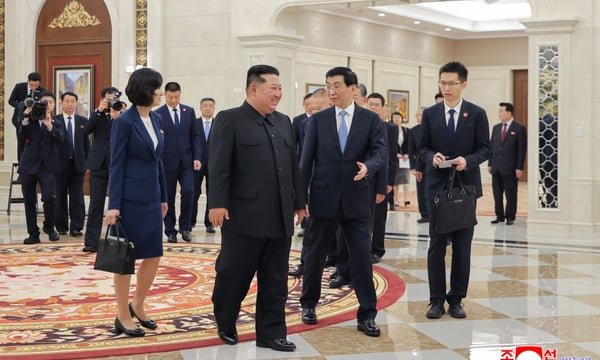
Xi Jinping's visit to North Korea in June 2026, the first such trip in seven years, represented a significant recalibration of Chinese policy. During the summit, the two leaders adopted what state media described as a "far-reaching blueprint" for strengthening what they termed "the most powerful and strategic relations" between the two countries. This agreement emphasised enhanced cooperation across diplomatic, law enforcement, and military domains, signalling Beijing's willingness to deepen engagement beyond purely economic channels.
The timing of Xi's visit was notable. It occurred against the backdrop of North Korea's rapidly expanding military partnership with Russia, including the deployment of thousands of North Korean troops to support Russian operations in Ukraine following the signing of a strategic defence agreement in 2024. Chinese leaders clearly recognised the risk of losing influence in Pyongyang as Kim Jong Un pivoted toward Moscow. The June summit therefore served as a deliberate counterweight, with Xi pushing for concrete mechanisms to implement closer coordination on regional security issues.
Implementation of this blueprint became the central focus of subsequent high-level exchanges. Wang Huning's visit to Pyongyang from 15 to 17 July 2026, as China's fourth-highest ranking official and a member of the Politburo Standing Committee, explicitly affirmed "the will of the Chinese party and the government" to translate the Xi-Kim understanding into practical outcomes. His meetings with Jo Yong Won, a powerful secretary of the Workers' Party of Korea Central Committee and Presidium member, underscored the importance both sides attach to party-to-party channels that often carry more weight than formal state diplomacy in communist systems.
The blueprint appears designed to create structured mechanisms for ongoing strategic communication. This includes regular high-level dialogues, joint law enforcement initiatives targeting sanctions evasion and border security, and potential military confidence-building measures. While details remain classified, the emphasis on "tactical cooperation" mentioned by Jo Yong Won suggests Beijing seeks operational-level coordination that stops short of formal alliance commitments that might alienate other regional actors.
The July 2026 High-Level Visits: Accelerating Momentum
The pace of diplomatic exchanges between Beijing and Pyongyang has markedly intensified in July 2026. North Korean Premier Pak Thae-song's three-day visit to Beijing beginning 10 July marked the 65th anniversary of the friendship treaty with ceremonial weight. During his meetings with Xi Jinping, the Chinese leader called for expanded cooperation and urged both sides to maintain "firm strategic resolve" while "resolutely defending our respective sovereignty, security and development interests," according to official Chinese statements.
This was followed immediately by Wang Huning's reciprocal visit to Pyongyang. The delegation's arrival at the Pyongyang Assembly Hall on 15 July for talks with Jo Yong Won extended what The Diplomat described as "a string of high-level exchanges" as Beijing works to keep pace with Pyongyang's deepening ties with Moscow. Wang's status as a member of the Politburo Standing Committee gave his visit particular significance, signalling that China views North Korea policy as a core strategic priority at the highest levels of the Communist Party.
These back-to-back visits demonstrate sophisticated diplomatic choreography. By hosting Pak Thae-song first and then dispatching Wang Huning, Beijing has created a rhythm of engagement that reinforces commitment while allowing both sides to address specific areas of cooperation. The 65th anniversary provided a convenient diplomatic hook, enabling both governments to frame their intensified engagement within the context of longstanding friendship rather than as a reaction to external pressures.
Yang Moo-jin, professor at the University of North Korean Studies in Seoul, offered insightful analysis of these developments. He noted that "North Korea wants to secure China's vast economic and geopolitical backing, while China seeks to maintain its influence on the Korean Peninsula and avoid losing the initiative in Northeast Asian affairs." This assessment captures the mutual dependencies driving the current diplomatic surge.
The China-Russia-North Korea Triangular Relationship
The accelerating China-North Korea engagement cannot be understood in isolation from the evolving triangular dynamics involving Russia. Since Russia's full-scale invasion of Ukraine in 2022, Moscow has cultivated increasingly close military ties with Pyongyang. The 2024 strategic defence agreement reportedly includes mutual defence provisions and has resulted in substantial North Korean troop deployments to the Ukrainian theatre, providing Russia with much-needed manpower while giving North Korea access to advanced military technology and hard currency.
This Russia-North Korea axis presents both opportunities and challenges for Beijing. On one hand, it creates a loose anti-Western alignment that complicates American and allied strategy in both Europe and Asia. The three countries share common opposition to what they characterise as American hegemony and have coordinated positions on issues ranging from Taiwan to Ukraine within various multilateral forums.
On the other hand, China has no desire to become junior partner in a Russia-dominated axis or to see Pyongyang become overly dependent on Moscow. Beijing's economic leverage over North Korea remains unmatched, with China continuing to serve as the North's largest trading partner despite international sanctions. By intensifying high-level diplomatic engagement, China aims to ensure that its strategic interests are not marginalised as Pyongyang diversifies its partnerships.
The triangular relationship exhibits elements of both cooperation and competition. While all three capitals criticise the US-led alliance system in East Asia, their specific priorities diverge. Russia focuses primarily on securing North Korean military support for its European conflict. China emphasises long-term strategic stability on the Korean Peninsula and preventing actions that might trigger direct US military involvement. North Korea seeks to maximise economic and technological benefits from both larger neighbours while preserving its autonomy.
This complex geometry has significant implications for Northeast Asian diplomacy. The strengthened China-North Korea channel may serve as a moderating influence on Pyongyang's more provocative impulses, though it could also embolden the North by providing diplomatic cover for continued nuclear and missile development. The triangular dynamic also complicates efforts by the United States, South Korea, and Japan to coordinate policy responses.
South Korea's Position and Strategic Dilemmas
For South Korea, the recent intensification of China-North Korea ties presents serious strategic challenges. Seoul maintains a formal alliance with the United States while pursuing economic engagement with China, its largest trading partner. The deepening alignment between Beijing and Pyongyang risks further isolating South Korea diplomatically while complicating efforts to manage inter-Korean relations.
The Yoon Suk Yeol administration, which has emphasised stronger trilateral cooperation with the United States and Japan, finds itself navigating an increasingly polarised regional landscape. North Korea's military cooperation with Russia has already prompted Seoul to provide indirect support to Ukraine, further straining relations with both Moscow and Pyongyang. The renewed China-North Korea engagement adds another layer of complexity to Seoul's security calculus.
Professor Yang Moo-jin's observation that China seeks to "maintain its influence on the Korean Peninsula and avoid losing the initiative" carries particular resonance for South Korean policymakers. Beijing's actions suggest a determination to prevent any fundamental realignment that might see North Korea drift too far into the Russian orbit or, conversely, that a future leadership change in Pyongyang might open new possibilities for South Korean engagement.
Seoul has responded by strengthening its alliance with Washington while cautiously managing relations with Beijing. The recent high-level visits have prompted renewed calls within South Korea for diplomatic initiatives aimed at reducing tensions, though the prospects for meaningful inter-Korean dialogue remain dim given Pyongyang's continued hostility. The triangular dynamics also raise questions about China's willingness to support South Korean interests in any future Korean unification scenarios, a topic of longstanding strategic concern in Seoul.
Implications for Regional Stability in Northeast Asia
The acceleration of high-level China-North Korea diplomatic engagement carries profound implications for regional stability. On the positive side, enhanced communication channels between Beijing and Pyongyang may help prevent miscalculation during periods of heightened tension. China's economic leverage provides a potential restraint on North Korean provocations that could trigger broader conflict. The "strategic communication and tactical cooperation" emphasised in recent talks could evolve into mechanisms for crisis management.
However, several risks loom. The strengthened partnership may encourage North Korea to pursue more aggressive policies, confident that it enjoys backing from both China and Russia. The "far-reaching blueprint" agreed between Xi and Kim could include military cooperation elements that enhance Pyongyang's capabilities, potentially destabilising the military balance on the peninsula. Moreover, the explicit linkage of sovereignty and security interests in recent statements suggests both countries may coordinate more closely in opposing American and South Korean military activities in the region.
The triangular relationship with Russia adds further volatility. If North Korea's involvement in Ukraine yields significant technological or economic benefits, Pyongyang may feel emboldened to escalate tensions with South Korea and the United States. China faces the delicate task of supporting its traditional ally while avoiding actions that might provoke a direct military confrontation with American forces, which remain stationed in South Korea under the Mutual Defense Treaty of 1953.
From a broader perspective, these developments reflect the return of great power competition to the Korean Peninsula. The region, which experienced relative stability during the post-Cold War period despite North Korea's nuclear programme, now faces renewed polarisation. The failure of previous diplomatic initiatives, from the Six-Party Talks to the Trump-Kim summits of 2018-2019, has left a vacuum that China is now attempting to fill through intensified bilateral engagement.
Looking ahead, the sustainability of this diplomatic surge will depend on several factors. China's ability to deliver meaningful economic benefits to North Korea remains constrained by international sanctions, though creative arrangements for sanctions evasion have long characterised bilateral trade. The evolution of Russia-North Korea ties will also influence Beijing's approach. Should Moscow's influence grow excessively, China may intensify its own engagement further. Conversely, if Russian capabilities diminish due to the Ukraine conflict, Pyongyang may become even more dependent on Chinese support.
For the international community, these developments underscore the need for coordinated diplomatic strategies that acknowledge China's central role while maintaining pressure on North Korea's nuclear programme. The recent high-level visits suggest that Beijing has chosen engagement over isolation, a policy approach with both risks and opportunities for regional stability. As Professor Yang Moo-jin observed, the current dynamics reflect fundamental geopolitical calculations by both Pyongyang and Beijing that will continue shaping Northeast Asian security for years to come.
The coming months will reveal whether the "far-reaching blueprint" produces tangible results in areas such as economic cooperation, border management, and strategic coordination. What remains clear is that China has moved decisively to reinforce its position as the primary external actor influencing North Korean behaviour, even as Pyongyang maintains its balancing act between Beijing and Moscow. This intricate diplomatic dance carries significant consequences not only for the Korean Peninsula but for the broader Indo-Pacific strategic landscape.
The intensification of China-North Korea ties in 2026 represents more than routine diplomatic exchanges. It signals a strategic adjustment by Beijing to evolving regional realities, with implications that extend far beyond bilateral relations. As high-level visits continue to accelerate, understanding these dynamics becomes essential for anyone seeking to comprehend the future trajectory of Northeast Asian security and diplomacy.
By Prof. David Park, Staff WriterThis article was produced with AI-assisted research and editorial support. Reporting is based on sources cited in the article.
What's Your Reaction?
 Like
0
Like
0
 Dislike
0
Dislike
0
 Love
0
Love
0
 Funny
0
Funny
0
 Wow
0
Wow
0
 Sad
0
Sad
0
 Angry
0
Angry
0

East Asia/Technology Correspondent at Global1.News. Seoul-based voice covering Korean politics, technology, business, and culture. Analyzes how technology and geopolitics intersect across East Asia.














Comments (0)