
COP30 Belém — Why Global Temps Keep Rising Despite Climate Talks
Ten years after the Paris Agreement, the world's nations gathered in Belém, Brazil, for COP30 — and the numbers tell a sobering story. Global CO₂ emissions hit a record 38.1 gigatons in 2025, fossil fuel production continues to expand across Latin America, and no major economy is on track to limit warming to 1.5°C. For the Amazon host city, the summit exposed a painful contradi
Ten years after the Paris Agreement, the world's nations gathered in Belém, Brazil, for COP30 — and the numbers tell a sobering story. Global CO₂ emissions hit a record 38.1 gigatons in 2025, fossil fuel production continues to expand across Latin America, and no major economy is on track to limit warming to 1.5°C. For the Amazon host city, the summit exposed a painful contradiction: Brazil champions climate leadership while approving new oil drilling in the rainforest's backyard.
COP30 in Belém — Why Global Temperatures Keep Rising Despite a Decade of Climate Talks
Belém, Pará, Brazil — July 2026 — The 2025 United Nations climate summit in Belém was meant to mark a turning point. Instead, COP30 became a stark reminder of the gap between diplomatic ambition and physical reality, as global emissions climbed to new heights and Latin America's fossil fuel expansion accelerated against a backdrop of unmet finance promises.
COP30 in Belém — A Decade After Paris, Where Do We Stand?
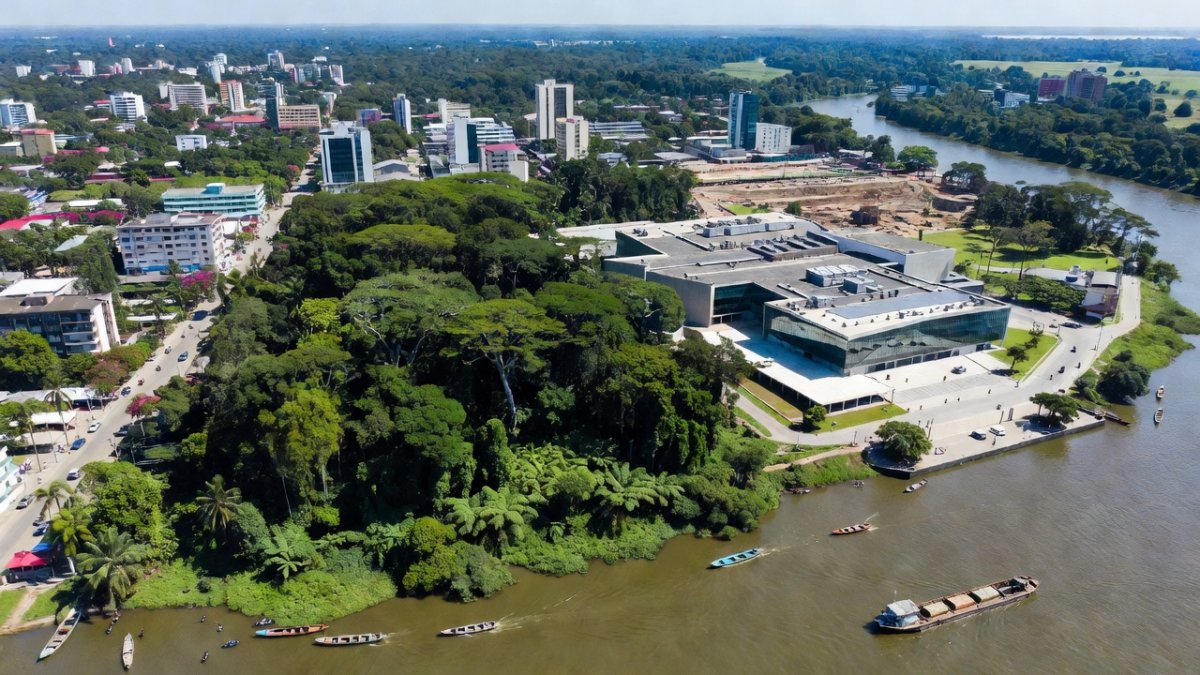
Ten years after the Paris Agreement, COP30 convenes in Belém amid stark evidence that global temperatures continue climbing. The Brazilian Amazon city hosts the summit at an estimated cost of $2 billion, yet infrastructure shortfalls remain glaring: 80 percent of Belém lacks sewage systems. A 13-kilometer road cut through rainforest for delegate access has already driven a 15 percent rise in local deforestation. No nationwide deforestation ban was enacted ahead of the talks, leaving critical ecosystems exposed.
Negotiators arrive with updated national plans that still fall short of limiting warming to 1.5°C. Every major economy remains off the required trajectory. Emissions data released just before the meeting show atmospheric CO2 concentrations rising steadily, underscoring the gap between diplomatic language and physical reality. Latin American delegations emphasize adaptation finance and loss-and-damage mechanisms, while developed nations resist new quantified commitments.
The symbolic weight of holding COP30 in the Amazon is undercut by Brazil’s simultaneous approval of new oil exploration blocks operated by Petrobras. Environmental licensing volumes increased 51 percent in the year preceding the summit. These contradictions frame the negotiations: a host nation promoting itself as a climate leader while expanding fossil-fuel extraction in the very biome meant to symbolize planetary health. Observers note that without binding rules on production, temperature goals will remain rhetorical targets rather than measurable outcomes.
Global Emissions Keep Rising — The Numbers Behind the Failure
Global CO2 emissions reached a record 38.1 gigatons in 2025, marking a 1.1 percent increase from the previous year. This figure arrives despite a decade of annual UN climate conferences and repeated pledges to peak emissions. No major economy has aligned its current policies with a 1.5°C pathway, according to independent tracking by multiple scientific consortia. The continued growth stems primarily from expanded coal, oil, and gas use in both developed and emerging markets.
Annual UN talks have produced incremental finance announcements and voluntary targets, yet none have altered the underlying production trajectory. Fossil-fuel subsidies worldwide still exceed $500 billion annually. At COP30, delegates again face the same structural problem: national climate plans omit any constraint on new extraction projects. The result is a widening gap between modeled 1.5°C scenarios and actual emission curves.
Atmospheric measurements confirm the physical consequence. Each additional gigaton locks in further warming regardless of conference communiqués. The absence of production-side measures at successive COPs has allowed supply to expand in parallel with demand-side efficiency gains. Without explicit limits on new fields and mines, temperature outcomes will continue to diverge from Paris goals. COP30’s final text is expected to repeat calls for peaking emissions “as soon as possible,” language that has accompanied every prior increase in the global total.
Latin America's Dilemma — Fossil Fuel Expansion vs Climate Leadership
Latin America currently accounts for 35 percent of global crude-oil production. Several governments simultaneously position themselves as climate advocates while accelerating extraction. Argentina plans to double unconventional output by 2032, relying on Vaca Muerta shale. Colombia and Ecuador have signaled continued reliance on oil revenues even as they host regional climate dialogues. These policies directly contradict the rapid phase-out required to stabilize temperatures.
Regional emissions are rising faster than the global average in part because new fields come online without corresponding reductions elsewhere. Environmental licensing reforms in multiple countries have shortened approval times, increasing project throughput. At COP30, Latin American finance ministers argue that wealthy nations must provide trillions in support before production can be curtailed. Developed-country negotiators counter that domestic subsidy reform must begin immediately.
The tension is most visible in national budgets. Oil and gas revenues fund social programs and debt service across the region. Shifting away from these sources requires credible replacement finance that has not materialized. Consequently, governments approve new drilling while pledging net-zero targets for 2050. This dual track ensures that Latin American emissions will remain elevated through at least the 2030s, regardless of diplomatic statements issued from Belém.
The Amazon at the Table — Brazil's Dual Role as Host and Policymaker
Brazil’s decision to host COP30 in Belém places the Amazon at the center of negotiations, yet domestic policy continues to authorize new extraction. Petrobras received approval for drilling in the Lula field, projected to produce one million barrels per day. The project lies within the Amazon basin and was green-lit months before the summit. Environmental impact assessments were completed under expedited timelines that reduced public consultation periods.
Deforestation rates inside Brazil have not declined in the lead-up to COP30. The 13-kilometer access road built for the conference itself contributed to the 15 percent local increase. No federal legislation imposing a permanent ban on new deforestation was passed. Instead, enforcement budgets remain flat while licensing volumes rose 51 percent. These actions occur alongside Brazil’s public calls for an ambitious global stocktake outcome.
Indigenous and civil-society groups staged protests that briefly disrupted venue access. Their demands center on halting new oil blocks and securing land rights. Brazilian negotiators respond that sovereign resource decisions cannot be dictated by external pressure. The resulting impasse illustrates the core difficulty: a host government cannot credibly champion forest protection while simultaneously expanding fossil-fuel infrastructure inside the same territory. Temperature outcomes will reflect the physical projects, not the conference rhetoric.
Climate Finance — Broken Promises and the $100 Billion Gap
The original $100 billion annual climate-finance goal was never met on a consistent basis. At COP29, donors pledged a new collective target of $300 billion per year, yet disbursement mechanisms remain slow and heavily concessional. Developing countries at COP30 are demanding at least $1 trillion annually in new, additional finance. The gap between announced figures and actual flows continues to undermine trust.
Brazil has proposed a Tropical Forest Forever Facility (TFFF) capitalized at $125 billion to reward standing forests. Pledges so far total less than one-fifth of that amount. Meanwhile, loss-and-damage funding approved in prior rounds has reached only a few billion dollars, far below estimated needs after recent extreme events. Protesters who entered the venue highlighted these shortfalls with banners citing unmet commitments.
Private capital mobilization has also lagged. Risk guarantees and blended-finance vehicles have not scaled to the levels required for energy-transition projects across Latin America and Africa. Without predictable grant and concessional flows, governments argue they cannot forgo fossil-fuel revenues. The finance impasse therefore directly sustains the emission trajectory that COP30 was convened to address.
The Bottom Line — What COP30 Means for Latin America
COP30 concludes with familiar language on ambition and cooperation, yet the underlying emission curve remains unchanged. Record 38.1 Gt CO2 levels and continued expansion of oil and gas infrastructure across the region indicate that temperature rise will persist. Latin American countries face simultaneous pressure to increase production for fiscal reasons and to demonstrate climate leadership for diplomatic reasons.
The absence of production limits in the final text means new fields and pipelines will proceed. Finance shortfalls will continue to be cited as justification. Regional temperatures are already rising faster than the global mean, amplifying impacts on agriculture, water, and cities. Future COPs will inherit the same structural contradictions unless governments align extraction policy with stated temperature goals.
For Latin America, the Belém summit underscores that diplomatic hosting alone does not alter physical outcomes. Concrete project approvals and budget allocations will determine whether emissions peak this decade or continue climbing. Current trajectories point to the latter.
By Elena Vasquez, Staff Writer
**Social Media Teaser:** COP30 in Belém cost $2B while global emissions hit 38.1 Gt — and Brazil approved new Amazon oil drilling. Read Elena's full analysis of the summit that exposed the gap between climate rhetoric and reality. 🌎🔥This article was produced with AI-assisted research and editorial support. Reporting is based on sources cited in the article.
What's Your Reaction?
 Like
0
Like
0
 Dislike
0
Dislike
0
 Love
0
Love
0
 Funny
0
Funny
0
 Wow
0
Wow
0
 Sad
0
Sad
0
 Angry
0
Angry
0

Latin America Correspondent at Global1.News. Based in Mexico City, covering politics, economics, energy, and culture across the region. Brings an on-the-ground perspective to stories spanning from the Rio Grande to Patagonia.













Comments (0)