
Venezuela Devastated by Twin Earthquakes: Survival, Grief, and Regional Solidarity
The Disaster That Shook Venezuela On June 24, twin earthquakes struck Venezuela within seconds of each other, registering a magnitude of 7.5 and ranking among the strongest tremors to hit the country in a century. The epicenter in La Guaira state devastated the coastal communities of Caraballeda, Catia La Mar, and Playa Grande, where entire buildings collapsed under the force o
The Disaster That Shook Venezuela
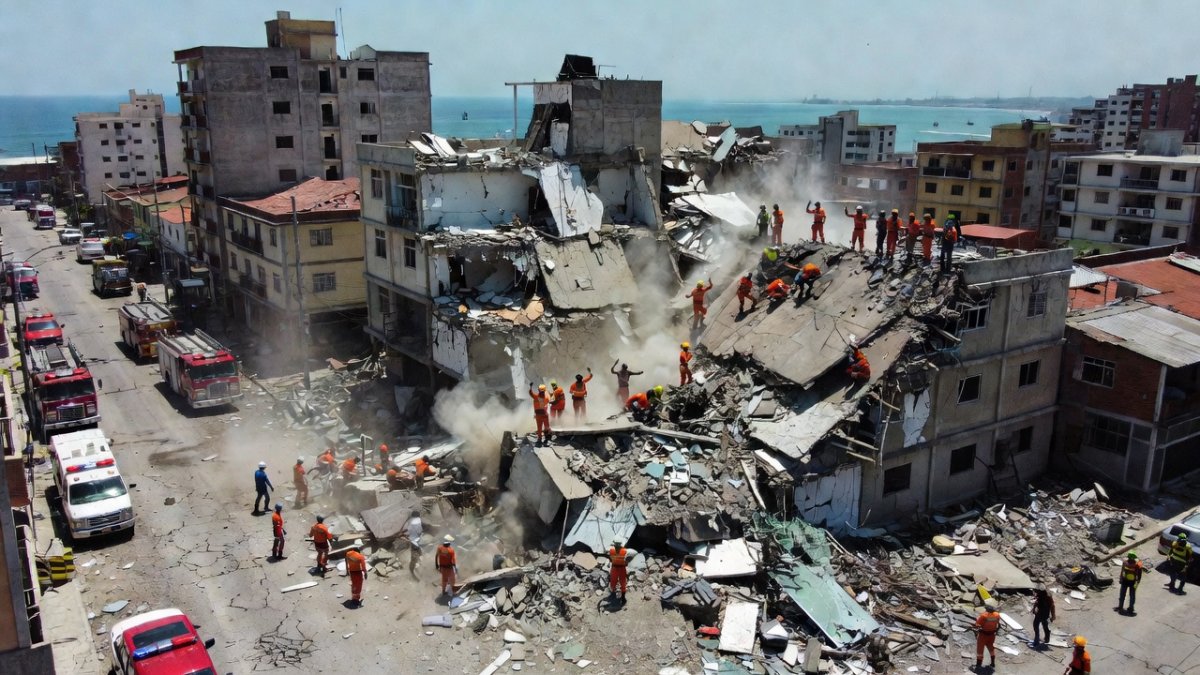
On June 24, twin earthquakes struck Venezuela within seconds of each other, registering a magnitude of 7.5 and ranking among the strongest tremors to hit the country in a century. The epicenter in La Guaira state devastated the coastal communities of Caraballeda, Catia La Mar, and Playa Grande, where entire buildings collapsed under the force of two successive seismic shocks. More than 2,600 people have been confirmed dead, with tens of thousands still missing beneath the rubble. The United Nations has begun procuring 10,000 body bags to handle the scale of fatalities.
Acting President Delcy Rodríguez has coordinated the national response from Caracas, deploying thousands of officials to the affected zone. The disaster has exposed long-standing vulnerabilities in Venezuelan urban infrastructure, where years of economic strain and limited maintenance left many buildings without proper seismic reinforcement. The Caribbean-South American plate boundary runs directly beneath the region, a geological reality that seismologists have long warned about. International rescue teams arrived within days from Chile, Costa Rica, Mexico, El Salvador, the United States, Jordan, and Portugal, bringing specialized equipment and expertise to supplement Venezuela's overstretched emergency services.
For the communities of La Guaira, the recovery effort will take months. The economic impact on port activities and tourism along the coast is already severe, disrupting regional trade routes and local livelihoods. The twin earthquakes have reignited discussions across Latin America about building codes, early-warning systems, and disaster preparedness in seismically active zones from the Andes to the Caribbean.
Rescue teams search collapsed structures in La Guaira state following the twin earthquakes (Global 1 News)
Survival Against the Odds: Stories from the Rubble
Among the most remarkable survival stories to emerge from the rubble is that of 12-year-old Fabiana, who spent 32 hours trapped inside the collapsed Ritamar Palace in Caraballeda. She survived on packets of ketchup and grated cheese she found in the debris while recording a desperate video on her phone, describing the situation to whomever might eventually see it. Firefighters abandoned the search twice after determining that reaching her was impossible. A volunteer named Viktor kept searching and eventually heard her faint responses. He located her and directed the team that finally pulled her free.
Her mother, Karina Blanco, had been teaching a spinning class when the earthquake struck. She drove at high speed to the building and found half of her daughter's bed sticking out of the debris. "I was running from one end of the complex to the other screaming 'She's dead. My daughter is dead.' I didn't know what to do," she told reporters. Viktor's persistence changed everything. Fabiana later described an unexpected calm during her ordeal: "I'm someone who gets very anxious and claustrophobic. But I don't know why, a strange calm came over me. Maybe my mind was in shock."
Her story has become a symbol of resilience in Venezuela, highlighting the critical role that community volunteers played in the first hours before international teams fully deployed. In neighborhoods across Caraballeda, neighbors organized search parties, brought tools, and pointed headlights from motorcycles and cars into the wreckage so rescuers could work through the night.
A Toddler's Rescue and a Family's Hope
Two-year-old Kleiber Moran was pulled from the rubble after six days by a specialized Jordanian search-and-rescue team working in La Guaira. Remarkably, he sustained no fractures despite the prolonged entrapment. He was wrapped in a Spiderman blanket when reunited with his aunt, Andreína Sarmiento, at a hospital in Caracas. His parents, Ana Luz and Carlos, remain missing. "I will take care of Kleiber with a mother's warmth until my sister appears, which is what we long for," Andreína told the BBC from the hospital bedside.
"I'm praying a lot to God to give me strength because he is only two years old and I am not a mother," she said, holding his hand. "It hurts me a lot because my sister always used to tell me that he is my son, and now it's like she's handing him over to me and saying 'this is your son, he is your responsibility.'" When Andreína first heard of Kleiber's rescue, she fell to the floor and wept before heading to meet him. When the two were reunited, Kleiber looked at her and immediately said "she Auntie."
The Jordanian team's methodical search techniques — including thermal imaging and systematic void-space mapping — proved critical in locating the toddler. Acting President Delcy Rodríguez described Kleiber's rescue as a "source of hope for our people" as the death toll continued to rise. Andreína expressed continued faith that her sister and brother-in-law will be found: "Just as they found my nephew, I have faith that they are going to find my sister and my brother-in-law." Medical staff at the Caracas hospital have monitored Kleiber closely, and he has been surrounded by toys in a ward with other children who survived the quakes.
Eight Days Under 140 Tonnes: The Rescue of Hernán Gil
Security guard Hernán Gil survived eight days trapped beneath 140 tonnes of rubble at the Galerias Playa Grande mall in Catia La Mar. Gil had been on duty in a small concrete booth in the basement parking lot when the twin quakes struck. The booth created a protective shell around him, shielding him from the immense weight of the collapsed structure above. Costa Rican Red Cross paramedic Allan Madrigal was the first to hear Gil's faint cries for help emerging from the rubble on the fourth day after the earthquake. "It was an emotional moment," Madrigal recalled. He asked a colleague to confirm that he "wasn't just imagining it."
Over 100 hours of painstaking work followed as teams from eight countries — Chile, Costa Rica, Mexico, El Salvador, the United States, Jordan, Portugal, and Venezuela — worked in rotating shifts. Parts of the access ducts they built collapsed several times, highlighting the dangers the work posed to rescuers as well as Gil. A small camera inserted into the rubble established visual contact. One of Gil's eyes was bloodshot and he wore a face mask passed to him through a small hole to protect him from dust and debris created by the digging. Marco Antonio Franco from the Mexican Red Cross described Gil as "a cheerful man" who "even asked for hydration drinks of specific flavours he likes."
Gil's survival after eight days has been presented as evidence of effective international coordination. A Chilean firefighter described the operation as "without doubt the most complex and technically difficult which I've had to tackle." Acting President Delcy Rodríguez visited Gil in the hospital, calling him a "living miracle." Allan Madrigal, on his first international rescue mission, said the work had changed him profoundly: "The lad who came here a week ago is not the same one that will return to Costa Rica, believe me."
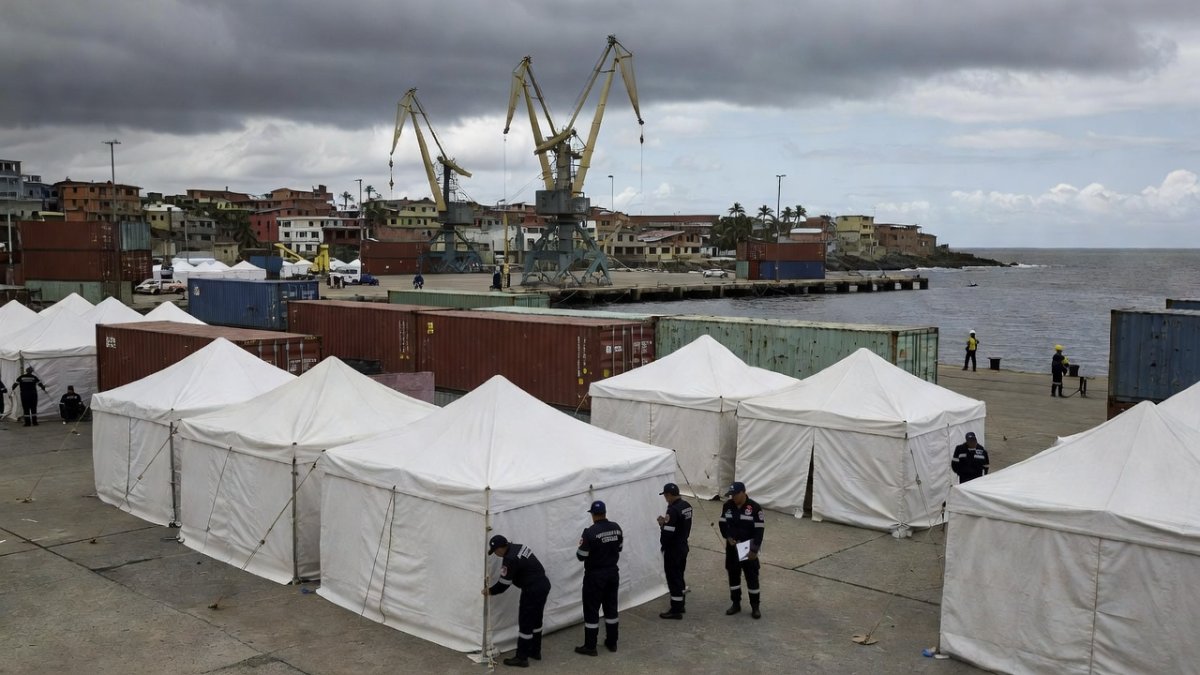
Families gather at the Los Silos port facility to identify loved ones in the aftermath of the earthquakes (Global 1 News)
Morgues Overwhelmed: Identifying the Dead
At the makeshift morgue established at the Los Silos port facility in La Guaira, bodies lie in rows wrapped in plastic sheeting, exposed to the blistering Caribbean sun. Families gather daily to identify loved ones by viewing photographs displayed on television screens. The scale of the disaster has overwhelmed local services. In the sweltering heat, decomposition is rapid. A free cremation tent offers dignified final arrangements for families who request it. The United Nations has procured 10,000 body bags to support the operations.
The identification process is agonizing. Liliana González, 60, came to look for her aunt but ended up identifying her 37-year-old nephew by a distinctive tattoo visible in one of the images on the screens. "I saw my mum when she died, but this... this isn't the same," she said as she left. Modesta Alemán, 56, traveled from Carayaca to look for her older sister Matilde, who lived in one of the hardest-hit areas. Volunteers had told her they could hear voices calling from the building "but no one could get them out." Jéssica Soto, 42, sat at the entrance of Los Silos for two days waiting for the remains of her 15-year-old daughter and three-year-old granddaughter who got trapped in their apartment after the earthquakes.
Medical and forensic personnel work under extreme conditions. The smell of decomposition is the first thing that greets anyone entering the facility. Forensic specialists use dental records to help identify victims whose bodies have become difficult to recognize. The process can take hours. Once identified, fingerprints are taken if possible, bodies are placed in coffins, and paperwork begins for death certificates — an essential document so funeral homes can collect the remains. For those still waiting, the uncertainty compounds the trauma. "I'm afraid of what I'm going to see in there, but it's the only way to end this agony," one woman said before passing through the gate.
Regional Solidarity and Political Shifts
The international rescue effort in Venezuela has drawn teams from eight countries, showcasing rare regional solidarity amid a period of significant political change in Latin America. Keiko Fujimori was declared the winner of Peru's tight presidential election on July 4, winning 50.135 percent of voters' support — a margin of less than 50,000 votes. Her victory, alongside the election of Abelardo de la Espriella in Colombia, marks a shift toward the right in Latin American politics. Fujimori promised a crackdown on organized crime and has aligned herself with US President Donald Trump's second-term foreign policy approach. Brazil's President Luiz Inácio Lula da Silva, facing an election later this year against the son of convicted former president Jair Bolsonaro, now stands as the region's predominant left-wing standard-bearer.
The political currents intersect with seismic realities. The Andes remain one of the world's most active tectonic zones, where outdated building codes in rapidly growing cities magnify risk. Cross-border cooperation during the Venezuela crisis offers a model for joint seismic monitoring and rapid-response agreements. Infrastructure experts argue that shared early-warning networks and standardized construction standards could reduce future fatalities across the region. The disaster has accelerated diplomatic conversations about pooling resources for disaster preparedness.
Acting President Delcy Rodríguez rejected criticism that her government had reacted too slowly, stating at a press conference that thousands of officials had been deployed after the quakes. "We have done everything in our power, and we will continue to do everything in our power and more," she told journalists. For neighboring countries, the disaster has prompted urgent reviews of their own preparedness measures. The question now is whether the political will exists to turn this shared tragedy into lasting structural change.
What Venezuela's Tragedy Means for Latin America
Venezuela's twin earthquakes have exposed vulnerabilities that extend far beyond its borders. Across Latin America, rapid urbanization has concentrated populations in seismically active zones without corresponding investment in building standards. From Chile to Mexico, cities have grown faster than the infrastructure needed to protect them. Brazil, as a regional leader, faces expectations to champion coordinated resilience funding and technology transfer. Lessons from the Venezuelan response — particularly the effectiveness of multinational teams and the indispensable role of community volunteers — should inform national strategies across the continent.
Reconstruction in La Guaira state will require sustained international support. Buildings must be rebuilt to modern seismic standards, and the economic recovery of port communities depends on restored trade routes and tourism. The human toll — over 2,600 confirmed dead, tens of thousands missing, families still waiting at facilities like Los Silos — demands long-term psychosocial support that Venezuela's strained public health system cannot provide alone. The disaster has also highlighted the need for modern forensic infrastructure across the region, including DNA processing capacity for mass-casualty events.
"I had hope and faith," Fabiana said from her hospital bed. Her words capture the resilience that will be needed as Venezuela begins the long process of recovery. For Latin America, the challenge is to turn this tragedy into a catalyst for change — investing in disaster preparedness, strengthening building codes, and building cross-border institutions capable of protecting growing populations along the continent's volatile fault lines. The earthquakes of June 24 may be the most destructive Venezuela has seen in a century, but they need not be the last warning the region receives.
By Elena Vasquez, Staff WriterThis article was produced with AI-assisted research and editorial support. Reporting is based on sources cited in the article.
What's Your Reaction?
 Like
0
Like
0
 Dislike
0
Dislike
0
 Love
0
Love
0
 Funny
0
Funny
0
 Wow
0
Wow
0
 Sad
0
Sad
0
 Angry
0
Angry
0
Latin America Correspondent at Global1.News. Based in Mexico City, covering politics, economics, energy, and culture across the region. Brings an on-the-ground perspective to stories spanning from the Rio Grande to Patagonia.











Comments (0)