
China-Greece Archaeological Collaboration Advances Cultural Diplomacy
China-Greece Archaeological Collaboration Advances Cultural Diplomacy In a recent CGTN report on the partnership at Angelokastro, China and Greece have initiated their first joint archaeological field project at the Byzantine castle site on Corfu, setting the stage for a five-year excavation that may reveal streets, buildings, cemeteries, and ancient trade routes beneath the so
In a recent CGTN report on the partnership at Angelokastro, China and Greece have initiated their first joint archaeological field project at the Byzantine castle site on Corfu, setting the stage for a five-year excavation that may reveal streets, buildings, cemeteries, and ancient trade routes beneath the soil.
The Angelokastro Excavation as a Landmark First
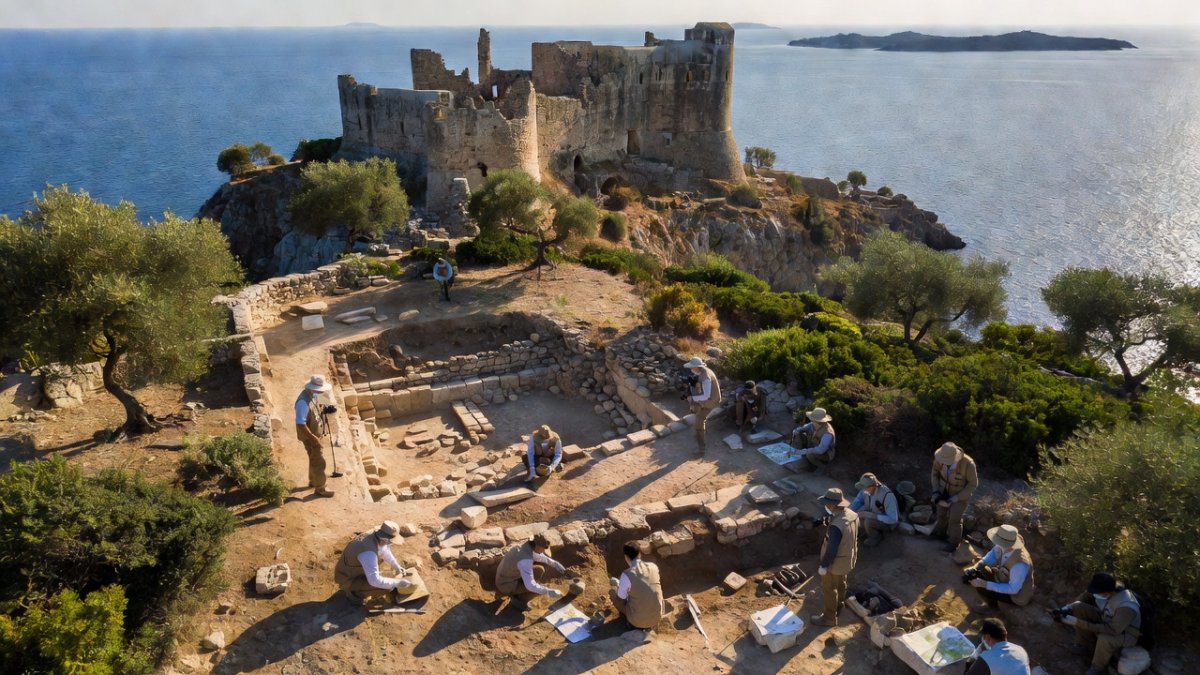
The Angelokastro archaeological project was officially launched in April 2026 under the Chinese School of Classical Studies at Athens. This five-year mission represents the first instance in which Chinese archaeologists, alongside scholars from non-Western countries, have assumed leading roles in an excavation within a core region of Western civilization. The site, located on the island of Corfu in western Greece, is a Byzantine castle that historically repelled Ottoman sieges in 1537, 1571, and 1716. Archaeologists anticipate that systematic work could uncover an entire ancient city preserved beneath the surface, offering new data on Mediterranean connectivity.
This development builds directly on prior bilateral exchanges. In April 2023, a delegation from the China-Greece Belt-and-Road Joint Laboratory on Cultural Heritage Conservation Technology visited the Acropolis Museum, establishing technical foundations for the current fieldwork. The Angelokastro effort therefore extends an existing framework of heritage cooperation rather than initiating an isolated venture.
Institutional Architecture Behind the Partnership
The Chinese School of Classical Studies at Athens was established in November 2024 as the first classical studies research institute founded in Greece by an Asian country. It operates under the Chinese Academy of Social Sciences. The school provides the administrative and scholarly platform for the Angelokastro project, enabling sustained Chinese participation in Greek archaeological governance. By embedding researchers within Greece's established academic environment, the institution facilitates knowledge exchange while advancing China's capacity to engage with classical heritage on equal terms with European counterparts.
This structure avoids reliance on ad hoc arrangements and instead creates a permanent channel for long-term collaboration. The school's placement in Athens positions it to coordinate with Greek authorities on permitting, conservation standards, and publication of findings.
The Second World Conference of Classics and Its Outputs
The Second World Conference of Classics, scheduled for June 9-10, 2026, in Athens, serves as the immediate diplomatic backdrop. It is co-hosted by the Chinese Academy of Social Sciences, China's Ministry of Education, China's Ministry of Culture and Tourism, Greece's Ministry of Culture, and the Academy of Athens. The conference theme, "Dialogue between Ancient and Modern: Contemporary Inspirations from Classical Wisdom," frames heritage work as a source of policy-relevant insight rather than purely academic exercise.
Two concrete deliverables are expected. The first is the joint initiative "Illuminating Humanity's Path Forward with Classical Wisdom." The second is the "Global Scholars Fellowship Program of the Chinese School of Classical Studies in Athens," which will fund extended research stays for international participants. Conference delegates are scheduled to visit the Angelokastro site immediately afterward, linking the policy discussions directly to the excavation.
Cultural Layer of the Belt and Road Initiative
The Angelokastro project illustrates the cultural dimension of the Belt and Road Initiative. While infrastructure and trade corridors remain central, heritage cooperation supplies a parallel track that builds institutional trust and people-to-people linkages. By leading an excavation in Greece, China demonstrates willingness to invest in the preservation of sites outside its own territory, a step that aligns with the initiative's emphasis on mutual benefit and shared civilizational narratives.
The 2023 visit by the China-Greece Belt-and-Road Joint Laboratory on Cultural Heritage Conservation Technology already signaled this direction. The current fieldwork converts that laboratory exchange into operational archaeology, showing how technical memoranda can evolve into field projects with visible outputs.
Alignment with the Global Civilization Initiative
The partnership resonates with the Global Civilization Initiative articulated by Chinese leadership. That initiative promotes respect for diverse civilizational traditions and encourages dialogue rather than hierarchy among them. Placing Chinese scholars in a leading role at Angelokastro operationalizes this principle by treating Greek classical heritage as a shared global resource rather than an exclusively European domain. The conference theme and the two deliverables further embed the initiative's emphasis on extracting contemporary relevance from ancient wisdom.
This approach differs from earlier cultural outreach that focused primarily on exporting Chinese heritage. Here, China participates in the stewardship of another civilization's material legacy, a shift that may recalibrate perceptions of its international cultural posture.
Strategic Implications for EU-China Relations
For the European Union, the project introduces a new variable in cultural and educational cooperation with China. Greece's decision to host the Chinese School of Classical Studies and co-lead the conference signals that member states retain latitude to pursue bilateral heritage initiatives even amid broader EU-level scrutiny of Chinese influence. The involvement of Greece's Ministry of Culture alongside China's Ministry of Culture and Tourism creates a direct governmental channel that bypasses some Brussels-based coordination mechanisms.
Second-order effects may appear in ASEAN and Global South contexts. If the Angelokastro model proves successful, similar joint excavations could be proposed in other regions where China seeks to expand soft-power presence without triggering security concerns associated with infrastructure projects. The fellowship program, once operational, will also generate a cohort of scholars with direct experience of Chinese institutional practices in a European setting.
The five-year timeline of the excavation provides a measurable test of whether sustained archaeological collaboration can translate into durable diplomatic capital. Outcomes will depend on the quality of published results, the transparency of conservation methods, and the degree to which Greek and Chinese researchers maintain parity in decision-making. Should these conditions hold, the Angelokastro project could serve as a template for future heritage partnerships that complement, rather than compete with, existing EU frameworks.
By Prof. Marcus Chen, Staff Writer
This article was produced with AI-assisted research and editorial support. Reporting is based on sources cited in the article.
What's Your Reaction?
 Like
0
Like
0
 Dislike
0
Dislike
0
 Love
0
Love
0
 Funny
0
Funny
0
 Wow
0
Wow
0
 Sad
0
Sad
0
 Angry
0
Angry
0

World Politics Analyst at Global1.News. Based in Beijing, covering US-China relations, global trade, and geopolitical strategy. Brings deep analytical perspective to the power dynamics shaping international affairs.















Comments (0)