
Wall Street Meets Main Street - Big Tech's AI Spending Is Getting Squeezed From Every Direction This Week
Big Tech's combined 25 billion in AI capex faces a test this week: Wall Street demands ROI as 142 coordinated data center protests erupt across 42 states. Allan Ali examines the convergence of financial and political pressure on AI infrastructure and what it means for hosting providers.
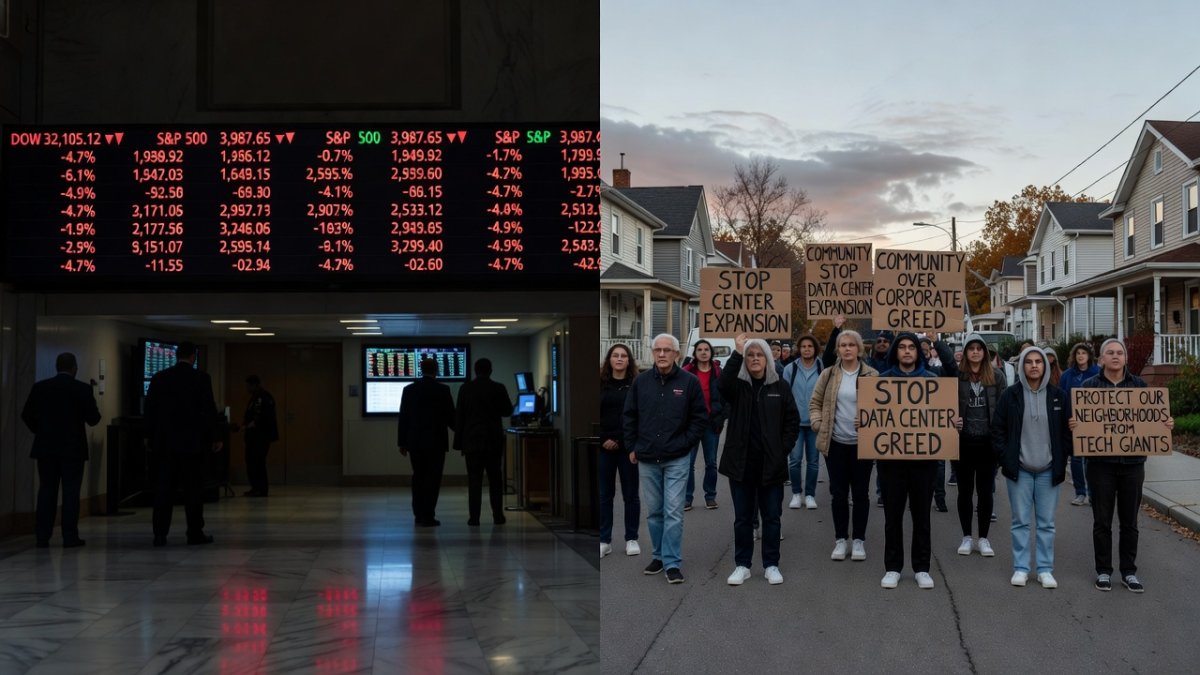
Wall Street Meets Main Street — Big Tech's AI Spending Is Getting Squeezed From Every Direction This Week
Let me tell you about a coincidence that isn't really a coincidence.
This week, Alphabet reports earnings on Wednesday. Microsoft and Meta follow next week. Apple and Amazon the week after. And in every single one of those calls, analysts are going to ask the same question: where's the return on $725 billion in AI capital expenditure?
But here's what makes this week different from every other earnings season in the last two years. While Wall Street is sharpening its knives over the ROI question, something else happened on Saturday that the earnings calls won't mention but every CEO in that suite knows about.
Saturday, July 18, 2026 — 142 coordinated protests across 42 states. A single coordinated day of action against data centers. From Wasilla, Alaska, to Naples, Florida. Eighteen protests in Texas alone. Organized by HumansFirst, a group led by former Tea Party leader Amy Kremer. Nonpartisan. Red states. Blue states. All saying the same thing: we don't want these things in our communities.
Two forces. Same target. Different directions. And they're both accelerating at the exact same time.
Big Tech Earnings Week 2026 — The Financial Squeeze
New York, NY — July 20, 2026 — Let's start with the numbers because the numbers are absurd even by Big Tech standards. The combined capital expenditure guidance from Alphabet, Amazon, Microsoft, and Meta for 2026 sits between $630 billion and $725 billion. That's a 62 to 77 percent increase over the approximately $410 billion the four companies spent last year. Which was itself a record year. Which was itself double the year before.
Alphabet reports this Wednesday, July 22. Analysts are expecting earnings per share of $2.88 on revenue of $113.63 billion. That's not the headline. The headline is that Alphabet's 2026 capex is expected to reach $187 billion — more than double last year's level. Amazon guided $200 billion. Meta's at $115 to $135 billion. Microsoft around $190 billion.
Jamie Dimon said on JPMorgan's Q2 earnings call that AI spending went from $400 billion globally last year to $700 billion this year, and he projects over a trillion next year. The CEO of the largest bank in America is calling this the biggest capital deployment cycle in history.
And the bond market is starting to blink. Amazon's trailing twelve-month free cash flow collapsed 95 percent to $1.2 billion. Long-term debt jumped from $65.6 billion to $119.1 billion year over year. The company is financing this buildout with borrowed money, and the market is noticing. A report from Curzio Research flagged that the bond market is "sending Big Tech a warning" as debt issuance for AI infrastructure climbs faster than revenue to support it.
This week's earnings calls are going to be a referendum on whether any of this spending is producing actual revenue. Not promises. Not "we're investing for the long term." Show me the cloud revenue growth. Show me the enterprise adoption. Show me something that isn't a GPU cluster sitting half-empty because the software ecosystem isn't ready yet.
Alphabet, in particular, is under the microscope. The company shed nearly $200 billion in market cap in June after a Gemini delay raised questions about its AI execution timeline. A $187 billion capex plan means you better deliver on your product roadmap. Wall Street is not patient, and it has not been impressed with the evidence so far.
The Data Center Revolt — The Physical Squeeze
Now let me tell you about the other squeeze happening at the same time.
Saturday's nationwide protests were the first coordinated day of action against AI data center buildout. One hundred and forty-two events across 42 states in a single day. That is not a fringe movement. That is not a few NIMBYs in one county. That is a national backlash that has gone from scattered local fights to an organized, coordinated opposition force in under twelve months.
HumansFirst, the group behind the protests, was founded by Amy Kremer — a veteran of the Tea Party movement who knows how to turn local anger into national political pressure. She compared the current effort to the Tea Party's early days in 2009. And she's not wrong about the parallels. The same frustration that fueled a grassroots political movement fifteen years ago is now being directed at data centers.
The group's message on Saturday was simple: "One nation united against data centers." Nonpartisan. Red and blue states equally represented. Eighteen protests in Texas, the state that has attracted the most data center development thanks to cheap land, available power, and business-friendly regulations. If Texas is turning on data centers, nowhere is safe.
The concerns are real and they're not going away. Individual AI data centers consume up to five million gallons of water per day for cooling. Electricity rates have jumped 267 percent over five years in some markets as utilities upgrade infrastructure to serve tech giants. Noise pollution from backup generators. Light pollution from 24/7 operations. Property value impacts in surrounding neighborhoods.
And the regulatory response is accelerating. By May 2026, local governments had enacted 78 data center restrictions — up from just 8 the previous year. Maine's legislature has approved what could be the first statewide ban on data center construction. Pennsylvania is considering a three-year moratorium on hyperscale facilities exceeding 5,000 servers. Twelve other states have filed data center moratorium bills in 2026.
On Saturday, that legislative momentum got a massive injection of public energy. Politicians in both parties now know there are votes in opposing data centers. And that changes the entire regulatory calculus.
The Secondary Bottleneck Nobody's Talking About — Community Consent
I've written before about the physical constraints on AI buildout — the GPU shortage, the power grid crisis, the cooling bottleneck. But what Saturday's protests make crystal clear is that community consent is becoming the binding constraint for the entire industry.
You can solve the GPU shortage. TSMC and Samsung are building fabs. You can solve the power crisis. New gas plants, nuclear restart, grid upgrades over the next decade. But you cannot solve community opposition with more money or better engineering. Once a town decides it doesn't want a data center, you're looking at years of legal battles, zoning fights, and ballot initiatives.
And the hyperscalers have been terrible at managing this. They buy land through shell companies. They announce projects to the public after contracts are signed. They promise jobs that never materialize — data centers employ 30 to 50 people once operational, not the thousands that communities imagine. The gap between what hyperscalers promise and what they deliver is a propaganda gift to the opposition.
The secondary bottleneck here is not physical or financial — it is political. And it may be the hardest one to solve because it requires something the hyperscalers have never shown: genuine community partnership rather than transactional land acquisition.
What This Actually Means for Independent Hosting Providers
If you're running an independent hosting business, this convergence of financial and political pressure on hyperscaler buildout is not just a spectator sport. It directly affects your business in four ways.
First — The customer repatriation window just got wider. Every CIO who watches this earnings week and sees the capex numbers will ask the same question: am I paying for this? If hyperscalers have to raise prices to justify a $725 billion capex line item, and they will, the cost gap between AWS/Azure and independent hosting widens. The 86 percent of CIOs already considering repatriation — that number is about to go higher.
Second — Regulatory uncertainty is a competitive moat. If Maine bans data centers and Pennsylvania imposes a moratorium, hyperscalers can't build there. But hosting providers don't need new data center construction. You can lease existing colo space. You can use older, less power-hungry facilities. The regulatory environment that blocks new hyperscale campuses doesn't block you — it protects your existing inventory from being undercut by subsidized hyperscaler capacity.
Third — The "local provider" narrative gets stronger every time a protest happens. When 142 communities across 42 states protest data centers, the contrast between a hyperscaler megacampus and your local hosting operation becomes a selling point. You're not building a 100-megawatt facility that drinks five million gallons of water. You're in an existing building, with existing power connections, employing local people. That story writes itself.
Fourth — Power pricing volatility is coming for everyone, but hyperscalers feel it more. The same utility cost increases that make data center economics harder for hyperscalers affect everyone on the grid. But hyperscalers are building with projected 20-year power cost assumptions. If those costs spike — and they will, given the grid investment needed — their entire business case breaks. Your shorter lease cycles and flexible power arrangements position you better for a volatile market.
The Structural Reality — This Squeeze Is Just Getting Started
The financial squeeze and the physical squeeze are independent forces, but they reinforce each other in ways that make the combined effect worse than either alone.
If hyperscalers can't show ROI this earnings season, their stock drops. When stock drops, capital for new construction gets harder to raise. But the community backlash is making construction harder anyway — harder permitting, longer timelines, more legal costs. Higher costs make ROI even harder to achieve. It's a self-reinforcing cycle that pulls in both directions.
Saturday's protests are not a one-day event. HumansFirst is already planning more. The Maine ban is likely to pass. Other states will follow. And every new restriction makes the existing data center footprint more valuable, which means the hyperscalers will fight harder for the sites they already have — driving up land prices, power costs, and community friction even further.
The bond market is sending a signal. The voting booth is sending a signal. The street — literally, 142 streets across 42 states — is sending a signal. The question is whether the CEOs making $725 billion in spending decisions are listening.
The Bottom Line
This week is going to be a stress test for the entire AI infrastructure thesis. If Alphabet reports strong cloud revenue and guides higher, the bulls get their narrative back. But if the numbers disappoint — and the data center revolt keeps making headlines — the AI capex cycle is going to look a lot less like a supercycle and a lot more like a sugar high that hit the wall of reality.
For independent hosting providers, this is the opportunity you've been waiting for. The hyperscalers are getting squeezed from both directions. Their costs are going up, their financing is getting harder, their regulatory environment is getting worse, and their community relations are in freefall. Every one of those pressures is an opening for the kind of hosting that actually listens to its customers, its communities, and its local economies.
The GPU shortage gets the headlines. The power grid crisis gets the policy papers. But the pincer movement of Wall Street and Main Street — that's what's going to define the next phase of AI infrastructure. And it starts this week.
Pay attention. And plan accordingly.
— Allan Ali, Founder
This article was produced with AI-assisted research and editorial support. Reporting is based on sources cited in the article.
What's Your Reaction?
 Like
0
Like
0
 Dislike
0
Dislike
0
 Love
0
Love
0
 Funny
0
Funny
0
 Wow
0
Wow
0
 Sad
0
Sad
0
 Angry
0
Angry
0

Publisher of Global1.News. Automation architect, systems builder, and the guy making sure the truth gets published.












Comments (0)