
Comfort Women Statue Freed After Six-Year Barricade in Seoul
The April 2026 Barricade Removal at the Statue of Peace On 1 April 2026, Seoul police temporarily dismantled the barricade surrounding the Statue of Peace, located near the former Japanese Embassy site in central Seoul. This marked the first such removal since the structure was erected in June 2020. The action occurred ahead of the weekly activist rally and followed the recent detention of a far-right group leader on defamation charges.
The April 2026 Barricade Removal at the Statue of Peace
On 1 April 2026, Seoul police temporarily dismantled the barricade surrounding the Statue of Peace, located near the former Japanese Embassy site in central Seoul. This marked the first such removal since the structure was erected in June 2020. The action occurred ahead of the weekly activist rally and followed the recent detention of a far-right group leader on defamation charges. Police indicated that the barricade would be lifted each Wednesday throughout April and signaled consideration of a permanent removal by month’s end.
The detention of far-right activist Kim Min-seok on 28 March 2026 for repeated online defamation of surviving victims marked a turning point in enforcement. Prosecutors cited Article 307 of the Criminal Act alongside the new National Assembly defamation statute, arguing that sustained harassment campaigns had chilled public discourse. Police records show that similar complaints filed between 2021 and 2024 had been dismissed for lack of evidence; the 2026 case succeeded because digital forensics linked Kim directly to coordinated bot networks amplifying false claims about victim compensation.
Seoul Metropolitan Police Agency officials justified the barricade removal through updated risk assessments that incorporated both crowd-density modeling and intelligence on potential counter-protests. Internal memos released under the Information Disclosure Act reveal that the force had maintained the barrier since 2020 primarily to prevent physical clashes between nationalist groups and civic organizations. The April policy shift reflects a broader recalibration following the Lee administration’s directive to prioritize “proportional public-order management” at historical sites.
Comparisons with earlier periods underscore the novelty of this approach. Between 2011 and 2016, the site operated without physical barriers despite frequent Japanese diplomatic protests. After 2019, however, successive conservative and progressive administrations tolerated incremental fortification. The 2026 decision therefore represents the first explicit reversal of that trend, testing whether procedural openness can coexist with heightened legal protections for victims.
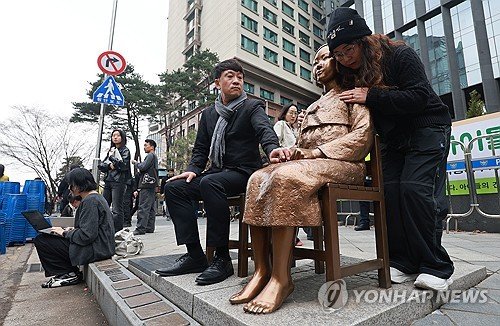
Colonial History and the Scale of Wartime Sexual Slavery
Korea remained under Japanese colonial rule from 1910 to 1945. During World War II, historians estimate that up to 200,000 women, the majority Korean, were forced into front-line military brothels. As of April 2026, only five government-registered survivors remained alive, with an average age of 95 and the oldest aged 97. These demographic realities underscore the narrowing window for direct testimony and the increasing reliance on archival and civic records.
Survivor Kim Bok-dong, who passed away in 2019 at age 92, testified before the UN Human Rights Council in 2016 that she was abducted at 14 and subjected to daily sexual violence for three years across multiple theaters. Her detailed account, corroborated by Japanese military documents discovered in the 1990s, helped shift international framing from “comfort women” to “wartime sexual slavery.” Similar testimonies from Gil Won-ok and Lee Yong-soo continue to anchor educational programs at the War and Women’s Human Rights Museum in Seoul.
The Wednesday Demonstration, launched on 8 January 1992, has now exceeded 1,600 consecutive weekly gatherings. Organized initially by the Korean Council for the Women Drafted for Military Sexual Slavery by Japan, the rallies have evolved into a hybrid physical-digital platform, with live streams reaching diaspora communities in Los Angeles and Osaka. Attendance data collected by the Council show a gradual decline from peak figures of 1,200 participants in the mid-1990s to roughly 300 in 2025, reflecting both survivor mortality and pandemic restrictions.
Institutional memory is preserved through the Council’s extensive archive of 1,200 victim affidavits and 800 hours of oral-history recordings. These materials have been deposited at the National Archives of Korea and selected for UNESCO’s Memory of the World Register nomination, illustrating how civic organizations have assumed curatorial responsibilities once the state proved reluctant to confront Tokyo directly.
The Statue’s Installation and Global Proliferation
The Statue of Peace, also known as the Sonyeosang, was first erected in December 2011 directly in front of the Japanese Embassy in Seoul. Comparable monuments have since appeared in the United States, Canada, Australia, Germany, and Italy. Each installation has served as a focal point for transnational memory activism while simultaneously provoking diplomatic friction with Tokyo.
The Glendale, California statue, unveiled in 2013, survived multiple lawsuits brought by Japanese-American plaintiffs and remains protected under First Amendment jurisprudence. In Berlin, a 2020 monument in Mitte district was installed after the city council overrode objections from the Japanese embassy, citing Germany’s own Vergangenheitsbewältigung obligations. An additional statue in the Italian city of Vicenza, dedicated in 2022, was funded entirely by Korean diaspora remittances and local feminist collectives.
Japanese government responses have ranged from formal diplomatic notes to economic pressure. In 2015, Tokyo threatened to withhold support for the UNESCO World Heritage listing of Sites of Japan’s Meiji Industrial Revolution unless Korean comfort-women references were minimized. Diaspora communities in the United States and Europe have countered these efforts by establishing sister-city resolutions and curriculum-adoption campaigns, effectively creating a parallel diplomatic track outside state-to-state channels.
Diplomatic Context Under Successive Administrations
The 2015 bilateral agreement saw Japan contribute one billion yen to a reconciliation fund. The Moon Jae-in administration dismantled that framework in 2018. President Lee Jae-myung has adopted a dual-track policy that sustains pressure on unresolved historical grievances while expanding security and economic cooperation with Japan. The National Assembly’s recent passage of legislation criminalizing defamation of wartime sexual slavery victims further institutionalizes this stance.
The 2015 “final and irreversible” deal allocated 100 million yen per surviving victim but was rejected by 33 of the 47 registered survivors at the time. Moon’s 2018 decision to dissolve the Reconciliation and Healing Foundation and return the remaining funds to Japan reopened the legal pathway for individual lawsuits. Lee’s administration has maintained this posture while quietly resuming GSOMIA intelligence-sharing and trilateral naval exercises with the United States.
The May 2025 Lee-Takaichi summit in Tokyo produced a joint statement on supply-chain resilience yet conspicuously omitted any reference to historical issues. Japanese media interpreted the omission as tacit acceptance of the 2015 framework; Korean civil-society groups countered with street demonstrations. Meanwhile, the National Assembly’s defamation bill, passed in March 2026, imposes fines up to 30 million won and potential imprisonment for knowingly disseminating false statements about victims, aligning domestic law with international human-rights standards.
Civic Activism and Weekly Rallies
Activist groups have maintained uninterrupted Wednesday demonstrations at the site since 2011. On 1 April 2026, participants responded with quiet applause as the barricade was lifted. The temporary measure reflected both improved public-order assessments and the deterrent effect of the defamation-related detention. Yonhap News Agency coverage of the event, later featured in the 7 May 2026 KOREA NOW broadcast, documented these measured public reactions.
The generational transition within the movement is evident in leadership changes at the Korean Council. Since 2023, the organization has been co-chaired by second-generation activists who emphasize digital archiving and intersectional linkages with #MeToo and climate-justice campaigns. This shift has broadened participation among university students while preserving the ritual of handing flowers to the statue each Wednesday.
Survivor aging has prompted new commemorative practices. The Council now records “legacy testimonies” in which family members recount stories on behalf of deceased victims, ensuring continuity. Attendance at the 1,600th demonstration in January 2026 included representatives from 14 countries, underscoring the event’s transformation from local protest into a global human-rights pilgrimage.
Forward-Looking Analysis of Korea-Japan Relations
Any permanent removal of the barricade would constitute a limited procedural adjustment rather than a resolution of the underlying bilateral dispute. The comfort women issue continues to intersect with parallel controversies over forced labor during the colonial period. Under the Lee administration, Seoul appears prepared to calibrate historical accountability measures alongside pragmatic cooperation in areas such as supply-chain resilience and regional security. Observers will monitor whether the April 2026 precedent leads to sustained open access or reverts under renewed political pressure.
Two plausible scenarios emerge. In the first, incremental normalization occurs through quiet diplomacy, with both governments focusing on economic security while allowing civic actors to manage memory politics. In the second, renewed nationalist mobilization in either country—perhaps triggered by the Sado Island gold-mine UNESCO nomination—could prompt re-installation of barriers and renewed legal friction.
The Sado mines dispute, scheduled for UNESCO review in 2027, directly links wartime forced labor to the comfort-women question. Korean diplomats have signaled that any Japanese narrative minimizing Korean conscript suffering will be met with renewed emphasis on sexual slavery documentation, illustrating how discrete heritage controversies remain entangled within a single historical memory regime.
International Law
United Nations treaty bodies have repeatedly classified Japan’s wartime sexual slavery system as a violation of international humanitarian law. The CEDAW Committee’s 2016 concluding observations urged Japan to accept full legal responsibility and provide adequate reparations, a recommendation reiterated in 2022. These findings place the comfort-women issue within the broader framework of state responsibility for systematic gender-based violence during armed conflict.
The 2000 Women’s International War Crimes Tribunal on Japan’s Military Sexual Slavery, though non-binding, established a precedent for civil-society adjudication when state mechanisms fail. Its judgment, citing the Hague and Geneva Conventions, concluded that Japan bore continuing obligations toward survivors. Subsequent UN Special Rapporteur reports have reinforced this view, emphasizing that statutes of limitations cannot extinguish claims arising from crimes against humanity.
Korea’s 2026 defamation legislation aligns domestic criminal law with these international standards by protecting victim dignity and historical truth. Legal scholars note that the statute mirrors provisions in German memory laws concerning Holocaust denial, suggesting a comparative model for addressing state-sponsored historical revisionism through targeted speech restrictions rather than blanket censorship.
By Prof. David Park, Staff WriterThis article was produced with AI-assisted research and editorial support. Reporting is based on sources cited in the article.
What's Your Reaction?
 Like
0
Like
0
 Dislike
0
Dislike
0
 Love
0
Love
0
 Funny
0
Funny
0
 Wow
0
Wow
0
 Sad
0
Sad
0
 Angry
0
Angry
0
East Asia/Technology Correspondent at Global1.News. Seoul-based voice covering Korean politics, technology, business, and culture. Analyzes how technology and geopolitics intersect across East Asia.














Comments (0)