
Amazon Deforestation Hits Decade Low as Soy Moratorium Ends
Satellite monitoring this week captured a rare victory for the Amazon as deforestation plunged to its lowest level in a decade, yet the Soy Moratorium's unraveling threatens to erase those hard-won gains and expose Latin America's forests to renewed soy-driven destruction. Industry pressure and legislative moves in Brasília are dismantling the very safeguards that made this progress possible, placing the region's climate stability and local communities at risk once more.
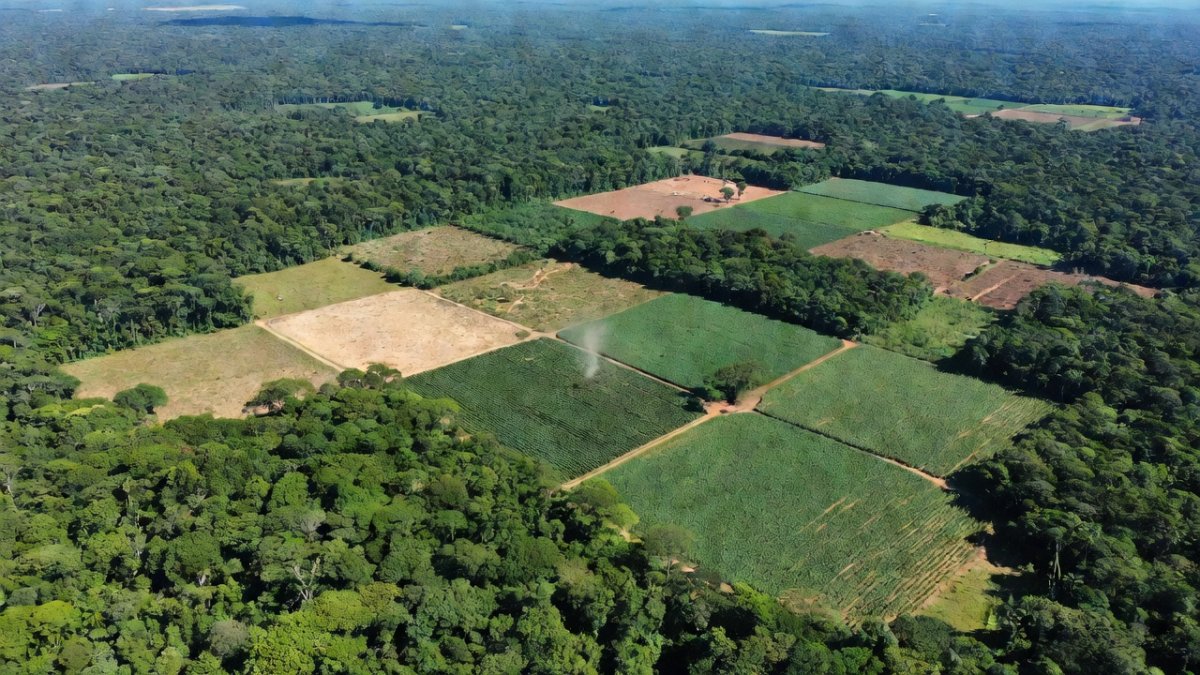
Satellite monitoring this week captured a rare victory for the Amazon as deforestation plunged to its lowest level in a decade, yet the Soy Moratorium's unraveling threatens to erase those hard-won gains and expose Latin America's forests to renewed soy-driven destruction. Industry pressure and legislative moves in Brasília are dismantling the very safeguards that made this progress possible, placing the region's climate stability and local communities at risk once more. The tension between short-term agricultural profits and long-term forest protection has rarely felt more urgent.
Amazon Deforestation Hits Decade Low as Soy Moratorium Collapse Looms
Brasília, Brazil — Brazil's Amazon rainforest has reached its lowest deforestation rate in ten years, with INPE satellite data showing a 38 percent drop in the first half of 2026. But the collapse of the Soy Moratorium and legislative threats to enforcement agencies threaten to reverse this progress, potentially unleashing a new wave of forest clearing across the Amazon basin.
Record Low Deforestation Figures
In the heart of the Brazilian Amazon, satellite eyes from INPE have captured a rare glimmer of hope amid years of environmental strain. Deforestation rates plunged 38 percent in the first six months of 2026 compared to the previous year, marking the lowest levels seen in a decade. Yet this progress hangs precariously as the Soy Moratorium unravels, with major industry players pulling back from commitments that have long protected vast tracts of rainforest. The stakes extend far beyond Brazil's borders, touching global climate goals and the livelihoods of communities across Latin America.
INPE satellite monitoring recorded 1,295 square kilometers of deforestation across the Brazilian Amazon from January through June 2026. That figure represents a sharp decline from the 2,090 square kilometers cleared during the same period in 2025. The data, drawn from Landsat and additional sensors during the dry season, places current rates at their lowest point in ten years. These numbers reflect strengthened monitoring and control mechanisms that have taken hold since the shift in federal administration.
Industry Pressure Ends the Soy Moratorium
Abiove, the Brazilian Association of Vegetable Oil Industries, has moved to exit the Soy Moratorium that once barred signatories from purchasing soy grown on Amazon land cleared after July 2008. Aprosoja Brasil, the soybean producers association, had applied sustained pressure for years to dismantle the agreement. The moratorium had functioned as a voluntary supply-chain safeguard that limited expansion into newly deforested areas. Its collapse removes a key barrier that helped stabilize forest cover in states such as Mato Grosso and Pará.
Legislative Threats to Enforcement Agencies
A bill now before Congress would restrict the operational reach of IBAMA and ICMBio, Brazil's primary environmental enforcement bodies. Civil society organizations have warned that the measure risks undermining Brazil's environmental credibility at a moment when deforestation numbers finally show improvement. The Conversation report notes that the recent decline stems largely from stronger monitoring, yet that foundation could be eroded by limits placed on field inspections and fines. Such changes would directly affect daily operations in remote Amazon municipalities where enforcement already faces logistical challenges.
In remote Amazon municipalities such as Altamira, São Félix do Xingu, and Novo Progresso, IBAMA and ICMBio agents have long operated under severe logistical constraints, relying on sporadic helicopter deployments and riverine patrols that can take weeks to reach illegal clearings. The proposed bill would strip these agencies of their authority to issue immediate embargoes on properties caught in active deforestation, limit the use of real-time satellite alerts for on-site inspections, and cap the value of administrative fines at levels far below current market incentives for soy expansion. Collection rates for environmental fines already hover below 5 percent in these regions, a pattern that worsened during the Bolsonaro administration when budgets for field operations were slashed by nearly 40 percent between 2019 and 2022, allowing violators to treat penalties as negligible business costs rather than deterrents.
From a regional Latin American perspective, these restrictions echo similar legislative maneuvers in Bolivia and Peru, where weakened enforcement bodies enabled soy and cattle frontiers to advance across shared border ecosystems. Historical data from INPE shows that fine issuance in Pará alone dropped from 8,200 notices in 2018 to under 3,000 by 2021 under Bolsonaro-era cuts, with collection remaining stagnant due to judicial backlogs. The current bill risks repeating this cycle precisely when 2026 monitoring gains have begun to restore credibility, potentially isolating Brazil from EU trade frameworks that now tie market access to verifiable enforcement capacity.
Projected Scale of Additional Forest Loss
Scientists project that the moratorium's end could trigger 1.4 million hectares of extra deforestation by 2035. This amount equals a 17 percent increase over the total deforestation recorded in the preceding decade. The associated carbon emissions would match Canada's annual output, amplifying Brazil's contribution to global greenhouse gases. Aprosoja Brasil has pointed to a 37.5 percent drop in Amazon deforestation alerts between August 2025 and May 2026 as evidence that market forces alone can suffice, yet independent analyses question whether those short-term alert reductions will hold without supply-chain restrictions.
When the Soy Moratorium ends, the primary mechanism driving new deforestation will be the removal of supply-chain traceability requirements, allowing traders to purchase soy from recently cleared Amazon plots without reputational or contractual penalties. This shift is projected to accelerate clearing most sharply in Mato Grosso's northern municipalities, Pará's BR-163 corridor, and Rondônia's expanding agricultural zones, where land prices remain low enough to attract large-scale investors. The 1.4 million hectare projection by 2035 represents roughly 28 percent of the current total soy area inside the Brazilian Amazon biome, an expansion that would convert carbon-rich forests at rates exceeding the 2019-2020 Bolsonaro peak in localized hotspots.
Concrete emissions modeling equates this additional loss to Canada's entire annual greenhouse-gas output of approximately 670 million tonnes of CO2 equivalent, releasing stored carbon through both direct burning and soil disturbance. Neighboring countries such as Bolivia's Santa Cruz department and Peru's Madre de Dios region would face spillover effects as displaced cattle ranching migrates across porous borders, undermining regional climate commitments made at COP summits. Independent analyses from Brazilian research institutes indicate that without moratorium-style safeguards, even short-term alert reductions observed in 2025-2026 are unlikely to persist once market signals favor frontier expansion over compliance.
Historical Shifts Under Successive Administrations
Deforestation climbed steadily during the Bolsonaro years as enforcement budgets shrank and rhetoric favored agricultural expansion. Rates began to fall after Lula's return to office, supported by renewed funding for INPE monitoring and coordinated action with state governments. The current 38 percent reduction builds on that trajectory, yet it remains vulnerable to policy reversals at the federal level. Communities in Acre and Rondônia, where smallholder farmers and indigenous territories border soy frontiers, have already felt the tension between export revenues and forest protection.
Deforestation during the Bolsonaro peak reached 11,088 square kilometers in 2019 and 10,851 square kilometers in 2020, figures that represented a 34 percent increase over the prior administration's average. In contrast, the first half of 2026 recorded just 1,295 square kilometers, reflecting renewed federal funding for INPE monitoring and joint operations with state environmental secretariats in Acre and Amazonas. International pressure played a decisive role: the EU-Mercosur trade agreement negotiations and COP26 commitments prompted Lula's government to restore enforcement budgets and re-engage with Amazon Fund donors, reversing the rhetorical and budgetary hostility that characterized the 2019-2022 period.
State governments have often diverged from federal policy, with Mato Grosso implementing its own traceability programs while Pará lagged until federal incentives aligned priorities. Indigenous territories have contributed substantially to the recent decline, with areas under formal protection showing deforestation rates up to 80 percent lower than surrounding non-titled lands, according to 2025 monitoring data. This territorial safeguard, strengthened through renewed demarcation processes, offers a scalable model for other Amazon basin nations facing similar commodity-driven pressures, though its durability depends on sustained federal-state coordination rather than episodic international attention.
Regional Stakes for Latin American Stability
Brazil's Amazon decisions ripple through neighboring countries that share river systems and trade corridors. A surge in emissions from renewed clearing would complicate regional climate targets and affect agricultural planning in Bolivia and Peru. Local economies tied to sustainable timber, ecotourism, and non-timber forest products stand to lose ground if large-scale soy expansion resumes unchecked. The interplay between federal legislation, producer associations, and satellite-verified data will determine whether the 2026 gains endure or give way to renewed clearing across the basin.
By Elena Vasquez, Staff WriterThis article was produced with AI-assisted research and editorial support. Reporting is based on sources cited in the article.
What's Your Reaction?
 Like
0
Like
0
 Dislike
0
Dislike
0
 Love
0
Love
0
 Funny
0
Funny
0
 Wow
0
Wow
0
 Sad
0
Sad
0
 Angry
0
Angry
0

Latin America Correspondent at Global1.News. Based in Mexico City, covering politics, economics, energy, and culture across the region. Brings an on-the-ground perspective to stories spanning from the Rio Grande to Patagonia.












Comments (0)