
BSP projects May inflation at 7.1% to 7.9% amid food, forex pressures
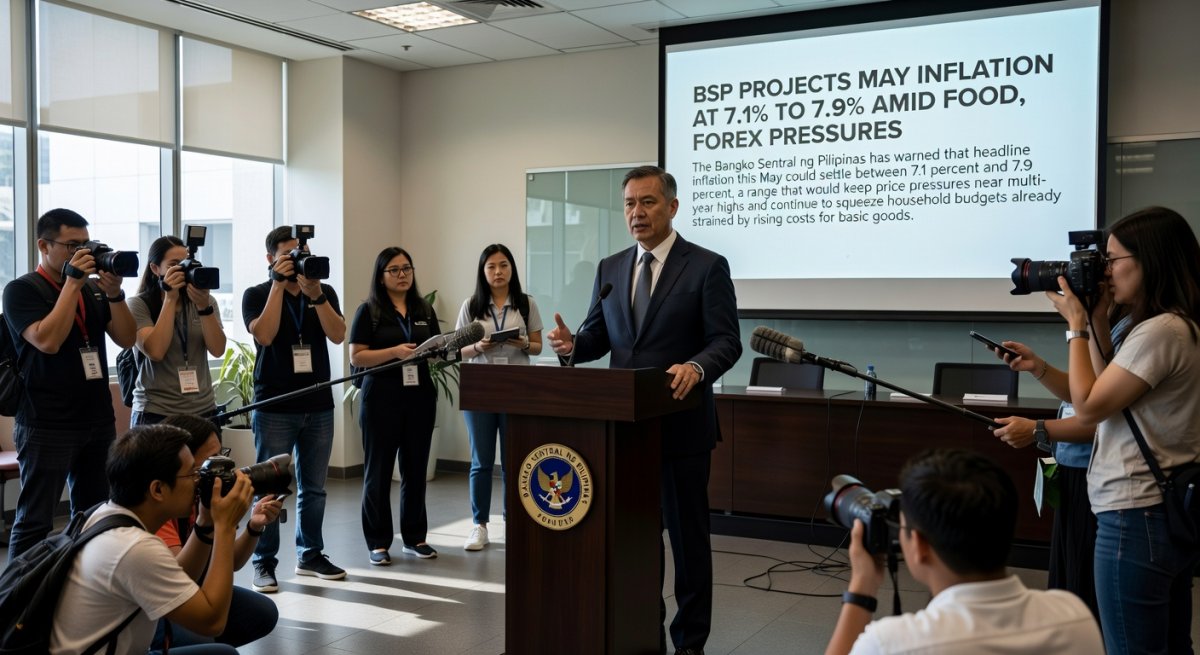
The Bangko Sentral ng Pilipinas has warned that headline inflation this May could settle between 7.1 percent and 7.9 percent, a range that would keep price pressures near multi-year highs and continue to squeeze household budgets already strained by rising costs for basic goods. The central bank’s projection points directly to two persistent forces—elevated food prices and the peso’s depreciation—as the main drivers pushing consumer costs higher at a moment when many families are still adjusting to the cumulative effects of earlier price spikes.
This outlook matters because inflation at these levels erodes real incomes, raises the cost of borrowing, and complicates efforts to sustain economic recovery. When food items that form the core of the typical Filipino diet become more expensive, the impact is felt most sharply by lower- and middle-income households that allocate a larger share of spending to staples. At the same time, a weaker peso increases the price of imported inputs used in local production, feeding through to final consumer prices and complicating the central bank’s task of anchoring expectations.
Drivers of the Projected Increase
The Bangko Sentral ng Pilipinas attributes the anticipated May outcome primarily to continued upward movement in food prices alongside the effects of peso depreciation. Food inflation has remained elevated for several months, reflecting supply constraints, weather-related disruptions, and higher input costs that have not yet fully eased. These pressures are compounded by currency movements: when the peso loses value against major trading partners’ currencies, imported commodities and raw materials become costlier in local terms, raising production expenses across a range of sectors. The combination of these factors creates a feedback loop. Higher food prices directly lift the consumer price index, while peso weakness amplifies the cost of imported components used in food processing, transportation, and packaging. The central bank’s range forecast reflects uncertainty around the precise timing and magnitude of these influences, yet the direction is clear: without a meaningful reversal in either driver, inflation is likely to remain above the government’s target band for an extended period.Background and Economic Context
Inflation has been a dominant policy concern in recent years as global supply-chain frictions, energy-price volatility, and domestic agricultural challenges converged. The Bangko Sentral ng Pilipinas operates under an inflation-targeting framework that aims to keep headline inflation within a range centered on 3 percent, plus or minus one percentage point. When actual or projected inflation moves well above the upper bound, the central bank faces difficult trade-offs between supporting growth and restoring price stability. Food items carry substantial weight in the Philippine consumer price basket, so sustained increases in this category exert outsized influence on the overall index. Meanwhile, the peso’s external value affects both imported inflation and expectations about future price trends. Depreciation can also influence capital flows and debt-servicing costs for entities with foreign-currency obligations, adding another layer of complexity for monetary authorities. These dynamics are not unique to the current period, yet the persistence of both food and currency pressures has kept inflation expectations from fully normalizing. Households and businesses alike adjust their behavior when they anticipate continued price increases—postponing purchases, seeking wage adjustments, or passing on higher costs—potentially entrenching the very pressures the central bank seeks to moderate.Implications for Households and Businesses
For ordinary consumers, inflation in the 7.1-to-7.9-percent range translates into noticeably higher weekly or monthly expenditures on food and other essentials. Staples such as rice, vegetables, meat, and fish become less affordable, forcing difficult choices about quantity and quality. Lower-income families, which already devote a larger proportion of income to food, experience a sharper reduction in purchasing power and may cut back on non-food items or draw down savings. Businesses face parallel challenges. Elevated input costs squeeze margins unless they can be passed on to customers, yet weak demand can limit pricing power. Firms reliant on imported machinery, packaging, or intermediate goods see their operating expenses rise in tandem with peso movements. Over time, persistent inflation can also distort investment decisions, as uncertainty about future costs discourages long-term planning. The broader economy feels these effects through slower consumption growth and potential delays in private investment. When inflation expectations remain unanchored, wage negotiations and contract pricing become more contentious, adding friction to labor markets and supply chains.Policy Considerations and the Path Forward
The Bangko Sentral ng Pilipinas has consistently signaled that it will continue to monitor incoming data closely and adjust policy settings as needed to bring inflation back toward the target range. While the precise sequence of future actions will depend on the evolution of food prices, currency movements, and global conditions, the central bank’s mandate requires vigilance against second-round effects that could prolong high inflation. Government agencies responsible for agriculture and trade are also expected to address supply-side constraints that contribute to food-price volatility. Measures that improve logistics, reduce post-harvest losses, and stabilize key commodity markets can complement monetary-policy efforts by easing the very pressures now pushing the inflation forecast higher. Looking ahead, the May outcome will provide an important data point for assessing whether the current combination of food and currency pressures is peaking or continuing to build. Subsequent inflation prints, together with updates on the peso’s external value and global commodity trends, will shape expectations about the duration of elevated price pressures and the policy responses required to restore balance. The central bank’s willingness to communicate its assessment transparently remains essential for guiding both market participants and the public through this period of adjustment.By Bella Reyes, Staff Writer
This article was produced with AI-assisted research and editorial support. Reporting is based on sources cited in the article.
What's Your Reaction?
 Like
0
Like
0
 Dislike
0
Dislike
0
 Love
0
Love
0
 Funny
0
Funny
0
 Wow
0
Wow
0
 Sad
0
Sad
0
 Angry
0
Angry
0

Isabella "Bella" Reyes
Philippines/Southeast Asia Correspondent at Global1.News. Manila-based journalist covering Philippine politics, environment, maritime security, and social issues. Passionate about marine conservation and the communities protecting the Philippines' natural heritage.














Comments (0)