
Japan Achieves First Hover Test of RV-X Reusable Rocket
**Keywords:** JAXA, RV-X, reusable rocket, Mitsubishi Heavy Industries, Noshiro Testing Centre, Japan space program, H3 rocket successor, reusable launch vehicle Japan Achieves First Hover Test of RV-X Reusable Rocket On Saturday, Japan conducted the first test flight of its experimental reusable rocket RV-X at JAXA's Noshiro Testing Centre in Akita Prefecture. The short-durati
Japan Achieves First Hover Test of RV-X Reusable Rocket
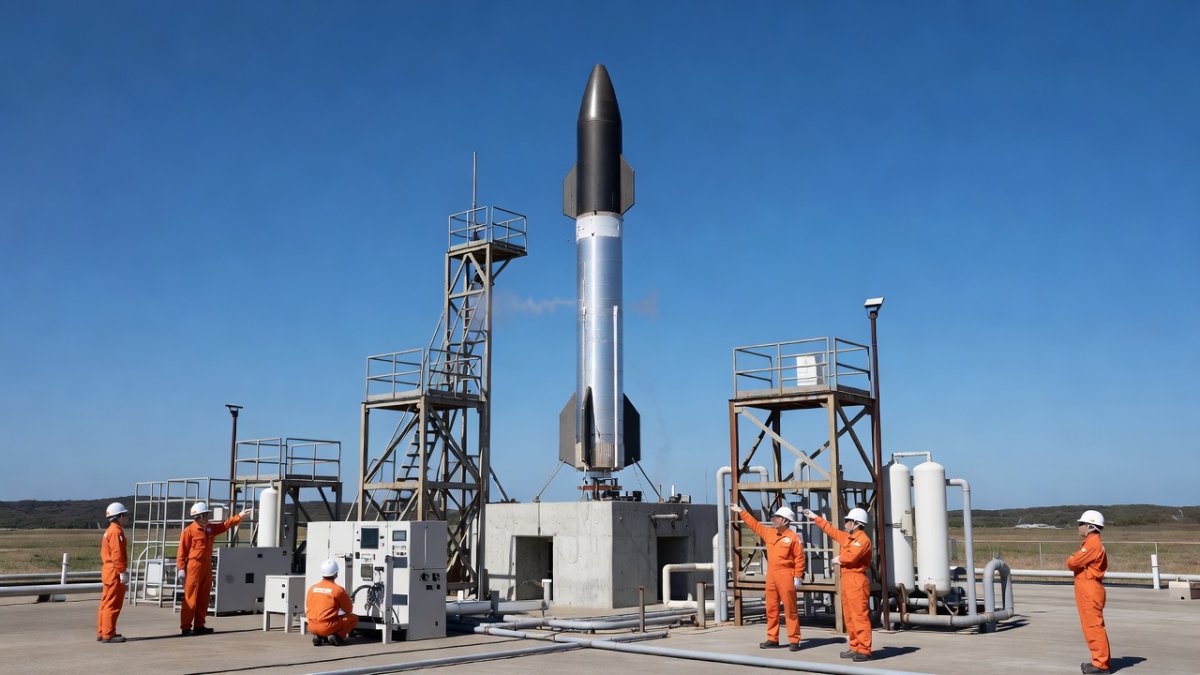
On Saturday, Japan conducted the first test flight of its experimental reusable rocket RV-X at JAXA's Noshiro Testing Centre in Akita Prefecture. The short-duration flight demonstrated controlled lift-off, horizontal movement, and safe landing, marking a concrete step toward reusable launch systems developed jointly by JAXA and Mitsubishi Heavy Industries.
Tags: JAXA, RV-X, reusable rocket, Mitsubishi Heavy Industries, Noshiro Testing Centre, Japan space program
Sequence of the Saturday Test Flight
The RV-X lifted off, hovered briefly, translated horizontally, and touched down without incident. The entire flight lasted less than one minute and reached a maximum height of approximately 10 meters. These parameters were confirmed through telemetry and video from the Noshiro site. The test was live-streamed by the space fan group NVS, allowing public observation of the vehicle's performance in real time. JAXA is scheduled to present detailed results during an online briefing later on Saturday.
Technical Specifications and Design Features
The RV-X measures 1.8 meters in diameter and 7.3 meters in length. It incorporates improved-durability engines and four shock-absorbing landing gear legs engineered for repeated operations. These features directly address the engineering requirements for vertical takeoff and landing profiles that reduce structural stress during recovery. All dimensions and subsystem details align with the joint JAXA–Mitsubishi Heavy Industries development baseline.
Japan-Specific Development Context
The RV-X program is anchored in Japan's national space infrastructure, with JAXA providing oversight and Mitsubishi Heavy Industries responsible for propulsion and structural integration. The effort connects to broader policy priorities that emphasize domestic launch capability. Japanese government assessments highlight competitive space transportation as essential for both the civil space program and national security objectives, ensuring independent access to orbit without reliance on foreign providers.
Purpose: Lower-Cost Successor to the H3 Rocket
The immediate objective of the RV-X campaign is to mature technologies that will enable a lower-cost, partially reusable successor to the current H3 single-use rocket. By demonstrating controlled recovery at low altitude, the program gathers data on engine reusability and landing dynamics that will inform larger-scale vehicles. This incremental approach mirrors Japan's established practice of validating subsystems before scaling to orbital demonstrations.
Future Test Campaign and Altitude Progression
Following the successful Saturday flight, JAXA and Mitsubishi Heavy Industries plan a series of incremental tests that will progressively increase altitude, with the next milestones targeting flights up to 100 meters. Each step will collect additional data on guidance, navigation, and landing gear performance under varying conditions while remaining within the controlled environment of the Noshiro Testing Centre.
International Timing and Regional Developments
The Saturday test occurred one day after China achieved its first successful recovery of a rocket first stage. While the Japanese flight remained at low altitude, it nevertheless represents an independent national milestone achieved through domestic institutions. Japan is also engaged in parallel reusable-rocket cooperation with France and Germany, complementing the JAXA–Mitsubishi Heavy Industries track and reinforcing multilateral technology exchange within a Japan-led framework.
By Kenji Tanaka, Staff Writer
This article was produced with AI-assisted research and editorial support. Reporting is based on sources cited in the article.
What's Your Reaction?
 Like
0
Like
0
 Dislike
0
Dislike
0
 Love
0
Love
0
 Funny
0
Funny
0
 Wow
0
Wow
0
 Sad
0
Sad
0
 Angry
0
Angry
0

Japan Correspondent at Global1.News. Tokyo-based voice covering Japanese politics, technology, economy, and culture. Tracks the intersection of tradition and innovation in one of the world's most dynamic societies.














Comments (0)