
The World Is More Fragmented Than at Any Point in My Lifetime: Outgoing UK Envoy Reflects on Six Years in Thailand
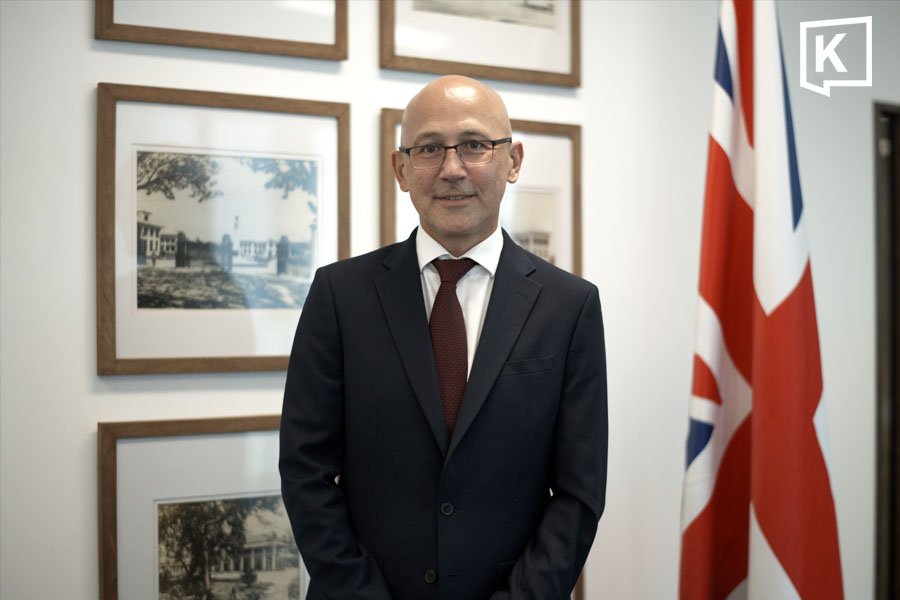
The World Is More Fragmented Than at Any Point in My Lifetime: Outgoing UK Envoy Reflects on Six Years in Thailand Arriving in Bangkok During the Height of the Pandemic When British Ambassador Mark Gooding reached Bangkok in 2020, Thailand had already closed its borders to most international visitors because of COVID-19 restrictions enforced by the Ministry of Public Health. To
The World Is More Fragmented Than at Any Point in My Lifetime: Outgoing UK Envoy Reflects on Six Years in Thailand
Arriving in Bangkok During the Height of the Pandemic
When British Ambassador Mark Gooding reached Bangkok in 2020, Thailand had already closed its borders to most international visitors because of COVID-19 restrictions enforced by the Ministry of Public Health. Tourist arrivals from every country had fallen sharply, and the British Embassy on Wireless Road operated with limited staff while Gooding spent much of his first year studying Thai language rather than attending large official events at Government House.
Thai communities across the capital adapted quickly, with temples in districts such as Dusit and Bang Rak offering daily alms rounds that continued even under movement controls. Gooding observed how Buddhist principles of patience helped both nations maintain quiet contact during those months when formal diplomacy slowed to a trickle.
A World More Fragmented Than Ever Before
Gooding described the international environment today as more divided than at any point in his lifetime, citing Russia’s invasion of Ukraine and rising pressure on multilateral institutions. He noted that shared interests in international law and free trade now require closer work between Britain and Thailand, two countries that both value the rules-based order upheld at the United Nations in New York.
For Thai readers this matters directly. Thailand’s economy depends on stable global shipping lanes through the Strait of Malacca, and any weakening of those rules could raise costs for exporters in Chonburi and Rayong who send electronics and automobiles to European markets. Gooding stressed that cooperation between Bangkok and London helps protect those routes and the livelihoods they support.
Elevating Relations to a Strategic Partnership
One clear achievement during Gooding’s posting was the upgrade of ties to a Strategic Partnership, making Britain the first European country to hold that status with Thailand. The agreement covers security cooperation, cyber issues, science, technology, education, climate change and trade, and was signed after several rounds of talks involving Thailand’s Ministry of Foreign Affairs.
Gooding explained that the partnership is not an end point but a framework for deeper work in the years ahead. Thai officials in the Department of European Affairs see the same value, especially as both nations experienced multiple changes of government during the six-year period. The continuity of the relationship has helped maintain steady progress on joint projects in renewable energy and university exchanges.
Trade Growth and the Enhanced Trade Partnership
Bilateral trade in goods and services rose from around five billion pounds to eight billion pounds over the past five years, a roughly sixty percent increase. After Britain left the European Union, negotiators in London could conclude their own commercial deals, leading to the Enhanced Trade Partnership that Gooding views as a possible step toward a future free trade agreement.
Thai exporters of processed food, gems and textiles have already benefited from smoother customs procedures at British ports. In daily life this means more British shoppers encounter Thai jasmine rice and frozen seafood in supermarkets, while Thai families notice a wider selection of British pharmaceuticals and machinery parts arriving through Laem Chabang port. The growth supports jobs in both countries without requiring an immediate full free trade agreement.
Record British Tourism and the Embassy’s Consular Role
British visitor numbers reached 1.2 million last year, placing the United Kingdom among Thailand’s largest long-haul source markets. Most travellers stay two or three weeks, enjoying hospitality, street food and cultural sites from the Grand Palace in Bangkok to temples in Chiang Mai. Gooding believes the planned reduction of visa-free stays from sixty to thirty days will have little effect on these patterns.
The British Embassy’s consular section remains its busiest overseas operation, handling more than two thousand cases last year, or roughly seven new cases every day. Staff assisted with over seven hundred deaths of British nationals, more than three hundred hospitalisations, road accidents, crime victims and prisoners. Most deaths involved elderly residents or visitors who passed from natural causes, and Gooding praised cooperation from Thai police and hospitals in provinces such as Phuket and Pattaya.
Tackling Cannabis Smuggling and Regional Stability
Since Thailand decriminalised cannabis, British airports have seen nearly one thousand arrests each year of people attempting to bring the substance into the United Kingdom. The Embassy now works daily with UK Border Force officers and Thai authorities at Suvarnabhumi and Don Mueang airports to reduce these incidents through better passenger information and joint enforcement.
Gooding also highlighted Thailand’s important role in efforts to restore peace in Myanmar after the 2021 military coup. Britain was among the first countries to impose sanctions, and Gooding noted that Thailand’s position as a neighbour gives it unique influence to encourage dialogue. Stable relations along the shared border help protect Thai communities in Mae Hong Son and Tak provinces from spillover effects that could disrupt cross-border trade and family ties.
Leaving with Affection for the Thai People
As Gooding prepares to depart Bangkok at the end of July for his new post as Director for Asia at the Foreign, Commonwealth and Development Office, he reflected on the privilege of serving in Thailand. He leaves with deep appreciation for the warmth of Thai communities and the country’s well-developed tourism infrastructure that continues to welcome visitors from every region.
For Thai readers the six-year tenure shows how steady diplomacy supports everyday connections: safer travel for families visiting Britain, stronger markets for Thai products in British shops, and continued cooperation on issues that affect both nations. The relationship built over 170 years of formal diplomacy and more than four centuries of royal family exchanges remains one of partnership and shared ambition in a changing world.
By Ann Srisawat, Staff Writer
This article was produced with AI-assisted research and editorial support. Reporting is based on sources cited in the article.
What's Your Reaction?
 Like
0
Like
0
 Dislike
0
Dislike
0
 Love
0
Love
0
 Funny
0
Funny
0
 Wow
0
Wow
0
 Sad
0
Sad
0
 Angry
0
Angry
0

Southeast Asia Correspondent at Global1.News. Based in Bangkok, covering Thai and Southeast Asian politics, economy, technology, and culture. Deep regional perspective on one of the world's most dynamic regions.












Comments (0)