
South Korea and Mongolia Launch a Golden Era of Strategic Partnership
South Korea and Mongolia Launch a Golden Era of Strategic Partnership The Historic Context of President Lee's Visit South Korean President Lee Jae-myung's state visit to Mongolia from July 9 to 11, 2026, represents the first such trip by a South Korean head of state in fifteen years. Following his participation in the NATO Summit in Turkiye, the journey to Ulaanbaatar signals a
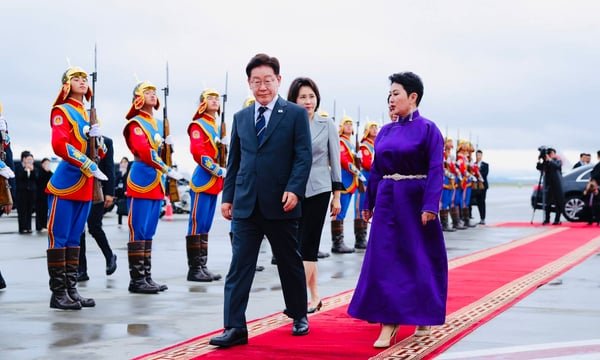
The Historic Context of President Lee's Visit
South Korean President Lee Jae-myung's state visit to Mongolia from July 9 to 11, 2026, represents the first such trip by a South Korean head of state in fifteen years. Following his participation in the NATO Summit in Turkiye, the journey to Ulaanbaatar signals a deliberate elevation of bilateral ties at a moment of shifting regional dynamics in Northeast Asia.
The visit builds on longstanding diplomatic relations while responding to contemporary needs for resource security and economic diversification. Mongolia's position as a landlocked neighbor to major powers makes its partnership with South Korea particularly salient for Seoul's foreign policy objectives.
Establishing the Golden Era Through Economic Agreements
During the visit, the two countries formally announced a "Golden Era of Korea-Mongolia Relations," a phrase first previewed by President Lee in an interview with Mongolia's state news agency Montsame. The announcement accompanied the signing of twenty-one cooperation agreements, chief among them a Comprehensive Economic Partnership Agreement that functions as a free trade framework.
Under the CEPA, South Korea will remove tariffs ranging from two to five percent on Mongolian mineral imports such as copper and molybdenum. In return, Mongolia will lower or eliminate duties on South Korean exports including cosmetics, trucks, and construction equipment. Trade ministers had reached a principle agreement in early June in Ulaanbaatar, setting the stage for finalization during the state visit.
South Korea's manufacturing sectors, particularly steel, automotive, and semiconductor production, create steady demand for high-purity molybdenum, with annual consumption reaching approximately 120 million dollars. The agreement directly addresses this requirement while supporting Mongolia's efforts to broaden its economic partnerships beyond traditional reliance on a narrow set of trading partners.
Business Engagement and Chaebol Involvement
President Lee was accompanied by a substantial delegation of South Korean business leaders, and approximately three hundred representatives from forty entities attended the Mongolia-South Korea Business Forum. Participants included POSCO Holdings chair Jang In-hwa, Kakao Bank CEO Yoon Ho-young, and Jang Byung-ho of Hanwha Investments and Securities.
Mongolian conglomerates such as MAK, MCS Group, and Tavan Bogd Group joined the discussions, alongside forty additional firms at a Special Export Consultation Session. The forum focused on opportunities in critical minerals, supply chains, logistics, and investment projects.
Over the past decade, South Korean investment in Mongolia has exceeded 1.1 billion dollars, according to data from the Ministry of Trade, Industry, and Energy and the Korea Trade Association. Retail and digital services have proven especially successful, with chains such as GS25 and CU Mongolia establishing widespread presence in Ulaanbaatar and serving as visible markers of consumer-market integration.
Expanding Cooperation Beyond Trade
Agreements reached during the visit extend into healthcare, education, agriculture, critical minerals, and clean energy transition. South Korea committed to supporting the establishment of Mongolia's second national cancer center and to deepening collaboration in scientific, technological, and digital fields.
The two sides also agreed to mutual recognition of driver's licenses, a practical measure reflecting the volume of cultural exchanges and the sizable Mongolian community residing in South Korea. These arrangements complement the economic dimension by strengthening people-to-people ties and institutional linkages.
Geopolitical Dimensions in Northeast Asia
Both Seoul and Ulaanbaatar articulated a shared vision for regional peace and stability during the visit. Mongolia's geographic position between China and Russia renders its diplomatic posture relevant to South Korea's broader Northeast Asian strategy, particularly in areas of security dialogue and economic resilience.
The strategic partnership upgrade occurs against a backdrop of evolving great-power competition. By institutionalizing cooperation through the CEPA and multiple agency-level agreements, the two countries create additional channels for engagement that can buffer against external shocks.
Implications for Mongolia's Development Strategy
Mongolia's new Prime Minister Uchral Nyam-Osor, in office for one hundred days at the time of the visit, has advanced initiatives such as Unlock Mongolia aimed at attracting foreign direct investment through reduced regulatory barriers. South Korean capital, historically concentrated in mining, now aligns with these diversification goals while continuing to support resource development.
Mongolian President Khurelsukh Ukhnaa highlighted the strategic partnership in his remarks at the Business Forum and welcomed joint ventures as growing partners. The combination of tariff liberalization, institutional agreements, and business-to-business platforms provides Mongolia with concrete mechanisms to pursue balanced growth.
By Prof. David Park, Staff WriterThis article was produced with AI-assisted research and editorial support. Reporting is based on sources cited in the article.
What's Your Reaction?
 Like
0
Like
0
 Dislike
0
Dislike
0
 Love
0
Love
0
 Funny
0
Funny
0
 Wow
0
Wow
0
 Sad
0
Sad
0
 Angry
0
Angry
0
East Asia/Technology Correspondent at Global1.News. Seoul-based voice covering Korean politics, technology, business, and culture. Analyzes how technology and geopolitics intersect across East Asia.












Comments (0)