
How Scientists Actually Weigh Planets Without a Scale
How Scientists Actually Weigh Planets Without a Scale Folks, this one blew my mind. Imagine trying to weigh something you can't even touch, let alone put on a scale. That's exactly what scientists have been doing for centuries with entire planets, and the story starts with a simple plumb bob on a Scottish mountain. Over at SciShow, Reid Reimers walks through the wild history of
How Scientists Actually Weigh Planets Without a Scale
Folks, this one blew my mind. Imagine trying to weigh something you can't even touch, let alone put on a scale. That's exactly what scientists have been doing for centuries with entire planets, and the story starts with a simple plumb bob on a Scottish mountain.
Over at SciShow, Reid Reimers walks through the wild history of gravitational measurements that let us pin down the mass of Earth, our neighboring planets, and even far-off exoplanets. You won't believe how a few clever tricks turned gravity into a cosmic scale.
By Allan Ali, Staff WriterThe Mountain That Gave Away Earth's Weight
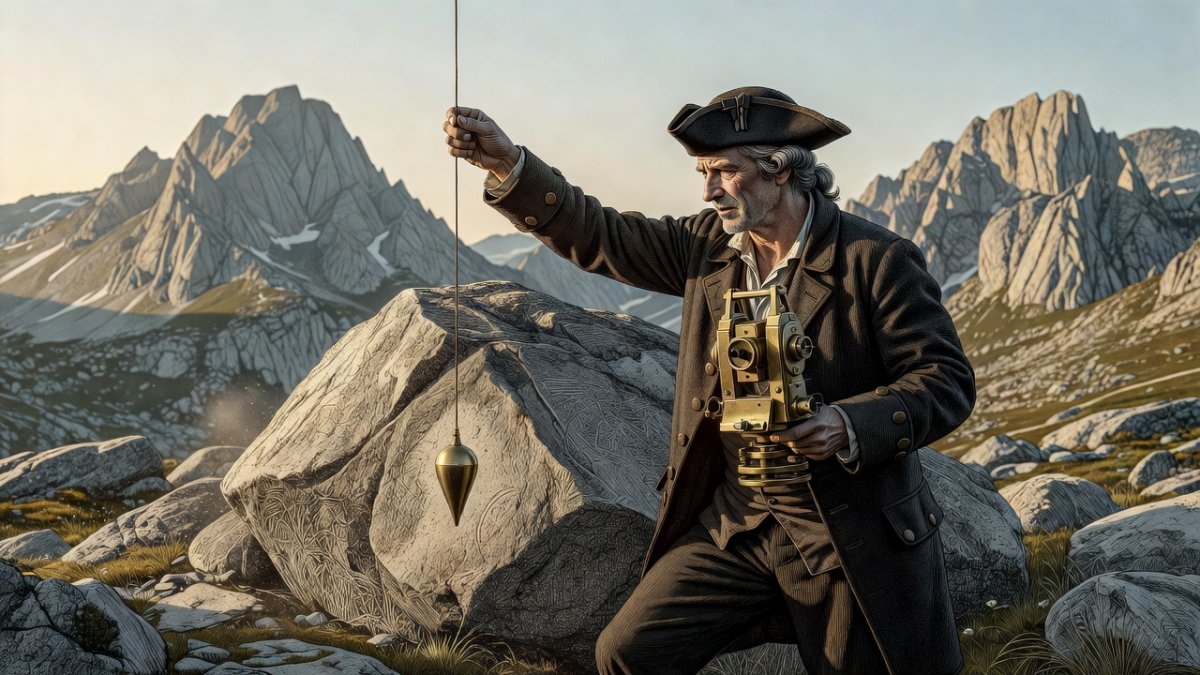
Back in the 1700s, astronomers realized they could use a mountain to measure Earth's mass. They picked Schiehallion in Scotland because of its nice, isolated shape. A plumb bob hung near the mountain would tilt slightly toward the rock due to its extra gravitational pull.
By measuring that tiny deflection and comparing it to the mountain's known volume, they calculated Earth's density. The result? Our planet weighs about 6 sextillion tons. That's the kind of number that makes you stare at the ground and wonder what's really under your feet.
Newton's Big Idea Changed Everything
Isaac Newton gave us the math. His law of universal gravitation showed that every object pulls on every other object. Once you know the strength of that pull and the distance between objects, you can solve for mass.
Think of it like this. Two people on ice skates holding a rope will slide toward each other. The speed they move tells you how heavy each person is. Planets do the same dance, just on a much bigger stage.
Moons Became Natural Scales
Once we had telescopes good enough to watch moons orbit planets, the job got easier. The time it takes a moon to go around tells you the planet's mass. Jupiter's big moons, for example, let scientists weigh the giant planet without ever leaving Earth.
You can try a version at home with a string and a weight. Swing it around and time the orbit. Change the center mass and the timing changes. Same principle, just smaller numbers.
Exoplanets Reveal Themselves Through Wobbles
Faraway stars wobble when planets tug on them. That wobble shows up in the star's light as tiny shifts in color. Measure the wobble size and speed, and you get the planet's mass.
Some worlds are so good at bending light they act like giant lenses. Even starless rogue planets can magnify background stars for a moment, giving away their mass through pure gravity.
Why Any of This Matters to You
Knowing planetary masses helps us understand how solar systems form and whether a distant world might hold an atmosphere. It also sharpens our search for planets that could support life.
Bottom line: gravity turns out to be the best scale in the universe. Every new measurement brings us closer to answering whether we're alone out there. Science keeps finding new ways to weigh the unweighable, and that's pretty amazing.
This article was produced with AI-assisted research and editorial support. Reporting is based on sources cited in the article.
What's Your Reaction?
 Like
0
Like
0
 Dislike
0
Dislike
0
 Love
0
Love
0
 Funny
0
Funny
0
 Wow
0
Wow
0
 Sad
0
Sad
0
 Angry
0
Angry
0

Publisher of Global1.News. Automation architect, systems builder, and the guy making sure the truth gets published.














Comments (0)