
Heavy Flooding in Argentina Exposes Gaps in Climate Policy and Infrastructure
In the neonatal unit of a Bahía Blanca hospital, nurse María López clutched a premature infant as murky floodwaters from the overflowing Canal Maldonado crept past the sandbags on March 7, 2025. Outside, 200 millimeters of rain had fallen in mere hours, turning streets into raging rivers that swallowed cars and homes. López’s own family home in the low-lying neighborhood sat un
Heavy Flooding in Argentina Exposes Gaps in Climate Policy and Infrastructure
Buenos Aires, Argentina - June 19, 2026 —

The Flooding Reality: Crisis Across Provinces
Heavy rains battered Argentina throughout 2025 and into 2026, triggering a cascade of emergencies that the Servicio Meteorológico Nacional addressed with repeated yellow, orange, and red alerts across sixteen provinces. Storms brought hail, winds exceeding 90 kilometers per hour, and rainfall totals of 40 to 70 millimeters in single events, overwhelming already saturated soils. In Bahía Blanca alone, the March 2025 deluge produced 200 millimeters in hours, killing between 10 and 16 people and forcing more than 1,400 residents from their homes. The Canal Maldonado and Arroyo Napostá burst their banks, flooding a hospital neonatal unit and leaving families stranded on rooftops. Buenos Aires Province endured its worst flooding in a decade, with nearly six million hectares submerged and an estimated two billion dollars in economic losses reported by CARBAP. The metropolitan area recorded 1,500 millimeters of rain in 2025, with another 600 millimeters projected by mid-2026. These figures are not anomalies but symptoms of a warming atmosphere that retains more moisture, amplified by shifting El Niño and La Niña patterns. The pattern echoes the deadly 2013 La Plata floods that claimed 89 lives through identical drainage failures, underscoring a repeating cycle of insufficient adaptation across the region.
Infrastructure Under Siege: Canals and Drainage at Breaking Point
Argentina’s aging drainage network stands at the center of the crisis. Buenos Aires metro pipes, some constructed from original clay more than a century ago, lack the capacity to handle today’s rainfall volumes. Relief channels such as Canal Maldonado, Arroyo Medrano, and Arroyo Napostá suffer from chronic poor maintenance and inadequate design, allowing water to back up into neighborhoods and critical facilities. Governor Axel Kicillof’s flagship Plan Maestro del Salado seeks to address these vulnerabilities across 59 municipalities and 1.5 million residents. The project, supported by international financing for its Tramo V segment, aims to recover eight million productive hectares through expanded hydraulic works. Yet implementation lags because of funding disputes and coordination failures between provincial and national authorities. Historical records reveal that British engineers mapped these same flood-prone zones as early as 1819, yet successive governments largely ignored the warnings. The result is a landscape where even moderate storms now produce catastrophic overflows, threatening hospitals, schools, and homes. Without accelerated investment in modern, climate-resilient infrastructure, these channels will continue to fail under intensifying precipitation events that scientists link directly to global warming.
The Human Toll: Displacement, Health and Livelihoods
Displacement numbers reveal the scale of suffering. In Tucumán during March 2026, between 10,000 and 15,000 people fled river overflows, including nearly 5,500 residents from the small town of La Madrid whose population totals only 6,000. Families in Buenos Aires Province faced similar upheaval, with stagnant waters breeding leptospirosis, gastrointestinal illnesses, and dengue outbreaks. Mental health strain weighs heavily on farmers and displaced households who have lost everything multiple times. The 2013 La Plata tragedy demonstrated how quickly such health crises escalate when drainage systems collapse, yet little systemic change followed. Across the affected zones, children miss school, elderly residents lose access to medication, and entire communities confront prolonged uncertainty. These human costs compound when basic services remain disrupted for weeks. The crisis also highlights broader Latin American patterns where rapid urbanization outpaces infrastructure upgrades, leaving the most vulnerable populations exposed. Sustained public health campaigns and psychosocial support must accompany any engineering fixes if Argentina hopes to break the cycle of repeated trauma.
Political Tensions: Province vs Nation in Climate Adaptation
Political friction between Governor Axel Kicillof and President Javier Milei has slowed critical responses. Kicillof accuses the national government of withholding Fondo de Infraestructura Hídrica funds needed for urgent works, while Milei’s administration points to provincial mismanagement. These disputes delay projects such as the Plan Maestro del Salado despite available international financing. Gabriel Katopodis, leading the Ministry of Infrastructure’s provincial risk management plan, struggles to bridge the divide. The tension reflects deeper federal-subnational coordination problems common throughout Latin America, where funding volatility undermines long-term adaptation. Similar conflicts have hampered flood responses in neighboring countries, revealing how political polarization can turn natural hazards into prolonged disasters. Without a unified national climate adaptation strategy backed by reliable financing, Argentina risks repeating the infrastructure failures that already devastated La Plata in 2013. Citizens in flood zones watch helplessly as partisan battles overshadow the urgent need for coordinated action on drainage upgrades and early-warning systems.
Agriculture in Crisis: When the Breadbasket Drowns
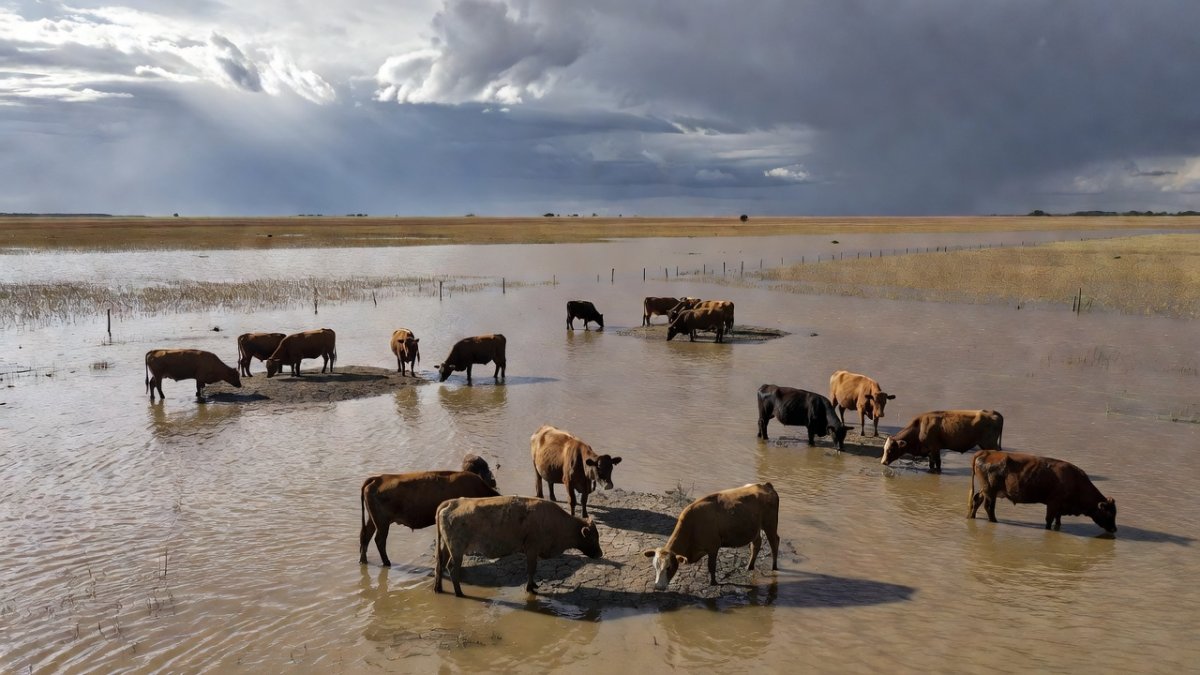
Santa Fe Province illustrates the agricultural devastation. Between one and 1.3 million hectares lie underwater, placing up to 700,000 cattle at risk and prompting an emergency agropecuaria declaration. The provincial government unveiled an 18 billion peso support package, yet many producers fear it arrives too late to prevent mass livestock losses. Buenos Aires Province’s six million affected hectares translate into roughly two billion dollars in damages according to CARBAP estimates, threatening Argentina’s role as a global food supplier. Saturated soils from 1,500 millimeters of rain in 2025, plus another projected 600 millimeters by mid-2026, have turned fertile pampas into lakes. These losses ripple through rural communities already strained by previous floods. The crisis mirrors challenges in Paraguay, Uruguay, and southern Brazil, where extreme rainfall events increasingly drown productive lands. Without accelerated investment in both hard infrastructure and climate-smart farming practices, the economic foundation of the region faces existential threat.
What This Means for Latin America
Argentina’s flooding crisis is not unique. Paraguay, Uruguay, Brazil, and Colombia confront parallel challenges of funding volatility, weak federal coordination, and maintenance gaps that leave populations exposed. Warmer atmospheres across the continent hold more moisture, making once-rare deluges routine. The 2013 La Plata disaster, with its 89 deaths from drainage failures, should have served as a regional wake-up call, yet similar patterns persist. Shared river basins and interconnected agricultural systems mean that one country’s infrastructure shortcomings affect neighbors. International financing offers partial relief, but sustained domestic commitment remains essential. Latin American governments must prioritize cross-border early-warning networks, updated drainage standards, and nature-based solutions alongside traditional engineering. Failure to act collectively will amplify displacement, health emergencies, and economic losses that already strain social fabrics across the hemisphere.
The Bottom Line — What Comes Next
The path forward demands sustained, nonpartisan investment in climate adaptation that transcends electoral cycles. Expanding the Plan Maestro del Salado, modernizing century-old drainage networks, and enforcing maintenance protocols for canals like Maldonado and Napostá represent immediate priorities. Equally vital are public health measures to combat leptospirosis and dengue, plus mental health services for affected families. Regional cooperation on data sharing and joint infrastructure financing could multiply impact across Latin America. Scientists warn that extreme rainfall will intensify; Argentina and its neighbors can no longer afford to treat each flood as an isolated tragedy. Only by confronting the systemic gaps exposed in Bahía Blanca, Santa Fe, and Tucumán can the region transform vulnerability into resilience. The lives of infants in flooded hospitals and farmers watching cattle drown depend on decisions made today. By Elena Vasquez, Staff Writer
This article was produced with AI-assisted research and editorial support. Reporting is based on sources cited in the article.
What's Your Reaction?
 Like
0
Like
0
 Dislike
0
Dislike
0
 Love
0
Love
0
 Funny
0
Funny
0
 Wow
0
Wow
0
 Sad
0
Sad
0
 Angry
0
Angry
0

Latin America Correspondent at Global1.News. Based in Mexico City, covering politics, economics, energy, and culture across the region. Brings an on-the-ground perspective to stories spanning from the Rio Grande to Patagonia.










Comments (0)