
This doctor is giving life back to female Yazidi victims of Islamic State
The Day Sinjar Fell: Captivity and Survival Under ISIS On 3 August 2014, Shireen was preparing for a high school examination in her family home in Sinjar when Islamic State militants entered the house and took her away. At nineteen she was sold as a sex slave first to a militant in Tal Afar and then, three months later, to Abu Omar in Mosul, where she became his third wife. Abu
The Day Sinjar Fell: Captivity and Survival Under ISIS
On 3 August 2014, Shireen was preparing for a high school examination in her family home in Sinjar when Islamic State militants entered the house and took her away. At nineteen she was sold as a sex slave first to a militant in Tal Afar and then, three months later, to Abu Omar in Mosul, where she became his third wife. Abu Omar already had two Iraqi wives who lived separately but beat her during family gatherings. He told her he loved her, yet she later said that when someone loves another person they do not rape her. The statement captured the destruction she felt. For more than two years she was confined to the house, allowed only to cook, wash dishes and clean. Two guards stood at the entrance; she could not step into the garden for fresh air. Abu Omar later brought two other Yazidi girls, one six years old and forced to clean, the other ten, both subjected to the same regime of rape.
Forced Conversion and the Yazidi Faith
Yazidis revere Melek Tawwus, the Peacock Angel, as the highest of seven angels emanating from their god Yasdan. Islamic State fighters told Shireen that Melek Tawwus was the devil and compelled her to convert to Islam. She was not permitted to leave the Mosul house for the entire period of captivity. In 2016 Iraqi forces freed her during the campaign to retake the city. By then her uncle and many friends had been killed; her father and one sister remain missing since 2014. Upon release she suffered depression and recurring nightmares.
Reaching Dr Nagham Nawzat in Duhok
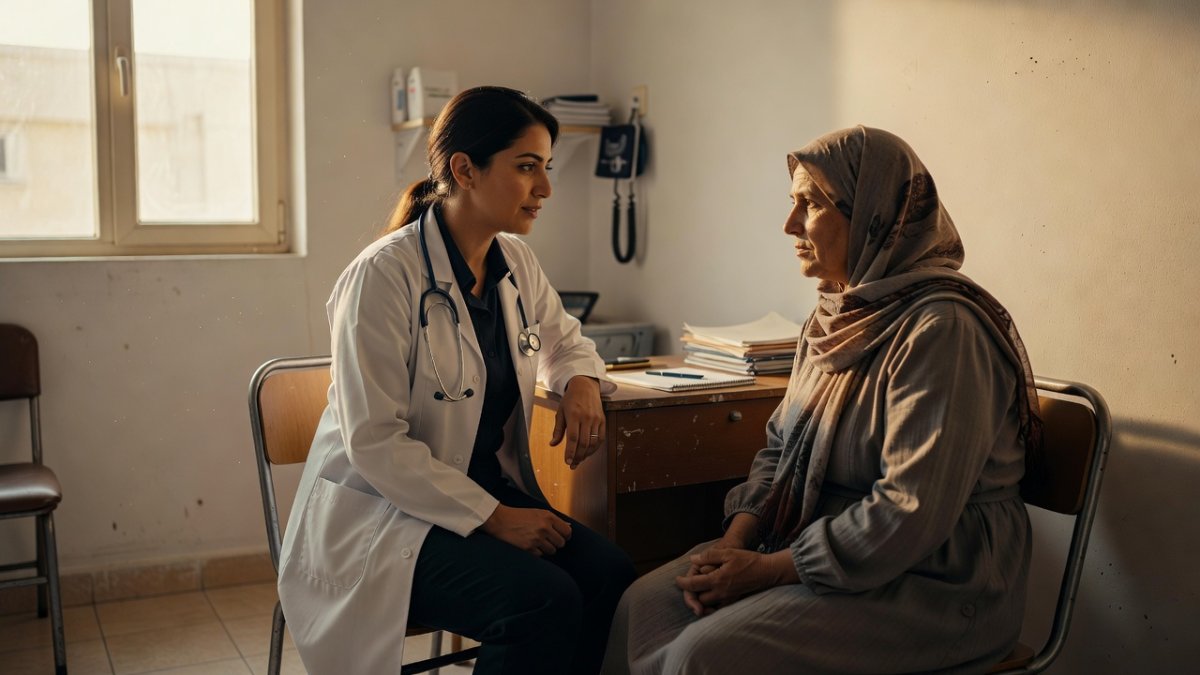
Shireen travelled to Duhok in Iraq’s Kurdish region and met Dr Nagham Nawzat, a Yazidi gynaecologist. The doctor performed a physical examination and also listened, offering emotional support. Shireen later stated that Dr Nawzat helped all of them and that without that help she would not be here today. The encounter occurred at the Duhok Survivors’ Centre, the only facility in Iraq specialising in gender-based violence and funded by the United Nations Population Fund.
Dr Nagham Nawzat’s Path to Medicine and Service
Dr Nagham Nawzat was born in Mosul in 1976 to a Yazidi family. Her lifelong ambition was to study medicine; she graduated with a degree in gynaecology from Mosul’s Medical College in 2002. When Islamic State seized almost a third of Iraq in 2014, at least 12,000 Yazidis were killed or kidnapped in what the United Nations has described as an ongoing genocide against the religious minority. In 2015 Dr Nawzat joined the Duhok Survivors’ Centre as a volunteer, providing healthcare and psychological support to women who had survived Islamic State captivity.
Scale of Liberation and International Recognition
Hussein al-Qaidi, director of the Kidnapped Affairs department at the Kurdistan Regional Government office in Duhok, reported that 2,023 Yazidi women had been liberated from Islamic State territories as of July 2018. Dr Nawzat has provided life-saving support to more than half of them, an estimated 1,200 women. In March 2016 she received the International Women of Courage Award from then US Secretary of State John Kerry for her work offering psychological support to traumatised Yazidi survivors and combating gender-based violence.
Connecting Policy Failures to Daily Human Suffering
The numbers released by the Kurdistan Regional Government and the United Nations Population Fund funding for the Duhok centre illustrate how official statistics translate into individual lives. Each of the 1,200 women treated by Dr Nawzat carries a story comparable to Shireen’s: abduction from Sinjar or surrounding areas, repeated sale in Mosul or Tal Afar, forced labour and sexual violence, and the loss of family members. The single specialised centre in Iraq remains the point where medical care and psychological support intersect for survivors who otherwise have nowhere to turn.
Continuing Needs in the Kurdish Region
Even after liberation, survivors such as Shireen continue to live with the physical and mental consequences of captivity. The Duhok Survivors’ Centre, supported by the United Nations Population Fund and staffed in part by volunteers like Dr Nawzat, addresses both dimensions. The International Women of Courage Award recognised the same combination of clinical skill and sustained presence that allowed women to begin rebuilding their lives inside the Iraqi Kurdish region.
By Fatima Al-Rashid, Staff WriterThis article was produced with AI-assisted research and editorial support. Reporting is based on sources cited in the article.
What's Your Reaction?
 Like
0
Like
0
 Dislike
0
Dislike
0
 Love
0
Love
0
 Funny
0
Funny
0
 Wow
0
Wow
0
 Sad
0
Sad
0
 Angry
0
Angry
0
Gulf/MENA Correspondent at Global1.News. Based in Doha, covering Gulf politics, energy markets, diplomacy, and development across the Middle East and North Africa. Tracks the economic transformation of the Gulf states.











Comments (0)