
Amadou and Mariam: Sounds of Mali — Documentary Celebrates the Legacy of Mali's Beloved Musical Duo
The documentary "Amadou and Mariam: Sounds of Mali" is now screening in theaters, celebrating the extraordinary life and music of Mali's most beloved musical couple. Directed by Ryan Marley, the 87-minute film chronicles a love story and musical journey that spans nearly five decades and conquered stages worldwide. Amadou and Mariam: Sounds of Mali — A Documentary Honours the L
The documentary "Amadou and Mariam: Sounds of Mali" is now screening in theaters, celebrating the extraordinary life and music of Mali's most beloved musical couple. Directed by Ryan Marley, the 87-minute film chronicles a love story and musical journey that spans nearly five decades and conquered stages worldwide.
Amadou and Mariam: Sounds of Mali — A Documentary Honours the Legacy of a Beloved Malian Duo
Dakar, Senegal — The documentary "Amadou and Mariam: Sounds of Mali" arrives at a moment when African audiences seek stories that honor resilience and creativity. Amadou Bagayoko and Mariam Doumbia built a partnership that carried traditional Malian sounds across continents while remaining rooted in Bamako. Their journey from local stages to global festivals now receives its fullest portrait in Ryan Marley's film, which captures their reflections before Amadou's passing.
Love Found in Silence: The Story Behind the Duo
Amadou Bagayoko and Mariam Doumbia met at the Institut des Jeunes Aveugles in Bamako, Mali, where both studied music despite societal attitudes that often told blind people they were "condemned to beg." The institute became their first creative home, offering a rare space where young blind musicians could form a band and perform together without immediate judgment from the wider community.
They married after discovering shared musical instincts and a determination to move beyond the limited expectations placed on them. Their early performances at the institute laid the foundation for a partnership that would last nearly 50 years. Amadou played guitar with a distinctive style shaped by Malian traditions, while Mariam's powerful voice carried both tenderness and strength.
The couple refused to accept the narrow paths society offered. Instead they built a career that began in Bamako and gradually reached international stages. Their music blended traditional Malian sounds with rock, blues, funk, and electronic genres, creating a sound that felt both ancient and modern at once.
Family life and music remained intertwined throughout their decades together. They raised children while touring and recording, always returning to Mali to reconnect with the rhythms and stories that first inspired them. This grounded approach kept their work authentic even as audiences grew worldwide.
Early recordings and local gigs in Bamako helped them refine the fusion that would later define their global identity. Friends and fellow musicians at the institute remember how Amadou and Mariam encouraged one another through every challenge, turning personal obstacles into shared artistic strength.
Their story demonstrates how love and music can overcome barriers that once seemed immovable. In Senegal we recognize this same spirit in our own griot traditions, where partnership and perseverance sustain cultural memory across generations.
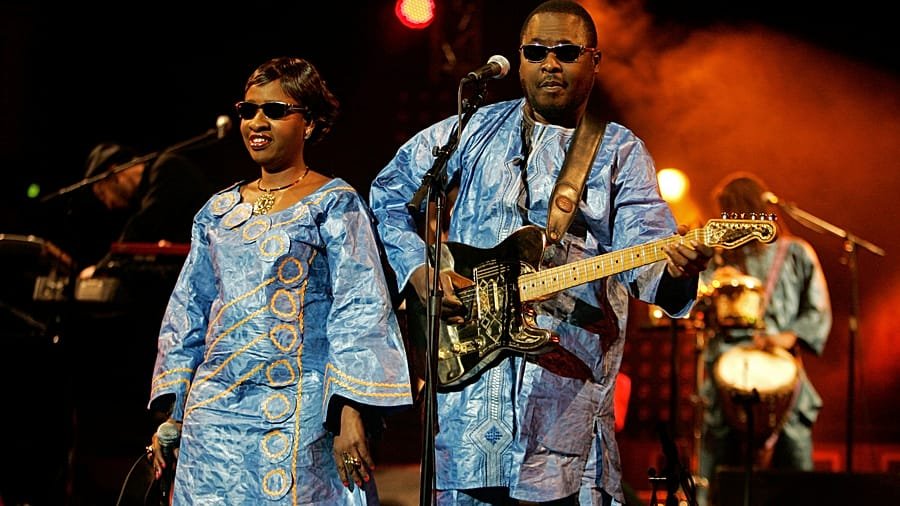
From Bamako to the World Stage: A Musical Triumph
Their breakthrough came with the Manu Chao-produced album "Dimanche à Bamako," which introduced their sound to millions and established them as international artists. The record sold millions of albums worldwide and opened doors to major festivals and collaborations that few African acts had previously accessed.
They composed the official song for the 2006 FIFA World Cup in Germany, bringing Malian rhythms to a global sporting audience. Later highlights included a performance at the closing ceremony concert of the 2024 Paris Olympic Games, where their presence reminded viewers of Africa's deep musical contributions to world culture.
Festival appearances at Glastonbury, Coachella, and Lollapalooza placed them alongside the biggest names in contemporary music. They shared bills with Coldplay, U2, and Stevie Wonder, proving that Malian music could command the same stages as rock and pop giants.
They played for President Barack Obama at the Nobel Peace Prize concert, an honor that underscored their role as cultural ambassadors. Collaborations with Damon Albarn of Blur and Gorillaz, along with Pink Floyd's David Gilmour, further expanded their reach while preserving the core of their Malian identity.
These achievements did not erase their connection to home. Regular returns to Bamako allowed them to mentor younger musicians and maintain the traditional elements that gave their work its distinctive character. The balance between global success and local roots became a model for other African artists.
Their trajectory shows how determination and musical innovation can carry West African voices to every corner of the world. Senegalese listeners have long felt kinship with their sound through shared Mbalax influences and the cultural exchanges along the Senegal River.
"Amadou and Mariam: Sounds of Mali" — A Documentary Portrait
The 2026 feature-length documentary directed by Ryan Marley, written by Ryan Marley, Katie Lafferty, and Sonia Godding-Togobo, offers an intimate look at their lives. Filming began before Amadou's passing in April 2025 at age 70, allowing the couple to reflect together on nearly five decades of partnership.
The 87-minute film includes personal interviews that reveal both the joys and hardships of their journey. Ryan Marley's approach captures the quiet moments between performances as well as the energy of their live shows, giving viewers a complete portrait of the duo.
World premiere screenings took place in France on February 6 and 8, 2026. The film opened in Quebec on June 26, 2026, timed with the Montreal Jazz Festival, where audiences responded warmly to its celebration of Malian creativity.
A special screening in Dakar, Senegal, was attended by Mariam Doumbia herself and followed by a concert that brought the documentary's themes to life on stage. The event connected directly with Senegalese music lovers who have followed the couple for years.
The Grand Rex in Paris hosted an aftermovie screening that drew large crowds eager to honor the duo's legacy. These theatrical releases have allowed communities across Europe and Africa to experience the film together in shared spaces.
Through careful editing and firsthand testimony, the documentary preserves voices and stories that might otherwise fade. Its timing ensures that Amadou and Mariam's reflections remain available for future generations seeking inspiration from their example.
Awards and Critical Acclaim
The documentary won the Prix de la meilleure œuvre canadienne at FIFA 2026, the Festival International du Film sur l'Art, recognizing its artistic and cultural value. This award placed the film among the strongest Canadian productions of the year while highlighting its African subject matter.
Le Parisien praised the film for its warmth and authenticity. Radio-Canada noted how it captures the essence of Malian life through music and personal testimony. La Presse described the film as a "chanson pour le Mali," a song for Mali that resonates far beyond its borders.
Critics across French-language outlets emphasized that the documentary is much more than a music film. It stands as a tribute to deep love, resilience, and the enduring power of Malian culture in the face of change.
Reviewers highlighted the film's ability to convey the couple's humor and tenderness alongside their professional achievements. This balance gives audiences a human portrait rather than a simple catalog of successes.
The critical response has encouraged wider distribution discussions, with many hoping the film will reach additional African cities beyond the initial Dakar screening. Its success at FIFA 2026 signals strong support for stories centered on African musical legacies.
Such acclaim affirms that African stories told with care and depth can earn recognition on international platforms. For Senegalese viewers, the praise feels personal because the themes of partnership and cultural pride echo our own artistic traditions.
Amadou and Mariam's Legacy in African Music
Amadou and Mariam served as Malian cultural ambassadors whose global success opened pathways for other African artists. Their example demonstrated that music rooted in local traditions could achieve worldwide recognition without losing its identity.
They paved the way for subsequent generations by proving that persistence and artistic integrity matter more than initial barriers. Many current West African musicians cite their career as proof that international stages remain accessible to those who stay true to their origins.
Their influence on the Mali music scene remains visible in the work of younger artists who continue to fuse traditional sounds with contemporary styles. This cross-pollination has strengthened West African music's presence on international platforms.
Deep connections to Senegalese music traditions, particularly Mbalax and the shared heritage of the Senegal River region, made their music feel familiar to audiences in Dakar and beyond. The cultural exchanges between Mali and Senegal have long enriched both nations' creative communities.
The couple's story represents the triumph of African artistry against societal barriers that once limited opportunities for blind musicians. Their success challenges outdated assumptions and inspires new confidence among artists facing similar obstacles today.
By maintaining strong ties to Bamako while touring globally, they modeled a sustainable approach to international careers that many African musicians now follow. Their legacy continues to shape how the continent's music travels and evolves.
What This Documentary Means for African Audiences
The significance of preserving African musical legacies through documentary film grows clearer with each passing year. "Amadou and Mariam: Sounds of Mali" joins a growing body of work that documents the continent's musical greats before their stories slip from living memory.
Younger generations of African musicians can learn from Amadou and Mariam's journey the values of artistry, partnership, and perseverance. Their example shows that long-term commitment to craft and to each other produces work that endures across decades and borders.
The documentary is currently screening in Canadian theaters as of late June 2026, tied to the Montreal Jazz Festival, with plans for wider distribution already underway. African audiences hope these plans will soon bring the film to additional cities across the continent.
Honoring Africa's cultural heroes while their stories can still be told remains essential. The film captures reflections from the couple before Amadou's passing, ensuring that their voices guide future interpretations of their work.
For Senegalese viewers, the documentary reinforces the importance of supporting films that celebrate shared West African heritage. It reminds us that music has always been one of our strongest bridges between nations and generations.
The growing collection of such documentaries strengthens cultural confidence across Africa. By watching these stories, new artists see that their own journeys can also become part of a living, expanding tradition.
By Amara Diop, Staff Writer
This article was produced with AI-assisted research and editorial support. Reporting is based on sources cited in the article.
What's Your Reaction?
 Like
0
Like
0
 Dislike
0
Dislike
0
 Love
0
Love
0
 Funny
0
Funny
0
 Wow
0
Wow
0
 Sad
0
Sad
0
 Angry
0
Angry
0

West Africa/Sahel Correspondent at Global1.News. Dakar-based journalist covering politics, security, climate, and development across Francophone and Anglophone West Africa. Tells the stories of a region undergoing profound transformation.













Comments (0)