
77 Headless Neolithic Skeletons Discovered in Slovakia
In the rolling fields near Vráble in Slovakia’s Nitra Region, archaeologists have uncovered 77 headless skeletons from a 7,000-year-old Linear Pottery Culture settlement, revealing sophisticated mortuary rituals rather than random violence and offering Indian researchers fresh frameworks for interpreting Neolithic sites such as Mehrgarh and Burzahom. 77 Headless Ne
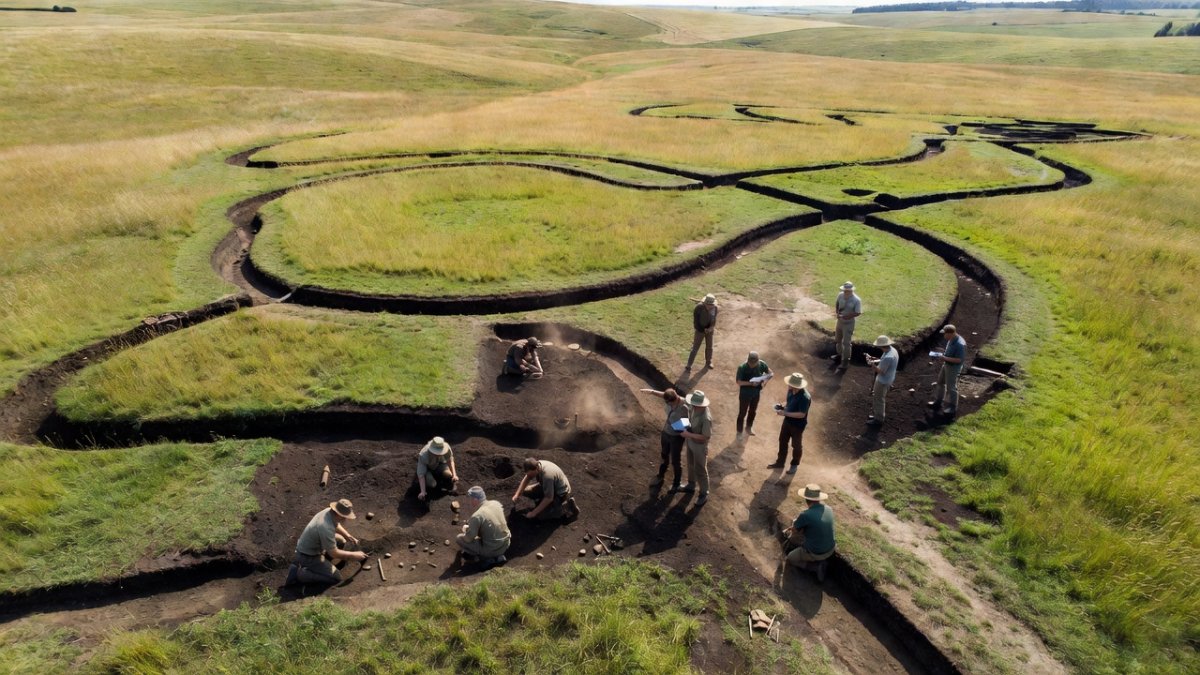
In the rolling fields near Vráble in Slovakia’s Nitra Region, archaeologists have uncovered 77 headless skeletons from a 7,000-year-old Linear Pottery Culture settlement, revealing sophisticated mortuary rituals rather than random violence and offering Indian researchers fresh frameworks for interpreting Neolithic sites such as Mehrgarh and Burzahom.
77 Headless Neolithic Skeletons Discovered at 7,000-Year-Old Slovakian Settlement
New Delhi – June 16, 2026 —
The Scale of the Vráble Discovery
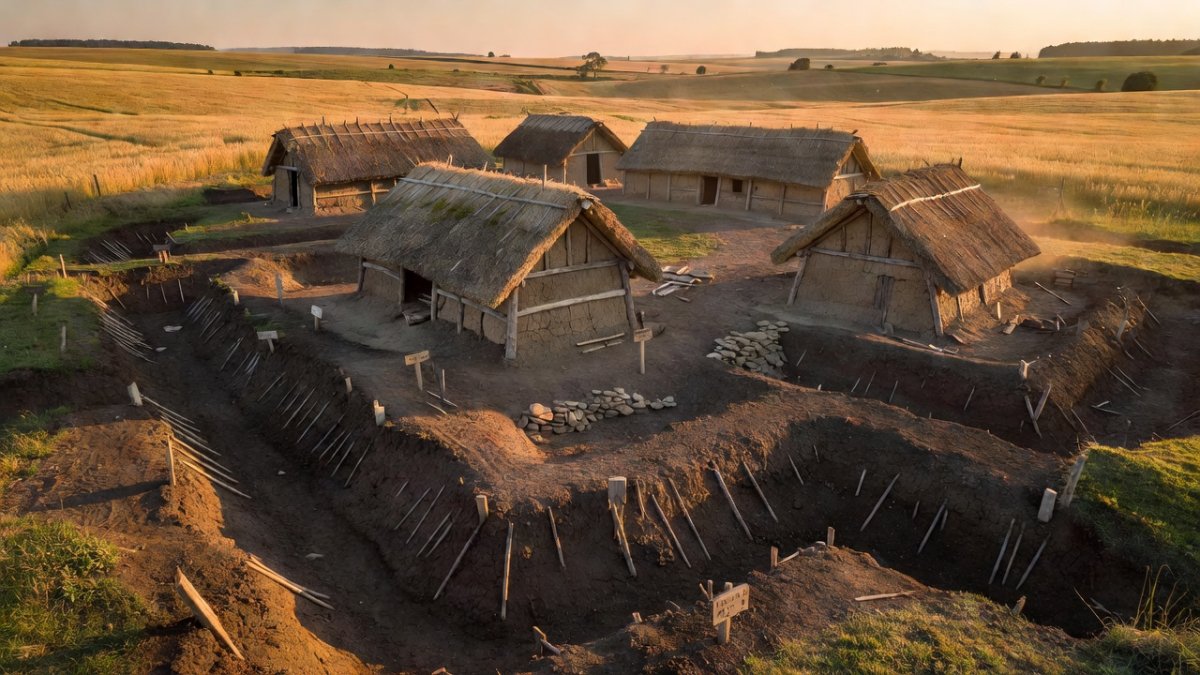
Excavations at the nearly 40-acre settlement have so far identified 112 individuals across three distinct neighborhoods, with the 77 headless remains concentrated exclusively in two surrounding ditches of the south-west neighborhood. Lead archaeologist Prof. Martin Furholt of Kiel University reports that 160 metres of the ditch system remain unexplored, suggesting the final count will rise. The settlement, established around 7,500 years ago in the Carpathian basin before spreading across Central Europe, featured post-built longhouses typical of Europe’s earliest farming communities.
Traditional burials elsewhere on the site contained bodies interred in pits near houses, accompanied by ceramic vessels, stone blades, and offerings of young sheep. In stark contrast, the ditch deposits show no such grave goods, indicating a deliberate separation of these individuals from standard funerary rites.
What the Skeletal Evidence Reveals
Biological anthropologist Dr. Katharina Fuchs of Kiel University has documented that the skulls were removed with sharp tools in “skillful removals,” not through violent decapitation. One child skeleton retained its skull among the otherwise headless adult remains, pointing to selective ritual treatment. These findings, published in the Proceedings of the Prehistoric Society in 2026, challenge earlier assumptions of widespread LBK violence seen at other sites where family groups suffered leg-breaking before execution.
The absence of trauma on the cervical vertebrae further supports the interpretation of post-mortem skull removal performed with precision. Researchers note that skulls may still lie buried within the settlement’s houses or in unexplored ditch sections, preserving potential evidence of ancestor veneration or community memory practices.
Neolithic Burial Practices Across Europe and Beyond
Headless burials appear across Neolithic Europe, suggesting shared cultural motifs rather than isolated anomalies. At Vráble, the exclusive location of these remains in one neighborhood’s ditches implies social differentiation within the community. This pattern contrasts with the more uniform pit burials found near longhouses, highlighting how space and treatment encoded status or ritual roles.
Comparative data from other LBK settlements show both violent and non-violent skull removal, indicating regional variation in mortuary expression. The Vráble evidence adds quantitative weight: 77 individuals represent a significant portion of the 112 recovered so far, underscoring the practice’s prevalence at this major site.
Lessons for Indian Neolithic Archaeology
India’s Archaeological Survey of India (ASI) has long studied comparable Neolithic mortuary traditions at Burzahom in Kashmir, where secondary burials and domestic dog interments date to approximately 3000 BCE, and at Mehrgarh in Balochistan, one of South Asia’s earliest farming villages established around 7000 BCE. The Vráble methodology—combining precise osteological analysis with spatial mapping of ditch systems—offers a model for ASI teams working at Maski in Karnataka and the Adichanallur urn burials in Tamil Nadu.
Indian prehistoric archaeology is experiencing renewed institutional focus, yet many excavations still rely on traditional recording rather than advanced bioarchaeological techniques such as isotopic analysis and 3D imaging of cut marks. Adopting Kiel University’s integrated approach could refine interpretations of secondary burial practices at Burzahom and clarify whether Mehrgarh’s early farming communities practised selective skull retention similar to the Vráble pattern.
Furthermore, the Indian education system’s growing emphasis on interdisciplinary heritage studies creates an opportunity for university programmes to incorporate European Neolithic datasets into curricula, fostering comparative research that links South Asian and Central European farming transitions.
Implications for Global Archaeological Methods
The Vráble findings demonstrate that large-scale ditch systems can preserve ritual evidence invisible in standard house-pit excavations. Indian archaeologists can apply similar systematic sampling strategies to unexplored Neolithic mounds, particularly in the Ganges plain and Deccan regions where settlement sizes often exceed 40 acres.
By integrating bioarchaeological protocols early in fieldwork, ASI projects could generate comparable datasets on age, sex, and modification patterns, strengthening claims about social complexity in India’s earliest agricultural societies. This methodological transfer aligns with national priorities to position India as a leader in prehistoric science rather than solely a consumer of foreign interpretations.
The Bottom Line
The Vráble discovery supplies concrete numbers—77 headless skeletons, 112 total individuals, 160 unexplored metres of ditch—that anchor a broader narrative of deliberate Neolithic ritual. For Indian archaeology, the site supplies both a cautionary tale about incomplete excavation and a practical blueprint for elevating bioarchaeological standards at sites such as Mehrgarh and Burzahom. As the count of remains at Vráble continues to climb, the parallel opportunity for Indian institutions to modernise their own Neolithic research grows correspondingly urgent.
— By Dr. Raj Patel, Staff Writer
This article was produced with AI-assisted research and editorial support. Reporting is based on sources cited in the article.
What's Your Reaction?
 Like
0
Like
0
 Dislike
0
Dislike
0
 Love
0
Love
0
 Funny
0
Funny
0
 Wow
0
Wow
0
 Sad
0
Sad
0
 Angry
0
Angry
0

India/South Asia Correspondent at Global1.News. Analytical voice with a background in science and health journalism. Based in New Delhi, covering Indian politics, education, healthcare, technology, and policy. Breaks down complex data into clear, actionable reporting.














Comments (0)