
Xi Jinping's Pyongyang Summit: Strategic Ambiguities in Northeast Asia's Evolving Triangle
Xi Jinping's Pyongyang Summit: Strategic Ambiguities in Northeast Asia's Evolving Triangle The Summit's Limited Deliverables and Enduring Constraints Xi Jinping's arrival in Pyongyang marked his first visit since 2019 and his initial overseas engagement of 2026. The two leaders exchanged familiar diplomatic phrases, with Kim Jong Un describing the bilateral relationship as soli
The Summit's Limited Deliverables and Enduring Constraints
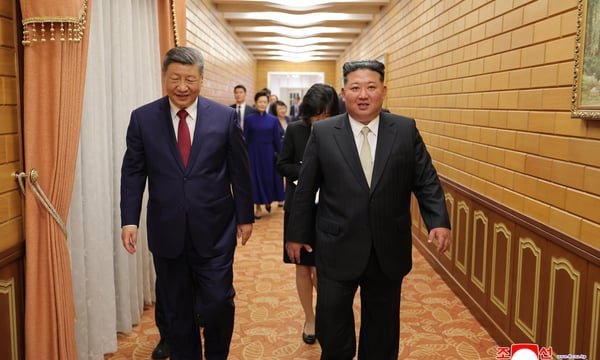
Xi Jinping's arrival in Pyongyang marked his first visit since 2019 and his initial overseas engagement of 2026. The two leaders exchanged familiar diplomatic phrases, with Kim Jong Un describing the bilateral relationship as solid and Xi Jinping expressing a desire to elevate ties to new heights. Yet the two-day meeting produced only broad commitments to future cooperation rather than concrete agreements on trade volumes or security protocols. This gap between rhetoric and substance reflects the structural limits that have long characterized interactions between Beijing and Pyongyang.
North Korean state media emphasized political, social, cultural, and economic spheres while omitting references to diplomacy, law enforcement, and military affairs that appeared in Chinese reporting. Such selective framing underscores Pyongyang's determination to control the narrative around sovereignty. Beijing, for its part, avoided any public mention of denuclearization, confirming that the topic remained off the agenda entirely. The absence of this core issue illustrates how both capitals prioritize stability over contentious demands that could derail the encounter.
Historical patterns from earlier summits suggest that high-level visits often serve symbolic functions more than operational ones. In this instance, the joint emphasis on high-level exchanges in coming months signals continuity rather than breakthrough. Korean analysts note that such language has repeatedly preceded incremental adjustments in border trade rather than transformative policy shifts. The enduring constraints therefore lie in mismatched priorities that neither side appears willing to confront directly.
Pyongyang's Nuclear Assertions and Sovereignty Calculus
Kim Jong Un publicly disclosed the launch of a new nuclear material production facility during the summit proceedings. This announcement reinforced Pyongyang's long-standing position that denuclearization constitutes an unacceptable red line. By revealing the facility, North Korea signaled its intent to expand rather than constrain its arsenal, a move timed to coincide with the presence of the Chinese delegation. Such transparency serves domestic consolidation while complicating external diplomatic overtures.
Kim Yo Jong's explicit characterization of North Korea as a nuclear weapons state whose arsenal forms the core force for sovereignty further entrenched this stance. The statement framed nuclear capability as an immutable reality rather than a negotiable asset. This declaration aligns with previous KCNA formulations that treat the program as central to regime survival. For inter-Korean relations, the timing suggests Pyongyang seeks to preempt any renewed engagement proposals from Seoul that might hinge on denuclearization preconditions.
The calculus behind these assertions reflects Pyongyang's assessment that external pressure from Washington, Seoul, and even Beijing has limited leverage. By elevating nuclear status during the summit, North Korea effectively compartmentalized economic cooperation from security concessions. Korean unification ministry officials have historically adjusted engagement roadmaps in response to such demonstrations, often shifting focus toward humanitarian channels. The current posture indicates that future inter-Korean dialogue will likely encounter the same sovereignty barrier that has persisted since the 2018-2019 period.
Beijing's Strategic Coordination Deficit
Xi Jinping's contribution to Rodong Sinmun invoked the traditional friendship between China and North Korea as invincible regardless of shifting international conditions. This phrasing echoes earlier joint statements yet arrives amid visible competition from Russian engagement. Xi's repeated calls for greater strategic coordination and military exchanges reveal an implicit recognition that Beijing's influence in these domains trails Moscow's recent advances. The appeal therefore functions as both reassurance and subtle course correction.
China's approach remains cautious, balancing economic leverage against the risk of pushing Pyongyang closer to alternative partners. Northeast Asia strategy documents from the Chinese foreign ministry have long prioritized stability on the peninsula to safeguard border regions and supply chains. In this summit, the emphasis on political and economic spheres over military ones suggests Beijing seeks to maintain its comparative advantage without direct confrontation. Korean scholars observe that such restraint has characterized Chinese policy since the 2000s, when denuclearization talks repeatedly stalled.
The coordination deficit carries implications for China's broader regional posture, particularly regarding trilateral dynamics with Russia and North Korea. By avoiding explicit linkage between economic cooperation and security alignment, Beijing preserves flexibility. Yet this same caution may accelerate Pyongyang's compartmentalization of relationships, limiting China's ability to shape outcomes on proliferation or crisis management. The result is a Northeast Asia strategy that prioritizes damage limitation over decisive influence.
Moscow's Parallel Alignment and Triangular Pressures
North Korean Foreign Minister Choe Son-hui's pre-summit remarks in Moscow highlighted a shared strategic position between the DPRK and Russia that corresponds to alliance-level coordination. These comments, which KCNA notably declined to cover, illustrate Pyongyang's practice of managing separate diplomatic tracks without public overlap. The omission allows North Korea to signal alignment with Moscow while preserving space for the Beijing visit. Such compartmentalization has precedents in earlier periods when Pyongyang balanced Chinese and Soviet interests.
Russia's provision of military technology stands in contrast to China's primary economic instruments, creating distinct leverage points within the triangle. This differentiation pressures Beijing to demonstrate equivalent strategic value during high-level meetings. Xi's appeals for military exchanges can be read as an attempt to narrow that gap without conceding ground on economic terms. Korean defense analysts track these shifts closely because they affect calculations about supply routes and technology diffusion across the peninsula.
The evolving triangle introduces new variables for regional stability. While China retains significant trade influence, Russia's military dimension offers Pyongyang diversification that reduces dependence on any single partner. KCNA's selective coverage reinforces the message that North Korea intends to maintain independent agency. Over time, this dynamic may encourage Beijing to recalibrate its own offerings to retain centrality in Pyongyang's strategic calculations.
Seoul and Washington: Policy Implications
South Korea's conditional engagement framework now confronts an explicit nuclear reality that the summit did little to soften. Seoul's unification ministry has historically calibrated outreach based on incremental confidence-building measures, yet Pyongyang's facility disclosure narrows the scope for such steps. The result is likely continued emphasis on deterrence alongside limited humanitarian channels rather than comprehensive dialogue. This adjustment mirrors earlier periods when nuclear advances prompted policy recalibration without full rupture.
United States deterrence strategy continues to prioritize extended deterrence commitments to allies while pursuing denuclearization diplomacy that the summit rendered even more aspirational. Washington and Seoul must therefore navigate the limits of trilateral coordination when one partner, China, shows little inclination to press the nuclear issue. Japanese involvement in regional responses gains added relevance here, as Tokyo's own security enhancements intersect with peninsula developments. The absence of denuclearization from the agenda effectively shifts focus toward managing consequences rather than reversing capabilities.
These policy implications extend to alliance management and burden-sharing discussions. Korean officials have noted that sustained nuclear assertions by Pyongyang strengthen arguments for enhanced missile defense and conventional capabilities. At the same time, the summit underscores the difficulty of achieving coordinated pressure when Beijing and Moscow maintain separate tracks. The outcome points toward a more fragmented diplomatic environment in which incremental risk reduction becomes the operative goal.
The Peninsula's Institutional Recalibration
Defense planning agencies in Seoul have begun reviewing force posture assumptions in light of the new nuclear material facility announcement. Such reviews draw on historical precedents from the 2017-2019 period when similar disclosures prompted adjustments to readiness postures and alliance exercises. The unification ministry, meanwhile, faces the task of updating engagement scenarios that previously assumed eventual denuclearization pathways. These institutional shifts reflect recognition that current realities diverge from earlier optimistic frameworks.
Deterrence architecture across the peninsula now incorporates the triangular pressures evident in the summit. Crisis management protocols must account for the possibility that North Korea will leverage its nuclear status to extract concessions in other domains. Korean academic analyses of past summits suggest that institutional memory plays a critical role in preventing overreaction while maintaining vigilance. The current environment demands precisely this balance between continuity and adaptation.
Forward-looking assessment indicates that the peninsula's institutional landscape will evolve toward greater emphasis on resilience rather than transformation. Historical patterns show that periods of heightened nuclear signaling have prompted incremental strengthening of legal and operational frameworks without immediate escalation. For Korea, this means sustained attention to inter-Korean communication channels alongside alliance coordination. The summit thus serves as another data point in a long trajectory of managed competition rather than decisive resolution.
By Prof. David Park, Staff WriterThis article was produced with AI-assisted research and editorial support. Reporting is based on sources cited in the article.
What's Your Reaction?
 Like
0
Like
0
 Dislike
0
Dislike
0
 Love
0
Love
0
 Funny
0
Funny
0
 Wow
0
Wow
0
 Sad
0
Sad
0
 Angry
0
Angry
0

East Asia/Technology Correspondent at Global1.News. Seoul-based voice covering Korean politics, technology, business, and culture. Analyzes how technology and geopolitics intersect across East Asia.















Comments (0)