
PM Carney's Dublin Visit: Trade, Heritage and EU Strategy
Prime Minister Mark Carney's official visit to Ireland marks a pivotal moment in strengthening transatlantic ties, leveraging his extensive background as former governor of both the Bank of England and the Bank of Canada to frame discussions on trade, investment and regulatory alignment. The two-day engagement, beginning June 13, 2026, underscores Canada's strategic pivot towar
Prime Minister Mark Carney's official visit to Ireland marks a pivotal moment in strengthening transatlantic ties, leveraging his extensive background as former governor of both the Bank of England and the Bank of Canada to frame discussions on trade, investment and regulatory alignment. The two-day engagement, beginning June 13, 2026, underscores Canada's strategic pivot toward European markets amid shifting global dynamics.
The Visit and Diplomatic Meetings
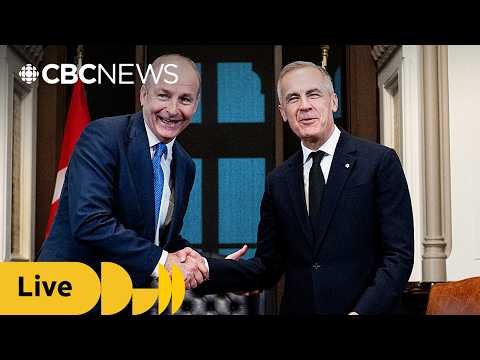
In a recent CBC News report broadcast on Saturday, Prime Minister Mark Carney arrived at Dublin Airport on June 13, 2026, for a two-day official visit to Ireland. He was greeted with full honours by Taoiseach Micheál Martin and his wife Mary O'Shea. Carney travelled with his wife Diana Fox Carney, while Canadian ambassador to Ireland Dennis King and Irish ambassador to Canada John Concannon also attended the arrival ceremony. Gardaí confirmed that any traffic impact would remain localised and minimal, with only temporary rolling road closures implemented around the airport perimeter to accommodate the motorcade.
Carney and Martin held a one-on-one meeting at Government Buildings, followed by a joint press conference. This marked the first bilateral visit to Ireland by a Canadian prime minister since Justin Trudeau's trip in 2017. The leaders signed the guest book at Government Buildings, with Carney adding a personal message about shared history and common values. Their initial encounter had taken place in Ottawa the previous September, when Martin first indicated Ireland's firm intention to ratify CETA.
The day concluded with an official dinner at Dublin Castle hosted by Martin. Carney had previously met Martin in Ottawa in September, setting the stage for this engagement. The Irish government described the visit as a significant milestone in bilateral relations. Carney's economic expertise, honed through leadership at the Bank of Canada and Bank of England, provided a steady analytical lens for the trade-focused agenda that followed.
Trade and Economic Partnership
During the meetings, Carney and Martin signed a new bilateral co-operation framework covering trade and investment, life sciences, research and innovation, security and defence. Bilateral trade in goods and services grew from €3.2 billion in 2016 to €12 billion in 2024. Canadian investment in Ireland increased 131 percent over the same period. Deirdre Giblin, head of the Ireland Canada Business Association, characterised the relationship as emerging, noting that Irish exports to Canada have nearly quadrupled since CETA took provisional effect.
Ireland stands as Canada's eighth largest foreign investor. The framework aims to build on these figures through targeted co-operation in key sectors. Both leaders highlighted the role of existing agreements in driving this expansion. A Conference Board of Canada report prepared for Ireland identified clear opportunities for Canada to increase exports in financial services, air transportation, management and consulting, while Ireland could expand sales of computer services and insurance and pension products into the Canadian market.
Irish government officials noted that the visit would further strengthen economic ties. The Conference Board of Canada has positioned Ireland as Canada's gateway to the European Union market, a point reinforced during the discussions. The same report cautioned that complex regulations, including interprovincial trade barriers, continue to pose challenges for Irish firms seeking to establish operations in Canada, underscoring the need for streamlined processes within the new framework.
CETA and European Market Access
Carney and Martin addressed the Canada-European Union Comprehensive Economic and Trade Agreement. Ireland is expected to fully ratify CETA within two to three weeks, as one of the remaining 10 EU countries yet to complete the process. The Irish government passed the Arbitration Amendment Act, enabling ratification once signed by the president. The Oireachtas approved the legislation specifically to remove legal hurdles and allow Ireland to finalise its commitment.
Irish exports to Canada nearly quadrupled since CETA came into force provisionally in 2017. Giblin of the Ireland Canada Business Association stated that full ratification is anticipated shortly after the visit. This step would lock in tariff reductions for Canadian exporters across the European single market. Martin had first signalled this timeline during his September meeting with Carney in Ottawa.
Business groups on both sides welcomed the timeline. Full ratification would remove remaining barriers and provide greater certainty for Canadian firms seeking access to EU supply chains through Ireland. The cancellation of a planned Irish trade mission to Canada in April, prompted by domestic fuel price protests, had delayed momentum, making the current visit an essential opportunity to regain lost ground.
Personal Heritage Dimension
Carney's Irish roots trace to his grandfather Robert Carney from Aghagower, Westport, County Mayo, and his grandmother Nora Moran from Mace, County Mayo. On Sunday, Carney will travel to Mayo to visit his grandparents' former home in Aghagower, attend Mass at the parish church, and visit the cemetery where ancestors are buried. Taoiseach Martin remarked, "With such strong Irish heritage, it will also be an opportunity for Prime Minister Carney to celebrate and explore his Irish heritage, and I know Mayo is looking forward to welcoming him home."
He will also meet Irish President Catherine Connolly in Westport during the same day. More than 4.4 million Canadians, representing over 12 percent of the population, claim Irish heritage, a demographic fact that Carney referenced in public remarks. The personal itinerary underscores the deep people-to-people connections between the two countries. Canadian officials noted that such heritage links often translate into sustained political and economic engagement.
Strategic Significance — Canada-EU Relations
Ireland assumes the EU Council presidency in July 2026, giving the visit added weight for Canadian interests. The leaders discussed co-operation on artificial intelligence strategy, an area where both countries seek to align regulatory approaches and research priorities. Canada published its national AI plan earlier this month, while Ireland released its own strategy last winter, creating a timely basis for joint regulatory dialogue.
Carleton University professor Fen Osler Hampson described the timing as strategic for Canada, noting Ireland's upcoming presidency role. Ireland cancelled a planned trade mission to Canada in April amid fuel price protests, making this engagement a key reset opportunity. The bilateral co-operation framework includes explicit provisions for security and defence collaboration. These elements position the visit as preparation for broader Canada-EU dialogue during Ireland's presidency term.
Canadian Context — Why This Matters at Home
For Canadian federal policy, the visit supports trade diversification efforts away from traditional North American markets. Strengthening ties with Ireland provides a practical entry point to the European Union, where regulatory alignment through CETA can benefit exporters in life sciences and technology sectors. Carney's central banking experience lent particular credibility to conversations on financial services and investment flows.
The framework's focus on research and innovation aligns with domestic priorities in Ottawa around economic growth and supply chain resilience. Federal officials view Ireland's role as a gateway as a concrete mechanism to expand Canadian commercial presence across the EU's 27 member states. The Conference Board of Canada report further highlighted potential gains in air transportation and management consulting, sectors where Canadian expertise can complement Irish strengths in computer services and insurance products.
Public safety and defence elements in the agreement also connect to Canadian concerns about transatlantic security co-operation. The visit reinforces Canada's multilateral approach at a time when global trade rules face ongoing pressure. Addressing interprovincial barriers, as flagged in the report, will be essential if Irish companies are to navigate the Canadian market with greater ease.
What Happens Next
Carney will travel to Paris en route to the G7 Leaders' Summit in Evian, France, scheduled for June 15-17. The Ireland visit provides diplomatic momentum ahead of those discussions, particularly on economic and security files. Follow-up mechanisms outlined in the new agreement will establish regular senior official meetings to track progress on trade, innovation and defence co-operation.
CETA ratification in Ireland is expected within two to three weeks following the signing of the bilateral framework. Both governments committed to advancing the AI strategy dialogue and investment promotion initiatives in the months ahead. Martin emphasised that the strengthened relationship would deliver tangible benefits for businesses on both sides of the Atlantic.
Canadian and Irish officials will now work to implement the co-operation framework's provisions, with particular attention to removing regulatory obstacles and expanding services trade. The heritage dimension of Carney's Mayo itinerary is expected to generate additional goodwill that could support long-term people-to-people and commercial linkages.
By Alex Thompson, Staff WriterThis article was produced with AI-assisted research and editorial support. Reporting is based on sources cited in the article.
What's Your Reaction?
 Like
0
Like
0
 Dislike
0
Dislike
0
 Love
0
Love
0
 Funny
0
Funny
0
 Wow
0
Wow
0
 Sad
0
Sad
0
 Angry
0
Angry
0

Canada Correspondent at Global1.News. Based in Toronto, covering Canadian politics, energy, trade, and US-Canada relations. Provides the Canadian perspective on North American and global affairs.














Comments (0)