
Xi and Kim Vow Stronger Ties as China President Ends Pyongyang Visit
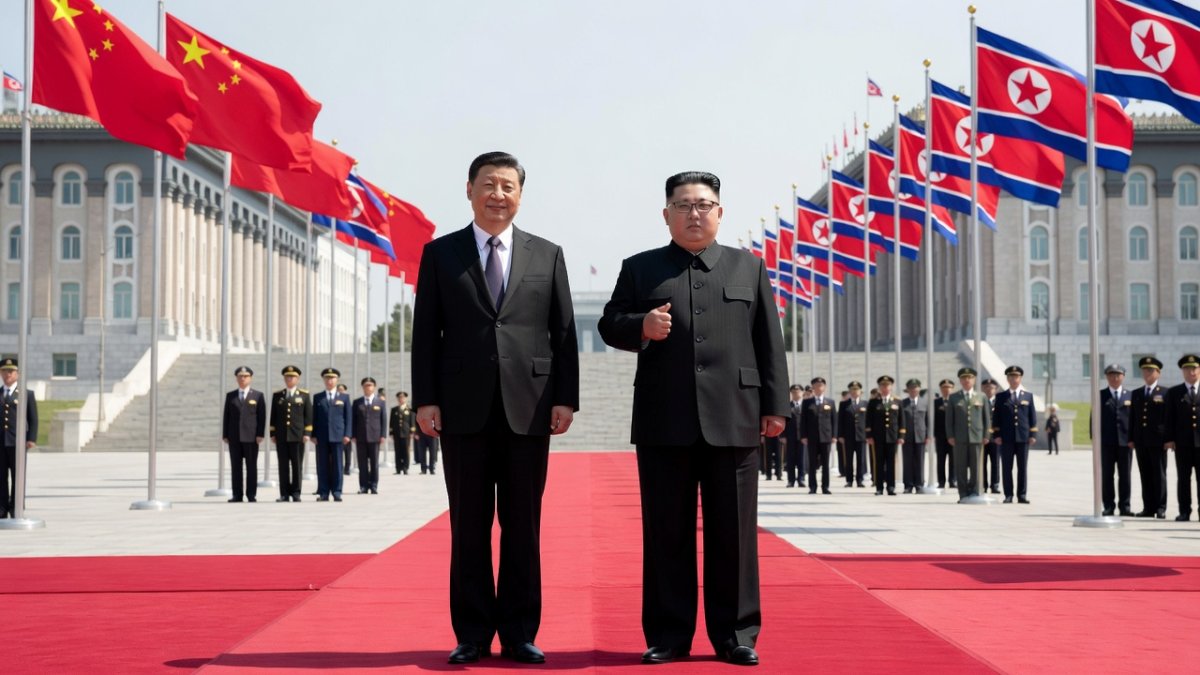
Xi and Kim Vow Stronger Ties as Chinese President Wraps Up Pyongyang Visit Details of the Two-Day State Visit Chinese President Xi Jinping concluded his two-day visit to Pyongyang on Tuesday, marking his first official trip to North Korea since 2019. North Korean leader Kim Jong Un arranged an elaborate welcome that included a red-carpet arrival ceremony and acrobatic performan
Details of the Two-Day State Visit
Chinese President Xi Jinping concluded his two-day visit to Pyongyang on Tuesday, marking his first official trip to North Korea since 2019. North Korean leader Kim Jong Un arranged an elaborate welcome that included a red-carpet arrival ceremony and acrobatic performances. State media reports from KCNA and Xinhua highlighted the ceremonial aspects without announcing any new economic agreements or security pacts. Xi was accompanied by key officials including Cai Qi, Dong Jun, Wang Yi and Wang Wentao, underscoring the high-level nature of the delegation.
Statements from Both Leaders on Bilateral Relations
At the Monday evening banquet, Xi described the relationship as one in which the two countries are "linked by mountains and rivers and share a common destiny." Kim responded by affirming that North Korea would continue to treat friendship with China as a top priority and reiterated support for Beijing's "One China" principle. Both sides noted that the visit coincided with the 65th anniversary of their mutual defence treaty, the only such agreement China maintains with any nation. Xi stated that the two leaders had reached an "important consensus" to deepen high-level exchanges and people-to-people contacts while grasping the trend of the times.
China's Strategic Objectives in Northeast Asia
The timing of the visit reflects Beijing's interest in maintaining influence over a neighbour whose actions affect regional stability and China's own security calculations. North Korea remains China's primary economic partner and a critical buffer along its northeastern border. By conducting this trip shortly after meetings with other major powers, Xi signals to Pyongyang that China continues to serve as its principal external supporter amid ongoing international sanctions. The absence of any public reference to denuclearisation in official readouts aligns with Beijing's recent practice of prioritising stability over explicit calls for disarmament on the Korean peninsula.
North Korea's Diplomatic Positioning
For Kim Jong Un, hosting Xi provided an opportunity to demonstrate continued access to high-level Chinese engagement despite sanctions. The visit occurred weeks after Xi's interactions with other heads of state, allowing Pyongyang to project an image of balanced diplomacy. Kim's emphasis on the "utmost importance" placed on bilateral ties, as reported by KCNA, serves domestic and international messaging purposes. At the same time, the lack of any stated commitment to economic reforms modelled on China's experience indicates persistent differences in approach to development policy.
Symbolic Gestures and Remaining Differences
On Tuesday the two leaders visited the Friendship Tower commemorating Chinese soldiers from the Korean War era and planted a fir tree at Pyongyang's leading cadre school. These acts reinforced the narrative of enduring ties. Xi stayed at the Kumsusan State Guest House, constructed in 2019 specifically to host his earlier visit. While the public displays emphasised continuity, Xi's reference to jointly advancing the "socialist cause" of both countries highlighted an area of divergence: Beijing has long encouraged Pyongyang to adopt market-oriented reforms while preserving one-party rule, yet North Korean policy statements have not echoed this direction.
Broader Geopolitical Implications
The visit occurs against a backdrop of shifting alignments involving Russia and the United States. China's role as North Korea's main economic lifeline gives Beijing leverage that other powers lack, yet this leverage is exercised cautiously to avoid destabilising the peninsula. For ASEAN and the European Union, sustained Sino-North Korean coordination could influence calculations on sanctions enforcement and regional security dialogues. In the Global South, the optics of high-level engagement between two socialist states may be read as evidence of alternative diplomatic networks outside Western-led frameworks. Second-order effects include potential adjustments in South Korean and Japanese defence planning as well as renewed attention to supply-chain resilience in critical minerals sourced from the region.
By Prof. Marcus Chen, Staff WriterThis article was produced with AI-assisted research and editorial support. Reporting is based on sources cited in the article.
What's Your Reaction?
 Like
0
Like
0
 Dislike
0
Dislike
0
 Love
0
Love
0
 Funny
0
Funny
0
 Wow
0
Wow
0
 Sad
0
Sad
0
 Angry
0
Angry
0

World Politics Analyst at Global1.News. Based in Beijing, covering US-China relations, global trade, and geopolitical strategy. Brings deep analytical perspective to the power dynamics shaping international affairs.














Comments (0)