
With New AI Governance Organization, China Seeks to Formalize Its Global AI Influence
Shanghai Launch Marks a Structural Bid for AI Norm-Setting On July 16, 2026, China formally launched the World Artificial Intelligence Cooperation Organization (WAICO) in Shanghai, with twenty-nine founding countries signing the founding agreement. Chinese Foreign Minister Wang Yi affixed Beijing’s signature to the document.
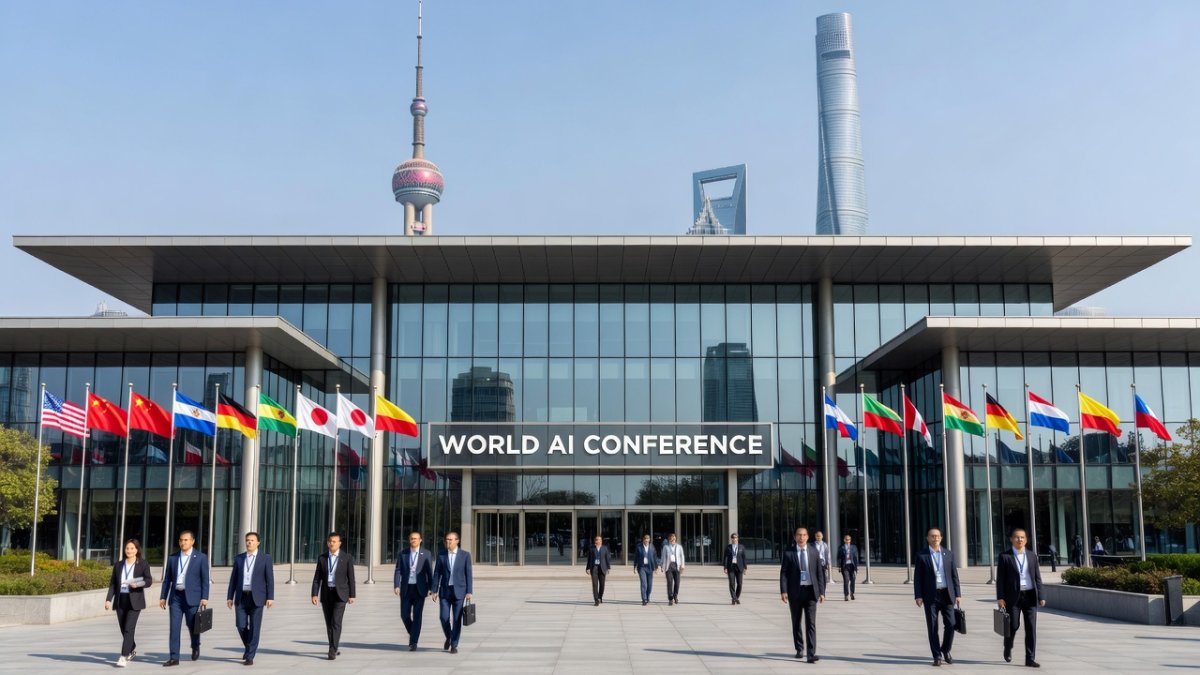
Shanghai Launch Marks a Structural Bid for AI Norm-Setting
On July 16, 2026, China formally launched the World Artificial Intelligence Cooperation Organization (WAICO) in Shanghai, with twenty-nine founding countries signing the founding agreement. Chinese Foreign Minister Wang Yi affixed Beijing’s signature to the document. The following day, July 17, President Xi Jinping officially unveiled the organization at the World AI Conference (WAIC) 2026, framing artificial intelligence as a “global public good” and pledging open-source, low-cost model development as a central pillar of the new body’s agenda. United Nations Secretary-General António Guterres attended the conference, lending a measure of multilateral visibility to the proceedings even as the signatory list itself reflected a clear geopolitical pattern.
The founding members include China, Russia, Brazil, Indonesia, South Africa, Kazakhstan, Laos, and Pakistan, among others. Notably, no G7 economy appears on the signatory list. Headquarters are to be located in Shanghai. Xi also pledged 5,000 training and seminar opportunities for developing countries over the next five years, a concrete capacity-building commitment designed to anchor WAICO’s appeal among states that have limited domestic AI infrastructure. In institutional terms, WAICO represents China’s most ambitious effort to date to formalize its influence over the future deployment and governance of artificial intelligence, moving beyond bilateral technology partnerships and conference diplomacy toward a standing organizational platform.
The timing is not incidental. WAICO’s launch followed closely on the heels of the UN Global Dialogue on AI Governance held in Geneva on July 6–7, 2026, and stands in deliberate contrast to earlier Western-led initiatives such as the Bletchley Park AI Safety Summit convened by the United Kingdom in November 2023. Where those forums emphasized safety testing, frontier-model risk, and alignment with existing liberal institutional architectures, WAICO’s public messaging has centered on access, affordability, and development—vocabulary calibrated for the Global South.
Mandate, Architecture, and the Politics of Institutional Design
Public details on WAICO’s internal governance structure remain limited at this stage, and it would be premature to describe the organization as fully operational across all intended functions. What can be stated with confidence is that the body is headquartered in Shanghai, was established by intergovernmental agreement among the twenty-nine founding signatories, and has been presented by Chinese leadership as a vehicle for international cooperation on AI development, training, and standards coordination. Xi’s emphasis on open-source and low-cost models suggests that technology diffusion and capacity-building will feature prominently alongside any normative or regulatory workstreams.
The choice of Shanghai as headquarters carries symbolic and practical weight. The city has been cultivated as a showcase for China’s AI industrial policy and hosts the annual World AI Conference, which has grown into one of the largest AI gatherings globally. Anchoring WAICO there ties the organization’s diplomatic identity to China’s domestic innovation narrative. The pledge of 5,000 training and seminar slots over five years is, in institutional design terms, a classic club-good strategy: it lowers the cost of participation for developing-country officials and technical cadres while building habitual engagement with Chinese platforms, curricula, and technical ecosystems.
Comparatively, WAICO’s early profile differs from the multi-stakeholder and safety-first orientation of Bletchley Park and related Western processes. Those initiatives drew heavily on participation from leading AI laboratories, civil society, and G7 governments, and they prioritized questions of catastrophic risk, model evaluation, and responsible scaling. WAICO’s founding cohort and messaging point instead toward a development-and-access frame, with China positioned as convener and provider. Whether the organization will develop binding standards, voluntary codes, interoperability protocols, or primarily training and convening functions will become clearer as implementing arrangements are elaborated. For now, the strategic signal is institutional presence itself.
Beijing’s Strategic Calculus: Why WAICO, and Why Now
WAICO did not emerge in a vacuum. It is best understood as the organizational expression of a longer Chinese effort to contest what Beijing views as U.S.-centric governance of critical and emerging technologies. U.S. export restrictions on advanced AI chips, imposed to constrain China’s access to high-end semiconductors for training large models, have been characterized by Chinese officials as an “overstretching” of national security rationales. Those controls accelerated Beijing’s search for both technological workarounds and diplomatic counter-narratives.
The global rise of DeepSeek, a Chinese open-source model family that achieved prominent performance benchmarks at comparatively low cost, supplied Beijing with a powerful empirical argument. If competitive models can be developed and released openly despite chip constraints, the logic runs, then U.S. export controls are not only coercive but also increasingly ineffective—and the appropriate international response is wider diffusion of open, affordable AI rather than tighter chokepoint enforcement. WAICO institutionalizes that argument. By branding AI as a global public good and committing to training for developing countries, China seeks to convert a defensive position under export controls into an offensive claim to leadership among non-G7 states.
There is also a sequencing logic. Western governments moved first on AI safety summits and plurilateral statements. The United Nations has begun to elaborate its own dialogue processes. China, rather than remaining a participant in forums designed elsewhere, has now created a dedicated organization on its own institutional terrain, with a membership base that excludes the G7 by composition if not by formal rule. This is consistent with a broader pattern in Chinese economic statecraft: build parallel or complementary institutions—development banks, connectivity forums, standards bodies—that reflect Chinese preferences and reduce dependence on Western gatekeeping. WAICO extends that template into AI governance.
US-China Tech Rivalry and Competing Governance Frameworks
The structural backdrop is a intensifying U.S.-China technology rivalry in which AI and advanced semiconductors sit at the center. Washington’s chip export controls aim to slow Chinese progress at the frontier of large-scale model training. Beijing’s response has combined indigenous substitution efforts, diplomatic framing of U.S. measures as unilateral and exclusionary, and now the creation of WAICO as a governance counterweight. DeepSeek’s prominence reinforced the open-source narrative that China has taken to international audiences: that innovation need not be locked behind proprietary Western stacks or subject to extraterritorial licensing regimes.
Competing governance frameworks are taking shape along familiar geopolitical lines. The Bletchley Park process and subsequent Western safety initiatives reflect a coalition of advanced economies concerned with frontier risks and inclined toward coordinated regulation of leading laboratories. The UN Global Dialogue on AI Governance offers a universalist venue but one whose outputs will likely remain high-level for some time. WAICO inserts a third pole: a China-led organization with a developing-country membership core, a Shanghai base, and an explicit development-and-access mandate. States need not choose exclusively among these frameworks, but agenda-setting power, technical standards, and training pipelines will increasingly reflect which institutions governments invest in.
For middle and smaller powers, the proliferation of AI governance venues creates both opportunity and pressure. Opportunity lies in forum-shopping and in extracting capacity-building resources from multiple patrons. Pressure lies in the gradual hardening of technical and normative ecosystems—cloud infrastructure, model repositories, evaluation benchmarks, data governance rules—that may not interoperate cleanly across geopolitical camps. WAICO’s emphasis on open-source and low-cost models is, in this light, not only developmental rhetoric but also an attempt to set default technical pathways that favor broader Chinese ecosystem participation.
South Korea’s Delicate Position: Legislation, Chaebols, and Alliance Constraints
South Korea illustrates with particular clarity the dilemmas facing advanced economies situated between Washington and Beijing. On January 22, 2026, the National Assembly passed the AI Basic Act, widely noted as Asia’s first comprehensive AI framework law. The Act establishes a National AI Committee chaired by the president, requires a national AI master plan on a three-year cycle, and mandates labeling of AI-generated content through watermarks. These provisions place Korea among the early movers in domestic AI regulation, with an institutional architecture that centralizes strategic coordination at the highest political level.
Investment commitments have been correspondingly large. Korean authorities have announced a 34 trillion won investment effort channeled through the National AI Committee framework. Samsung Group has committed to a $649 billion, decade-long push spanning AI chips, data centers, and robotics—an industrial mobilization on a scale that reflects both commercial ambition and national strategic priority. President Lee Jae-myung has publicly unveiled major elements of this agenda. Korea’s AI trajectory is inseparable from its semiconductor industry: Samsung and SK Hynix are central suppliers in global memory and advanced chip markets, and any fragmentation of AI governance or technology stacks directly affects their capital allocation, export markets, and compliance burdens.
Geopolitically, Seoul remains a treaty ally of the United States while maintaining deep economic ties with China. U.S. export-control regimes and allied coordination on semiconductor equipment and AI-related technologies pull Korea toward Washington’s restrictive posture. Chinese market exposure, supply-chain integration, and the risk of retaliatory measures pull in the opposite direction. WAICO’s emergence sharpens this tension. Korea is not among the founding signatories, consistent with its alliance identity and regulatory alignment with advanced-economy AI safety discussions. Yet Korean firms cannot ignore a China-led cooperation body that may shape standards, procurement preferences, and training networks across a large share of the developing world. The National AI Committee will have to weigh whether and how Korean technical agencies engage WAICO processes without undermining alliance commitments or the credibility of the AI Basic Act’s governance model.
Northeast Asian AI Governance and the Semiconductor Nexus
Northeast Asia concentrates an extraordinary share of global semiconductor manufacturing capacity and AI hardware expertise. Taiwan’s foundry leadership, Korea’s memory and logic capabilities, and Japan’s equipment and materials strengths form an interdependent production system that U.S. policy has sought to secure within allied frameworks. China’s drive for semiconductor self-sufficiency and AI model competitiveness runs directly through this regional industrial geography. WAICO does not alter fabrication physics, but it can influence demand patterns, partner selection, and the political legitimacy of alternative supply and software stacks across the Global South.
For Korea’s semiconductor industry, several implications follow. First, standards and certification regimes emerging from China-centered forums could affect market access conditions for Korean chips and AI systems in WAICO member states, particularly if preferential treatment accrues to participants in Chinese-led training and cooperation programs. Second, open-source model ecosystems promoted through WAICO may shift competitive dynamics in application layers, altering demand for inference hardware and specialized accelerators where Korean firms compete. Third, compliance with U.S. export controls will continue to constrain what Korean companies can sell to Chinese AI developers, even as those developers gain diplomatic cover and international partners through WAICO.
Regionally, the absence of a standing Northeast Asian AI governance dialogue leaves a gap. Korea’s AI Basic Act, Japan’s evolving AI guidelines, and China’s dual track of domestic regulation plus WAICO diplomacy are developing on parallel tracks with limited formal coordination. Inter-Korean relations add a further complication: any future connectivity or capacity-building agenda on the peninsula would have to navigate sanctions regimes and alliance politics, and WAICO is unlikely to be a neutral vehicle for such purposes. The practical result is that Northeast Asian AI governance will remain fragmented, with firms and ministries managing overlapping compliance obligations rather than a coherent regional regime.
Global South Agency and the International Architecture
WAICO’s most immediate constituency is the set of developing countries among and beyond its twenty-nine founding members. For many of these states, the binding constraint on AI adoption is not frontier-model safety governance but access to compute, skills, and affordable software. Xi’s pledge of 5,000 training and seminar opportunities over five years, paired with advocacy of open-source and low-cost models, is tailored to that constraint. Brazil, Indonesia, South Africa, and others among the founders bring substantial diplomatic weight within their respective regions and within groupings such as BRICS, amplifying WAICO’s potential reach.
This does not mean Global South governments will simply align with Beijing. Many will participate in UN processes, maintain ties to Western development programs, and seek technology from multiple vendors. But institutional presence matters. Training cohorts, model repositories, and cooperation agreements create path dependencies. If WAICO becomes the primary venue through which officials from lower-income states encounter AI policy templates and technical assistance, Chinese preferences on data governance, content moderation, and state-centric AI deployment will travel with that assistance. Western initiatives that underinvest in durable capacity-building will find their normative influence correspondingly limited.
At the level of international architecture, WAICO contributes to a pluralization—and potential fragmentation—of AI governance. A world of overlapping organizations is not inherently unstable, but it raises coordination costs and increases the likelihood of incompatible standards. The UN’s role as a universal forum becomes more important under such conditions, yet also more contested, as major powers seek to have UN outputs reflect the priorities of their preferred minilateral bodies. Guterres’s attendance at the Shanghai conference signals UN engagement with the Chinese initiative without constituting endorsement of WAICO as a substitute for broader multilateral processes.
Forward Outlook: Institutional Competition and Korea’s Strategic Choices
Looking ahead, WAICO’s significance will depend less on launch-day communiqués than on implementation. Key indicators include the pace at which the Shanghai headquarters builds a professional secretariat, the content and geographic distribution of the promised training programs, the extent to which technical working groups produce draft standards or model policies, and whether additional states—particularly major emerging economies not yet on the founding list—accede to the agreement. Equally important is how G7 governments respond: whether through reinforced investment in their own AI cooperation offerings, efforts to strengthen UN-centered processes, or attempts to set interoperability requirements that limit fragmentation.
For China, WAICO offers a platform to convert technological narratives—open-source success, resistance to export controls, AI as public good—into organized international influence. For the United States and its partners, the organization is a reminder that governance vacuums and development gaps will be filled by someone; safety-focused summits alone do not exhaust the demand for AI cooperation. For South Korea, the episode underscores the need for a calibrated strategy that preserves alliance trust and the integrity of the AI Basic Act while protecting the global market position of Samsung, SK Hynix, and the broader Korean AI-semiconductor complex.
The National AI Committee, operating under presidential leadership and backed by multi-trillion-won investment commitments, is the natural locus for that strategy. It will need to track WAICO’s technical outputs, assess engagement options short of membership, and coordinate with like-minded governments in Northeast Asia and beyond on standards interoperability. Chaebol capital expenditure plans of the magnitude announced by Samsung assume relatively open global markets for AI hardware and services; institutional bifurcation raises the risk premium on those bets. Academic and policy communities in Korea should treat WAICO not as a distant diplomatic curiosity but as a structural feature of the emerging AI order—one that will shape rules, talent pipelines, and market access for a generation.
In sum, the July 2026 launch of WAICO marks a deliberate Chinese move from participation in others’ AI forums to ownership of a standing organization with a developing-country core and a Shanghai center of gravity. Its long-term impact remains to be determined by implementation and by the responses of other major actors. What is already clear is that global AI governance is no longer a single-track conversation dominated by Western safety summits. It is an arena of institutional competition in which development access, open-source ecosystems, and semiconductor geopolitics are tightly bound—and in which Korea’s regulatory ambition and industrial weight give it both exposure and agency.
By Prof. David Park, Staff WriterThis article was produced with AI-assisted research and editorial support. Reporting is based on sources cited in the article.
What's Your Reaction?
 Like
0
Like
0
 Dislike
0
Dislike
0
 Love
0
Love
0
 Funny
0
Funny
0
 Wow
0
Wow
0
 Sad
0
Sad
0
 Angry
0
Angry
0
East Asia/Technology Correspondent at Global1.News. Seoul-based voice covering Korean politics, technology, business, and culture. Analyzes how technology and geopolitics intersect across East Asia.














Comments (0)