
New Zealand’s India FTA and the Recalibration of Asia-Pacific Economic Diplomacy
A Historic Visit and a New Trade Partnership The July 11 visit by Indian Prime Minister Narendra Modi to New Zealand, coming on the heels of the bilateral Free Trade Agreement signed in April, marks a notable recalibration in Wellington’s external economic strategy. This was the first visit by an Indian prime minister since Rajiv Gandhi traveled to New Zealand in 1986, underscoring both the historical gap and the renewed political will to deepen ties. For decades New Zealand has oriented its ma
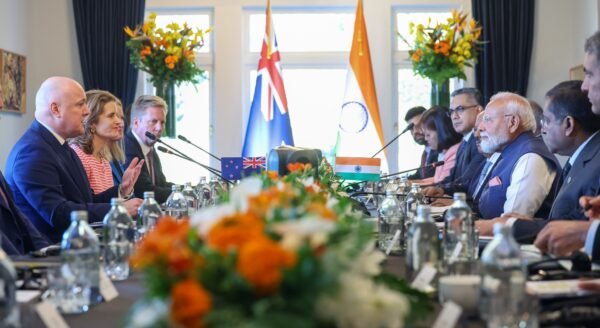
A Historic Visit and a New Trade Partnership
The July 11 visit by Indian Prime Minister Narendra Modi to New Zealand, coming on the heels of the bilateral Free Trade Agreement signed in April, marks a notable recalibration in Wellington’s external economic strategy. This was the first visit by an Indian prime minister since Rajiv Gandhi traveled to New Zealand in 1986, underscoring both the historical gap and the renewed political will to deepen ties. For decades New Zealand has oriented its major economic partnerships toward China and Australia, and to a lesser extent the United States, the United Kingdom, and the European Union, while relying primarily on Australia and other Western states for security. The new agreement and the accompanying high-level diplomacy signal an effort to expand and balance those relationships amid growing militarization and politicization across the Pacific.
Two-way annual trade between New Zealand and India currently stands at approximately $3.1 billion, of which New Zealand exports account for roughly $718 million, concentrated in wool, logs, and apples. The Indian government has described the FTA as a “forward-looking partnership” that promises additional economic opportunities for its labor-intensive sectors such as textiles and leather. On the New Zealand side, Trade Minister Todd McClay stated that the agreement would eliminate or reduce tariffs on 95 percent of exports, including kiwifruit, apples, meat, wool, coal, and forestry products. “It puts New Zealand exporters on an equal or better footing to our competitors across a range of sectors and opens the door to India’s rapidly expanding middle class,” McClay said. These concrete market-access provisions form the commercial core of the deal, even as broader strategic considerations shape its political significance.
From an academic perspective, the timing and framing of the agreement reflect a wider Asia-Pacific pattern in which middle powers seek to hedge against over-dependence on any single major economy. New Zealand’s open economy, in which trade in goods and services comprises about 50 percent of national output, has already produced free trade agreements with the United Kingdom, the European Union, and participation in the Comprehensive and Progressive Agreement for Trans-Pacific Partnership. The India FTA extends that network into a market that has overtaken Japan as the world’s fourth-largest economy and is projected to grow at more than 6 percent in the coming years. Limited prior commercial penetration of the subcontinent by New Zealand firms makes the agreement an explicit attempt to alter that trajectory.
Economic Stakes and Domestic Controversies in Wellington
Although the trade legislation supporting the deal passed its first reading in Parliament at the end of June with Labour Party support, the agreement has generated substantial domestic controversy. Foreign Minister Winston Peters, leader of New Zealand First, the Nationals’ coalition partner, objected on several grounds. He argued that the FTA adversely affected national migration policy, failed to secure sufficient access for dairy products, and imposed unrealistic investment obligations on New Zealand business. Peters told Radio New Zealand that “the deal was neither free, nor fair,” adding that he had “seen deals where the objective was for political purposes rather than economic advantage for New Zealand. This is one of those.”
A central point of contention concerns whether the agreement “commits” New Zealand to invest $20 billion over the next 15 years or merely requires it to “promote” investment in India. Critics have observed that reaching such an investment volume is improbable for an economy of New Zealand’s size, and that shortfalls could allow India to claw back market access. The Māori Party (Te Pāti Māori) has rejected the agreement for failing to uphold Te Tiriti o Waitangi / the Treaty of Waitangi or to protect Māori interests. More vituperative rhetoric has also surfaced: Shane Jones, deputy leader of New Zealand First, warned of a “butter chicken tsunami,” while Destiny Church leader Brian Tamaki urged New Zealand to “purge” Hindus, Sikhs, and Muslims in response to claimed persecution of Christians in India under Modi—remarks that drew widespread condemnation across the political spectrum.
These domestic debates illustrate the classic tension in open trading states between aggregate welfare gains and distributional or identity-based concerns. Dairy access limitations, investment reciprocity, and Treaty obligations are not peripheral; they touch core constituencies and constitutional principles. Yet the government’s rationale remains clear: diversification of export markets and supply chains reduces vulnerability to any single partner’s political leverage. The legislation continues to move through parliamentary stages, and the agreement’s provisions are therefore best understood as coming into force through a phased process rather than as fully operational at present.
Diversifying Beyond China: New Zealand’s Strategic Calculus
The FTA is explicitly framed as an effort to diversify import and export supply chains away from heavy dependence on China. New Zealand policymakers have registered the vulnerabilities that such concentration can create, including the possibility that Beijing might leverage trading relationships to pursue broader political objectives. This calculus is not unique to Wellington; it resonates across the Asia-Pacific, where states of varying sizes have sought to rebalance commercial exposure without precipitating outright decoupling.
India’s demographic and growth trajectory supplies the positive counterpart to that risk-management logic. With a rapidly expanding middle class and competitive labor-intensive manufacturing, India offers New Zealand exporters of agricultural and forestry products a market whose scale and growth rates differ markedly from those of traditional partners. At the same time, the agreement embeds political and security components that parallel the trading relationship—an increasingly common feature of contemporary trade diplomacy. The India–New Zealand “Roadmap to 2030” outlines commitments to improve bilateral ties in investment and technology, thereby linking commercial access to longer-term strategic cooperation.
For scholars of international political economy, the New Zealand case demonstrates how middle powers can use preferential trade agreements both to capture efficiency gains and to signal alignment preferences in a more contested regional order. The careful sequencing—signature in April, high-level visit in July, legislative progress thereafter—illustrates the domestic political management required to sustain such diversification.
South Korea’s Trade Diversification Imperative
South Korea’s own experience supplies a particularly instructive parallel. For decades Seoul has maintained deep economic interdependence with China while anchoring its security relationship with the United States. Chinese demand has been central to the export performance of major chaebol in electronics, automobiles, petrochemicals, and intermediate goods. Yet episodes of economic coercion—most notably following the 2016 decision to deploy the Terminal High Altitude Area Defense system—underscored the political risks of concentrated exposure. Successive Korean administrations have therefore pursued diversification as a strategic necessity rather than a discretionary preference.
The Comprehensive Economic Partnership Agreement between Korea and India, which entered into force in 2010, constituted an early institutional step. Under President Moon Jae-in’s New Southern Policy, launched in 2017, Seoul sought systematically to elevate economic and diplomatic engagement with ASEAN and India. The subsequent Yoon Suk-yeol administration has reframed these efforts within a broader Indo-Pacific Strategy that emphasizes supply-chain resilience, technology cooperation, and rules-based order. Korean firms, including leading chaebol, have expanded manufacturing footprints in India, particularly in automobiles and electronics, precisely to reduce single-market vulnerability and to position themselves for India’s domestic demand growth.
Daily life and industrial policy in Korea are directly implicated. Export-oriented employment, small- and medium-enterprise supply chains linked to chaebol production networks, and the education of a workforce capable of operating in diverse markets all depend on successful diversification. Korean universities and vocational institutions have correspondingly increased language and area-studies offerings related to South Asia, while government agencies such as the Ministry of Trade, Industry and Energy and the Korea Trade-Investment Promotion Agency have intensified matchmaking and risk-assessment services for Indian market entry. These practical measures mirror New Zealand’s recognition that formal tariff reductions must be accompanied by sustained commercial and institutional effort.
Navigating the China-India Balance: Lessons for Seoul
Korea’s navigation of the China–India relationship is more complex than a simple substitution of one large market for another. China remains an indispensable trading partner, a critical node in regional production networks, and a permanent geographic neighbor whose policies affect the Korean Peninsula directly. India, by contrast, offers demographic scale, democratic institutional affinity, and growing strategic weight within the Quad and other Indo-Pacific frameworks, yet its regulatory environment, infrastructure constraints, and competitive manufacturing ambitions present distinct challenges for Korean investors.
The New Zealand–India FTA therefore carries analytical value for Seoul. First, it illustrates how a smaller open economy can pursue ambitious market-access goals while managing domestic distributional and identity politics—an experience relevant to Korean debates over agricultural sensitivities and labor mobility. Second, the explicit linkage of trade provisions to a “Roadmap to 2030” covering investment and technology cooperation offers a template for upgrading Korea’s own CEPA with India into a more comprehensive strategic-economic partnership. Third, the cautious public framing—emphasizing opportunity and resilience rather than confrontation—provides a diplomatic vocabulary that Korean policymakers have already employed and can refine further.
Inter-Korean dynamics add another layer. Any sustained deterioration in China–Korea economic relations would constrain Seoul’s capacity to manage North Korea through a combination of pressure and engagement, given Beijing’s residual influence in Pyongyang. Diversification toward India and other partners therefore serves not only commercial risk management but also the preservation of strategic autonomy on the Peninsula. Historical precedents, including Korea’s earlier diversification drives after the Asian financial crisis and after THAAD-related retaliation, demonstrate that such rebalancing is possible when underwritten by consistent policy attention and chaebol investment decisions.
Broader Implications for Northeast Asian Diplomacy
Viewed from Northeast Asia, the New Zealand–India agreement contributes to a gradual multipolarization of economic diplomacy. It reinforces the trend whereby states seek overlapping rather than exclusive partnerships, thereby reducing the zero-sum character of great-power competition. For South Korea, Japan, and even Taiwan, the demonstration that India is prepared to conclude high-standard trade agreements with partners of varying sizes strengthens the case for deeper engagement with New Delhi. Simultaneously, it reminds Beijing that commercial over-concentration can prompt hedging behavior among its trading partners.
Regional institutions and minilateral formats will feel secondary effects. The Comprehensive and Progressive Agreement for Trans-Pacific Partnership, RCEP, and various Indo-Pacific economic frameworks all gain additional texture when bilateral deals such as New Zealand–India create new nodes of connectivity. Korean diplomacy, which has long emphasized both multilateral rules and bilateral FTAs, is well positioned to exploit these complementarities. The Ministry of Foreign Affairs and the presidential office will continue to calibrate messaging so that closer India ties are not interpreted in Beijing as containment, while still delivering tangible diversification benefits to Korean industry and consumers.
Educational and societal dimensions should not be overlooked. As Korean students, professionals, and tourists increase their exposure to India, and as Indian professionals and students become more visible in Korea, mutual familiarity can underwrite the political sustainability of closer economic ties. Parallel processes are already visible in New Zealand’s own debates over migration and cultural accommodation, debates that Korean society will encounter in its own form as people-to-people links expand.
Strategic Significance and the Path Ahead
The New Zealand–India Free Trade Agreement, still progressing through domestic legislative stages after its April signature and the July 11 Modi visit, is best understood as an instrument of both commercial opportunity and strategic hedging. It does not sever New Zealand’s extensive ties with China, Australia, or traditional Western partners; rather, it adds a significant new vector. The controversies surrounding dairy access, investment commitments, Treaty obligations, and migration illustrate that such diversification is politically costly and requires careful management. Yet the underlying logic—reducing vulnerability while capturing growth in a major emerging market—remains compelling for open economies throughout the Asia-Pacific.
For South Korea, the episode supplies both validation and caution. Validation, because Seoul’s multi-year effort to elevate India within its foreign economic policy rests on the same structural diagnosis of China risk and Indian opportunity. Caution, because domestic political economy constraints, regulatory complexity in India, and the need to preserve workable relations with Beijing all limit the speed and scope of rebalancing. Chaebol investment decisions, government facilitation through agencies such as KOTRA, and sustained diplomatic attention will determine whether Korea converts formal agreements into durable market share and supply-chain resilience.
In the broader architecture of Asia-Pacific diplomacy, the agreement signals that middle powers retain agency. They can negotiate preferential access, link trade to technology and investment roadmaps, and thereby shape the density of regional economic networks. As India continues its rise and as China remains central to global production, the capacity of states such as New Zealand and South Korea to diversify without decoupling will constitute a key test of whether the regional order evolves toward managed multipolarity or sharper fragmentation. The careful, phased implementation of the New Zealand–India FTA offers one empirical data point in that larger strategic experiment.
By Prof. David Park, Staff WriterThis article was produced with AI-assisted research and editorial support. Reporting is based on sources cited in the article.
What's Your Reaction?
 Like
0
Like
0
 Dislike
0
Dislike
0
 Love
0
Love
0
 Funny
0
Funny
0
 Wow
0
Wow
0
 Sad
0
Sad
0
 Angry
0
Angry
0

East Asia/Technology Correspondent at Global1.News. Seoul-based voice covering Korean politics, technology, business, and culture. Analyzes how technology and geopolitics intersect across East Asia.












Comments (0)