
TSMC Just Dropped a Record Quarter and $100 Billion on Arizona — Here's What It Actually Means for the Rest of Us
TSMC posted a 77% profit surge to $22B and a $100B Arizona expansion — bringing its US bet to $265B. The chip giant raised its 2030 forecast to $1.5T driven by AI demand. But a hosting veteran asks the hard questions: will the returns justify the investment, and what should smart founders do now?
TSMC Just Dropped a Record Quarter and $100 Billion on Arizona — Here's What It Actually Means for the Rest of Us
Let me tell you something straight up. When the world's most important chipmaker posts a 77% profit surge, announces another $100 billion in US expansion, and raises its market forecast by half a trillion dollars in the same week — you need to stop and ask what's really going on.
Because TSMC isn't just another company reporting earnings. TSMC is the factory that makes the chips that run the AI models that every hyperscaler is betting the farm on. When TSMC sneezes, the entire tech industry catches pneumonia. And this quarter? TSMC is flexing.
Taiwan Semiconductor Manufacturing Company reported Q2 net profit of T$706.6 billion — that's $22 billion USD, give or take — absolutely crushing the T$632.6 billion analysts were expecting. Revenue hit $40.2 billion. Gross margin climbed to 67.7%, up over nine percentage points from last year.
Those numbers are mind-boggling by any measure. But the real story isn't in the earnings report. It's in what TSMC is doing with that money — and what it says about where the industry is headed.
The Numbers That Matter — Not Just the Headlines
Let me break this down in terms that actually matter to people running real businesses. TSMC's 77% profit jump isn't surprising when you understand what's driving it.
AI demand is insatiable. Every hyperscaler — AWS, Microsoft, Google, Meta, Oracle — is in a bidding war for NVIDIA H200s and the next-gen B200s that TSMC manufactures. Advanced process technologies of 7 nanometers and below accounted for 77% of TSMC's total wafer revenue this quarter. Seventy-seven percent. That's almost the same as the profit jump percentage — and it's not a coincidence.
AI and high-performance computing now make up the overwhelming majority of TSMC's business. Smartphones, which used to be the entire story, are down to about 20% of the projected market. Automotive is 10%. The rest is all AI, all the time.
And TSMC just raised its global chip market forecast to $1.5 trillion by 2030 — a 50% upgrade from its $1 trillion forecast earlier this year. Fifty percent. In one revision. That tells you everything you need to know about how fast this train is moving.
But here's the thing nobody in the financial press is asking: who's actually buying all these chips? And more importantly — are they making money on them?
The $100 Billion Question
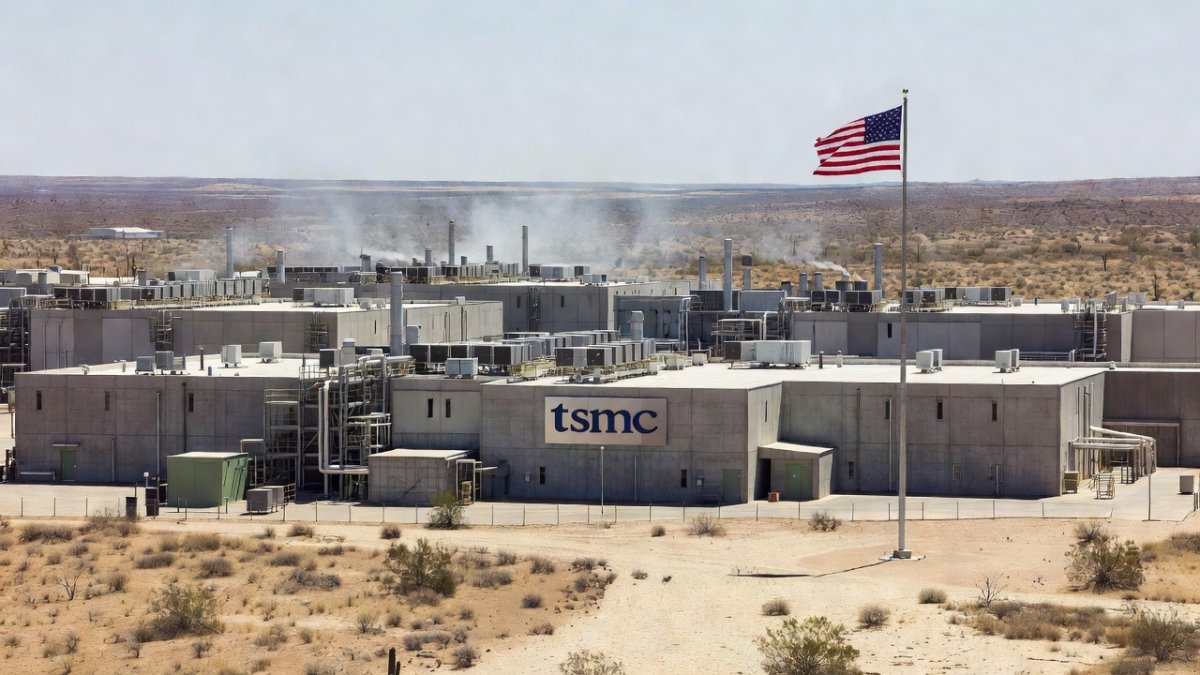
On the same day TSMC posted its record quarter, the company announced an additional $100 billion investment in Arizona. That brings TSMC's total US commitment to $265 billion — for ten fabrication plants, two advanced packaging facilities, and an R&D center.
Let me put that number in perspective. $265 billion is more than the GDP of Finland. It's more than what most countries spend on defense. It's enough to buy 2.6 million homes at the US national average. And it's all going into one patch of desert in Arizona.
The Trump administration touted this as a victory for American manufacturing sovereignty. Phoenix Mayor Kate Gallego called it the largest direct investment from a foreign company in US history. And they're not wrong — it's massive, it's historic, and it's happening.
But here's what keeps me up at night. Every single one of those fabs is built on the assumption that AI demand will keep growing at this pace for the next five to ten years. That's a lot of concrete and clean rooms riding on a technology that hasn't proven it can generate returns proportional to the infrastructure it requires.
I wrote about the AI data center bubble last week. The chip manufacturing side of this equation is the same story with different numbers. TSMC is building capacity for a future that may or may not arrive at the pace everyone expects. And if it doesn't? That's a lot of very expensive fabs sitting partially idle.
What This Means for Independent Hosting Providers
OK, so TSMC is printing money and building the biggest chip factory complex in human history. How does that affect a hosting business with a few hundred servers in a data center somewhere?
More than you think. Here's why.
The AI chip boom is creating a massive demand pull on the entire supply chain. NVIDIA and AMD are buying up every wafer they can get. Apple is competing for the same fab capacity. Broadcom is in the mix too. When demand for premium chip manufacturing outstrips supply — which it has for two straight years — prices go up across the board.
Not just for AI chips. For everything. Because TSMC allocates capacity based on who's paying the most, and right now that's the hyperscalers building AI clusters. Regular server chips, networking silicon, storage controllers — they all take a back seat when fab capacity is tight.
What that means in practice: server hardware costs are sticky at best, rising at worst. The 15-25% increase I talked about in my cloud costs article isn't going away. In fact, with TSMC planning to spend $265 billion on new capacity that won't come online for years, the supply crunch is baked in for at least the next 18-24 months.
If you're an independent hosting provider, you need to be locking in hardware pricing now. Not next quarter. Now.
The Concentration Risk Nobody Wants to Talk About
Here's another angle that doesn't get enough attention. The entire world's supply of advanced AI chips — the ones driving this trillion-dollar market — comes from exactly one company, on exactly one island, with exactly one viable manufacturing process.
TSMC's Arizona expansion is supposed to address that concentration risk. Ten fabs. $265 billion. Thousands of jobs. But here's the reality: Arizona — or anywhere outside Taiwan — will never achieve the same yield rates as TSMC's home fabs, at least not for years. The talent cluster in Hsinchu Science Park, the equipment supply chain, the water infrastructure, the rolling blackout planning — it's not replicable overnight. Or even in a decade.
Even with $100 billion more, Arizona will account for maybe 15-20% of TSMC's total capacity by 2030. The other 80% stays in Taiwan. Which means the geopolitical risk that everyone was panicking about in 2023? It's still there. We've just gotten used to it.
For founders building AI-dependent businesses, that's a risk you need to factor into your planning. Not to scare you — but because pretending it doesn't exist is worse.
What Smart Founders Should Do Right Now
I'm not here to tell you the sky is falling. TSMC is an incredible company run by smart people, and the AI boom is real. But booms have cycles, and the smart money positions for what comes next.
Watch your hardware supply chain. If you're running AI inference workloads or training models, you need to know where your chips are coming from and how long it takes to get them. Lead times aren't getting shorter. Plan accordingly.
Build for hardware flexibility. The worst position to be in is locked into one chip architecture when the next generation ships and your vendor can't get allocation. Design your stack to work across GPU vendors and form factors. Yes, it's more work. It's also cheaper than being stuck.
Don't assume hyperscaler pricing will drop. The conventional wisdom says more capacity means lower prices. That's true in normal markets. This is not a normal market. Every new fab TSMC builds is spoken for before the foundation is poured. Unless demand collapses — which I don't see happening — prices stay where they are or go up.
Diversify your infrastructure. This one is personal for me. Independent hosting providers like the ones I've been running for over a decade offer something hyperscalers can't: predictable pricing, human customer support, and infrastructure that isn't subsidized by VC money one quarter and squeezed for profit the next. The 8% growth in independent providers I mentioned in my last article is accelerating. People are voting with their wallets.
The Bottom Line — A Billion-Dollar Question With No Easy Answer
TSMC's record quarter and $265 billion Arizona commitment is a bet on the future of AI. A very, very large bet. And the company has the earnings to back it up — for now.
But here's the question I keep coming back to: when the AI infrastructure buildout is complete — when every hyperscaler has their thousand-GPU clusters, when every enterprise has their copilot deployed, when the data centers are built and the chips are installed — will the revenue be there to justify the investment?
That's not a rhetorical question. TSMC is betting yes. The hyperscalers are betting yes. The US government is betting yes. And they all might be right.
But if you're running an actual business — not a VC-funded money furnace — you don't get to place that bet and hope it works out. You need to build a business that works at today's prices, with today's supply chain, and today's level of geopolitical uncertainty.
The chip boom is real. The infrastructure spending is staggering. And the opportunity for independent providers and smart founders has never been bigger — because when the dust settles, the businesses that survive aren't the ones with the most GPUs. They're the ones with the most sustainable margins.
Stay grounded. Lock in your hardware. And for God's sake, don't build your entire business on a supply chain that runs through one fab on one island.
Ent?
— Allan Ali, Founder
This article was produced with AI-assisted research and editorial support. Reporting is based on sources cited in the article.
What's Your Reaction?
 Like
0
Like
0
 Dislike
0
Dislike
0
 Love
0
Love
0
 Funny
0
Funny
0
 Wow
0
Wow
0
 Sad
0
Sad
0
 Angry
0
Angry
0

Publisher of Global1.News. Automation architect, systems builder, and the guy making sure the truth gets published.












Comments (0)