
The Chinese Graduate Accused of Being Mexico's Fentanyl King
The Chinese graduate accused of being Mexico's fentanyl king stands at the center of a pipeline that has flooded North and South American streets with synthetic opioids, devastating families from the mountains of Sinaloa to the favelas of Rio de Janeiro.
The Chinese graduate accused of being Mexico's fentanyl king stands at the center of a pipeline that has flooded North and South American streets with synthetic opioids, devastating families from the mountains of Sinaloa to the favelas of Rio de Janeiro. Cartel members and former associates have detailed how Zhang Zhidong allegedly coordinated shipments of precursor chemicals, turning academic credentials from Peking University into a bridge between Chinese ports and Mexican laboratories. This network, if the allegations hold, exposes how global trade routes enable criminal empires that ignore borders and exploit weak oversight across Latin America.
Chinese Graduate Named in Mexico Fentanyl Pipeline Probe
Mexico City, Mexico — In recent days, fresh testimony from detained cartel operatives has pointed to Zhang Zhidong as the alleged architect linking Chinese chemical suppliers to production sites run by the Sinaloa Cartel and the Jalisco New Generation Cartel. Investigators describe a system that moved precursors through established commercial channels into Pacific ports, sustaining labs that produce the fentanyl now reaching communities far beyond Mexico's borders. The case highlights persistent gaps in monitoring that allow such flows to continue despite years of bilateral pressure.
Zhang Zhidong's Alleged Path from University to Cartel Supply Lines
Zhang Zhidong, described by ex-colleagues as a sharp operator with strong logistics knowledge, reportedly used his background to identify and secure chemical sources in eastern China. Sources close to the investigation say he established connections that funneled materials through legitimate-looking export channels. These moves allegedly allowed precursors to reach Mexican soil without immediate detection by customs authorities at key entry points.
Former associates have told authorities that Zhang positioned himself as a reliable intermediary who understood both regulatory paperwork and the demands of large-scale buyers. His alleged role expanded as demand for fentanyl precursors grew, turning what began as isolated shipments into a steady stream. This pattern mirrors other cases where educated professionals have been drawn into transnational networks operating across the Pacific.
Zhang Zhidong’s trajectory from the laboratories of Peking University to the hidden supply chains feeding Mexican cartels reveals how technical expertise can be quietly repurposed for devastating ends. Trained in chemistry and industrial logistics, he would have studied the precise molecular structures and transport protocols that later allowed precursors to move undetected across oceans. In a country where state-backed mining firms often serve as legitimate covers for resource extraction, Zhang allegedly learned to exploit the same bureaucratic opacity, registering shell companies that masked chemical shipments as industrial minerals destined for Latin American markets.
This pattern echoes earlier cases of Chinese professionals drawn into cartel networks, where educated intermediaries known as “Brother Wang” figures broker deals between factories in Guangdong and plazas in Sinaloa or Michoacán. These men rarely touch the product themselves; instead they manage paperwork, bribe port officials, and maintain the fiction of ordinary commerce. What makes Zhang’s story especially painful for communities across Mexico is the realization that the same skills once celebrated as engines of development now accelerate the flow of deadly synthetics into neighborhoods already scarred by poverty and violence.
Shipments Routed Through Pacific Ports to Inland Labs
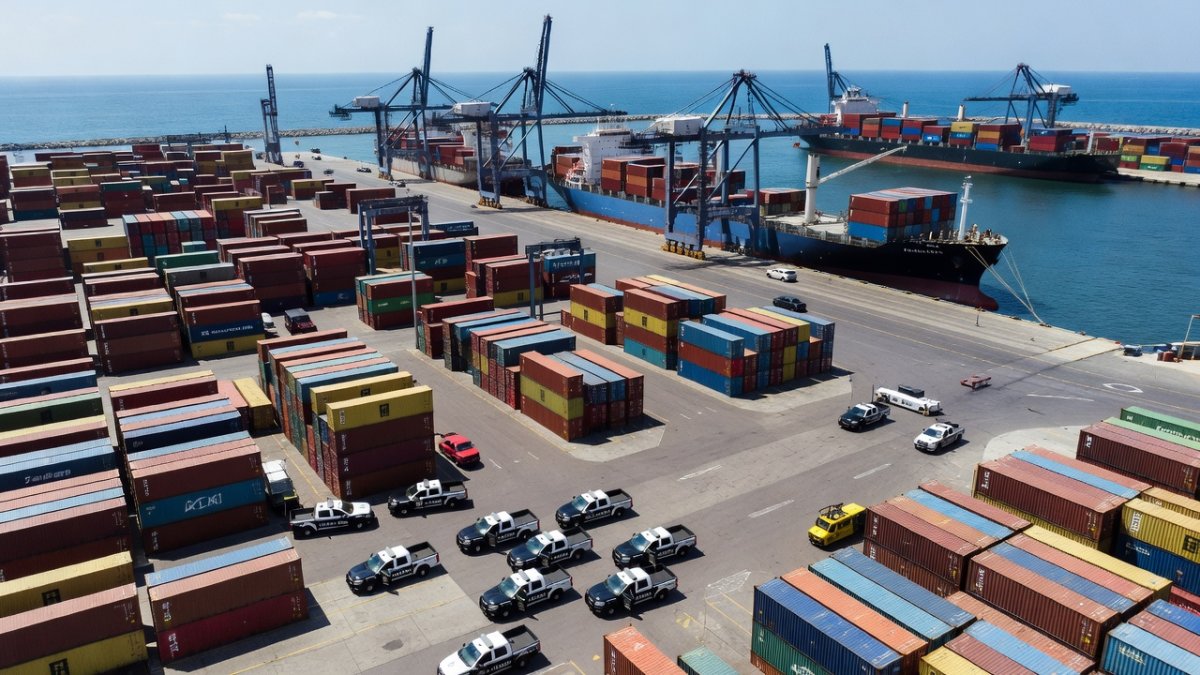
Precursors allegedly traveled from Shanghai and Ningbo ports aboard vessels bound for Manzanillo and Lázaro Cárdenas. Once unloaded, the chemicals moved inland toward production facilities concentrated around Culiacán. Cartel members have described how these deliveries supported continuous output that fed distribution networks stretching into the United States and southward into Central America.
Port records and witness statements suggest the use of standard commercial documentation to mask the true end users. Mining company fronts reportedly provided cover for the cargo manifests, allowing containers to clear inspections more easily. This method exploited the high volume of legitimate mineral trade between Asia and Mexico's Pacific coast, a route long used for both legal commerce and illicit goods.
Manzanillo and Lázaro Cárdenas handle millions of containers each year, their vast terminals offering perfect camouflage for chemical precursors hidden among legitimate cargo. Forklifts move steel boxes day and night while customs officers, stretched thin by inspection rates below two percent, rely on manifests that list harmless industrial compounds. Chinese export controls exist on paper, yet the sheer volume of traffic and the use of third-party logistics firms create layers of deniability that allow tainted shipments to clear both ends of the Pacific route with minimal scrutiny.
False documentation turns routine container movements into invisible pipelines. A single mislabeled consignment can supply an inland lab for months, feeding the production of fentanyl and other synthetics that eventually reach Mexican streets and cross the northern border. The ports’ infrastructure, built to accelerate global trade, now accelerates tragedy for the very communities whose labor keeps those terminals running.
Supplying Sinaloa and CJNG Operations in Culiacán
Inside Culiacán, laboratories allegedly converted the incoming precursors into finished fentanyl products under the direction of both the Sinaloa Cartel and CJNG factions. Operatives have recounted how Zhang's shipments arrived with enough volume to keep multiple sites running at capacity. The resulting product then moved through established smuggling corridors that reach far into South America.
Regional enforcement agencies, including Mexico's Policia Federal and Fiscalía General, have documented the human cost in communities where addiction rates have climbed sharply. Similar patterns appear in Colombia and Peru, where precursor diversion has also been reported, showing how one pipeline can destabilize public health across several nations. Local hospitals in western Mexico report rising overdose cases that echo trends seen in Brazilian cities dealing with synthetic drugs arriving via Pacific routes.
Front Companies, Corruption, and Enforcement Gaps
Investigators point to mining-related entities as the primary vehicles for concealing the chemical shipments. These fronts allegedly handled paperwork that satisfied port authorities while shielding the actual buyers. Corruption at various levels of the supply chain has complicated efforts by SEMAR and customs officials to intercept every suspicious container.
Transnational enforcement remains difficult because coordination between Chinese export regulators, Mexican port security, and Latin American police forces often lags behind the speed of the networks. Brazilian Policia Federal operations have uncovered parallel routes that feed synthetic opioids into the Southern Cone, underscoring the shared challenge of monitoring vast maritime trade lanes. Without stronger real-time information sharing, such pipelines continue to adapt faster than authorities can respond.
Recent scandals at Mexican ports have exposed how bribes paid to mid-level customs agents and port administrators allow front companies to operate for years before detection. China-Mexico bilateral agreements on precursor control remain largely symbolic, hampered by differing legal definitions and limited real-time intelligence sharing. SEMAR and the Policía Federal face chronic underfunding and jurisdictional rivalries that leave gaps wide enough for sophisticated networks to exploit, while local officers risk their lives confronting organizations that can replace any seized shipment within weeks.
Brazil’s Polícia Federal offers a telling contrast, having developed specialized chemical-monitoring units that track precursors through domestic ports and airports with greater consistency. Yet even there, political interference and resource shortages limit impact. Across the region, enforcement remains reactive rather than preventive, leaving vulnerable populations to absorb the human cost while powerful interests on both sides of the Pacific continue to profit.
Regional Fallout Across Latin American Communities
The alleged pipeline has intensified violence in Mexican states already strained by cartel competition, while addiction and overdose deaths climb in urban centers from Guadalajara to São Paulo. Families in rural Sinaloa and coastal Michoacán describe lost sons and daughters, a story repeated in Colombian and Peruvian towns where similar chemical flows have taken root. Economic pressures in these areas make recruitment into the trade more appealing for young people with limited options.
Governments across the region face the dual burden of confronting powerful criminal organizations while addressing the social damage left behind. Public health systems in Mexico and Brazil alike struggle to expand treatment capacity fast enough to match the spread of synthetic opioids. The case of Zhang Zhidong, if proven in court, illustrates how distant decisions in Chinese ports can reshape daily life in Latin American neighborhoods thousands of kilometers away.
In Brazil the arrival of synthetic opioids has already begun reshaping the drug landscape in São Paulo’s favelas, Rio’s peripheral neighborhoods, and even the planned avenues of Brasília. Young people who once encountered only cocaine or crack now face substances far more lethal and addictive, overwhelming under-resourced public clinics that lack both naloxone and specialized treatment protocols. Colombia and Peru, long focused on coca eradication, confront similar blind spots as precursor chemicals slip through their own ports and border crossings.
Latin America’s public-health response lags far behind the coordinated systems of the United States and Europe, where harm-reduction programs and surveillance networks at least attempt to track synthetic threats. Here the burden falls heaviest on the poorest communities, where inequality already determines who receives medical care and who is left to bury their children. The same structural neglect that once allowed cartels to recruit now allows their newest products to claim lives with little organized resistance from the state.
By Elena Vasquez, Staff WriterThis article was produced with AI-assisted research and editorial support. Reporting is based on sources cited in the article.
What's Your Reaction?
 Like
0
Like
0
 Dislike
0
Dislike
0
 Love
0
Love
0
 Funny
0
Funny
0
 Wow
0
Wow
0
 Sad
0
Sad
0
 Angry
0
Angry
0

Latin America Correspondent at Global1.News. Based in Mexico City, covering politics, economics, energy, and culture across the region. Brings an on-the-ground perspective to stories spanning from the Rio Grande to Patagonia.












Comments (0)