
Xi Jinping's 2026 Pyongyang Summit: Strategic Signals and Korean Peninsula Repercussions
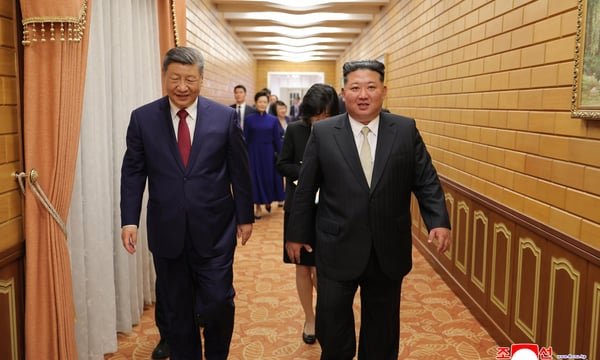
Xi Jinping's 2026 Pyongyang Summit: Strategic Signals and Korean Peninsula Repercussions Historical Context of the Xi-Kim Summit Xi Jinping's 2026 visit to Pyongyang marked his first trip to the North Korean capital since 2019 and his initial overseas engagement of the year. This timing positioned the summit as a deliberate signal within the broader architecture of Northeast As
Historical Context of the Xi-Kim Summit
Xi Jinping's 2026 visit to Pyongyang marked his first trip to the North Korean capital since 2019 and his initial overseas engagement of the year. This timing positioned the summit as a deliberate signal within the broader architecture of Northeast Asian diplomacy, where China-North Korea ties have long served as a counterweight to U.S. alliances on the peninsula. For South Korean policymakers in Seoul, the resumption of high-level contact between Beijing and Pyongyang raises immediate questions about the durability of inter-Korean channels, particularly as the Lee Jae-myung administration seeks to calibrate its own outreach amid shifting great-power alignments.
The two leaders framed the encounter in familiar language of continuity, with Kim Jong Un describing the relationship as solid and Xi Jinping expressing intent to elevate ties to new heights. Both sides pledged future engagement through high-level visits and expanded cooperation across political, social, cultural, and economic domains, according to KCNA reporting. Yet the absence of concrete deliverables beyond these general commitments underscores how historical patterns of symbolic diplomacy continue to shape outcomes, leaving South Korean analysts to assess whether renewed Beijing-Pyongyang coordination will constrain or enable renewed inter-Korean dialogue.
South Korea's foreign policy establishment has historically viewed such summits through the lens of alliance management, recognizing that any deepening of China-North Korea coordination directly influences the strategic space available for Seoul's independent initiatives. The 2026 meeting therefore revives longstanding debates within Korean academic and policy circles about the limits of multilateral pressure on Pyongyang when one key interlocutor prioritizes bilateral stability over denuclearization objectives.
The Nuclear Red Line: Pyongyang's Unwavering Position
Throughout the summit, denuclearization remained an explicit red line for North Korea, with Pyongyang publicly rejecting calls from Washington, Seoul, and Beijing alike. Kim Jong Un disclosed the launch of a new nuclear material production facility and announced plans to further strengthen the country's nuclear arsenal, framing these steps as essential to national defense. Kim Yo Jong reinforced this stance by describing North Korea's status as a nuclear weapons state as a stark reality and nuclear weapons as the core force underpinning sovereignty.
This posture directly constrains South Korean foreign policy options, as any inter-Korean engagement must now navigate Pyongyang's insistence that its nuclear capabilities are non-negotiable. Seoul's diplomatic initiatives, whether bilateral or through trilateral frameworks involving the United States, face structural limits when the counterpart views denuclearization itself as an existential threat rather than a bargaining position. The summit's silence on the phrase "denuclearization of the Korean Peninsula" mirrors the omission seen in Xi Jinping's recent meetings with Lee Jae-myung and Vladimir Putin, signaling a shared reluctance among these capitals to press the issue.
From the perspective of Korean Peninsula stability, Pyongyang's public emphasis on nuclear expansion during the Xi visit suggests that inter-Korean relations will remain frozen along security lines unless South Korean strategy adapts to a reality in which nuclear status is treated as permanent. This development compels Seoul to weigh the costs of continued sanctions coordination against the possibility of limited economic or humanitarian engagement that does not challenge the nuclear program.
Selective Disclosure: What KCNA Left Out
KCNA reported agreements to strengthen bilateral ties through high-level visits and cooperation in political, social, cultural, and economic spheres, yet omitted references to diplomacy, law enforcement, and military affairs that Chosun Daily indicated were also discussed. This selective presentation highlights how North Korean state media shapes domestic and international narratives to emphasize economic and political solidarity while downplaying security dimensions that could alarm neighbors. For South Korean observers, such omissions complicate assessments of whether the summit produced tangible shifts in the military balance on the peninsula.
The potential for future military exchanges carries vast implications for regional stability, as any institutionalization of China-North Korea defense coordination would alter the threat environment facing South Korean forces. Seoul's defense planning and alliance management with Washington must therefore account for the possibility that agreements reached in Pyongyang could translate into operational cooperation not publicized through KCNA channels. This information asymmetry places additional burdens on South Korean intelligence and diplomatic reporting.
Inter-Korean relations suffer when transparency is lacking, because South Korean policymakers cannot reliably gauge whether Beijing has secured influence over Pyongyang's military posture or merely acquiesced to existing arrangements. The pattern of selective disclosure thus reinforces the need for Seoul to maintain independent verification mechanisms rather than relying solely on official North Korean or Chinese statements when formulating responses to summit outcomes.
The Russia Factor: Choe Son-hui's Parallel Diplomacy
In advance of the summit, North Korean Foreign Minister Choe Son-hui described relations with Moscow as sharing a common position on all strategic issues at the level of an alliance, a characterization that KCNA notably declined to cover. This parallel track of diplomacy underscores Pyongyang's diversified external partnerships and suggests that Xi Jinping's appeals for greater strategic coordination and military exchanges with North Korea reflect awareness of comparative deficits relative to Russia-North Korea ties. South Korean foreign policy must therefore track multiple vectors of North Korean engagement rather than focusing exclusively on the Beijing channel.
The contrast between publicized China-North Korea economic and political cooperation and the quieter Russia alignment reveals Kim Jong Un's ability to leverage competing patrons. For Seoul, this dynamic complicates efforts to build regional consensus on sanctions enforcement or denuclearization pressure, as North Korea can offset Chinese restraint by deepening ties elsewhere. The omission of Choe Son-hui's Russia remarks from KCNA further illustrates how information control serves to obscure the full scope of Pyongyang's strategic options.
Inter-Korean relations are indirectly affected because South Korea's own outreach to Moscow and Beijing must now factor in North Korea's demonstrated capacity to maintain parallel alliances. This reality encourages Seoul to pursue more autonomous foreign policy postures that do not assume unified great-power pressure on Pyongyang, while still recognizing the enduring importance of China as North Korea's primary economic partner.
South Korea's Strategic Calculus
Media coverage across Pyongyang, Beijing, Moscow, and Seoul reflected divergent national priorities, with each capital projecting its own hopes and concerns onto the Xi-Kim encounter. South Korean reporting, exemplified by Chosun Daily's attention to omitted military and law-enforcement provisions, demonstrates a focus on security implications that Chinese and North Korean outlets minimized. This divergence in emphasis requires Seoul's foreign policy community to synthesize multiple narratives when evaluating summit consequences for inter-Korean stability.
By avoiding concessions and keeping neighbors uncertain about his intentions, Kim Jong Un appears to have extracted the greatest advantage from the visit, preserving maximum flexibility in both nuclear and conventional domains. South Korean strategists must therefore design policies that anticipate continued North Korean opacity rather than expecting the summit to produce moderating effects. The lack of any denuclearization discussion across Xi's recent meetings with Lee Jae-myung, Putin, and Kim further narrows the diplomatic toolkit available to Seoul.
Daily life in South Korea remains shaped by these high-level dynamics through persistent security tensions and economic uncertainty tied to North Korean behavior. Policymakers in Seoul consequently prioritize alliance resilience and diversified economic partnerships as hedges against the possibility that renewed China-North Korea coordination will prolong the peninsula's division rather than facilitate reconciliation.
Forward-Looking Assessment for the Korean Peninsula
The 2026 summit reinforced existing patterns in which symbolic gestures of friendship substitute for substantive progress on core security issues. With both sides committing only to future engagement without timelines or benchmarks, the trajectory of China-North Korea relations offers limited grounds for optimism regarding near-term shifts in inter-Korean relations. South Korean foreign policy will likely continue to emphasize deterrence and alliance coordination while exploring selective engagement opportunities that do not require Pyongyang to alter its nuclear stance.
Regional stability hinges on whether military and law-enforcement exchanges materialize beyond the publicized economic and cultural domains. Should such cooperation advance, the implications for South Korea's defense posture and diplomatic maneuvering room would be significant, compelling adjustments in both bilateral relations with China and trilateral coordination with the United States. The summit's outcomes thus serve as a reminder that Korean Peninsula dynamics remain embedded within wider great-power competition.
Ultimately, the ability of South Korean institutions to navigate these developments will depend on accurate interpretation of selective disclosures and parallel diplomatic tracks. By maintaining analytical independence and focusing on verifiable developments rather than rhetorical commitments, Seoul can better position itself to respond to whatever concrete steps emerge from the renewed Beijing-Pyongyang dialogue.
By Prof. David Park, Staff WriterThis article was produced with AI-assisted research and editorial support. Reporting is based on sources cited in the article.
What's Your Reaction?
 Like
0
Like
0
 Dislike
0
Dislike
0
 Love
0
Love
0
 Funny
0
Funny
0
 Wow
0
Wow
0
 Sad
0
Sad
0
 Angry
0
Angry
0

East Asia/Technology Correspondent at Global1.News. Seoul-based voice covering Korean politics, technology, business, and culture. Analyzes how technology and geopolitics intersect across East Asia.














Comments (0)