
White Cheese Shortage Hits Israeli Supermarkets Amid Crisis
Cottage cheese shortage spreads to white cheese as Tnuva's Alon Tavor automated warehouse remains crippled by a months-long computer malfunction. German firm Dematic won't send technicians over security concerns, forcing remote fixes and manual workarounds while demand rises 4% and ministers stay silent.
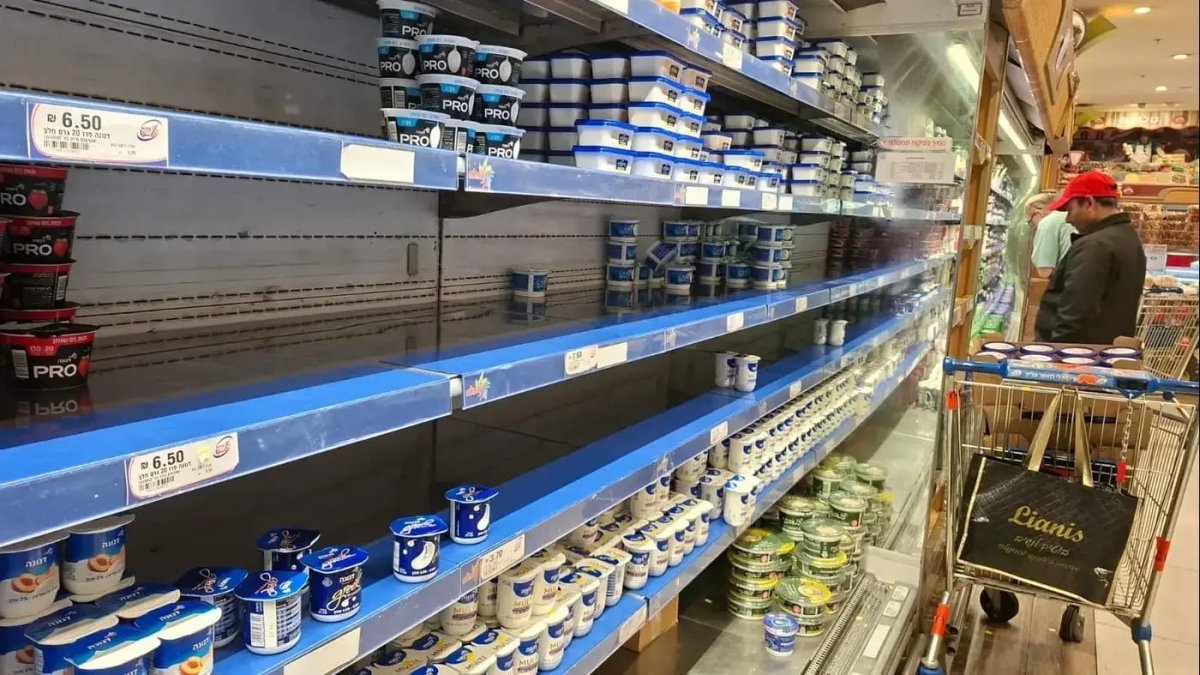
White Cheese Joins Cottage Cheese on Empty Supermarket Shelves
What began as a frustrating hunt for cottage cheese has, in recent days, spilled over into another staple of the Israeli refrigerator. Shoppers across the country report that white cheese, long a price-controlled fixture in dairy aisles, has become nearly as scarce as its better-known cousin. A frustrated consumer told local media that not a single major chain had even one tub of white cheese available, a complaint echoed in stores from Tel Aviv to Jerusalem and points north. The shortage is no longer confined to a single product; it is reshaping daily shopping routines and forcing households to rethink breakfast tables and recipe staples that have defined Israeli kitchens for generations.
Food market sources explain the expansion in straightforward terms. When cottage cheese disappears, consumers switch to white cheese and begin hoarding what they can find. That behavior empties shelves faster than suppliers can restock them, creating an escalating tailspin. Price-controlled white cheese, once a reliable budget option, is vanishing under the weight of redirected demand. The result is visible in supermarket chains including Shufersal and other major retailers, where dairy sections that once offered steady variety now display sparse rows and handwritten notes apologizing for temporary unavailability.
Consumer Frustration Mounts Across Retail Chains
The human face of the shortage is plain in checkout lines and social media posts. Families accustomed to keeping multiple tubs on hand for children, for baking, and for everyday meals now face empty coolers. Shoppers describe making multiple stops in a single afternoon, only to leave empty-handed. In some neighborhoods, the absence of white cheese has become a talking point as common as traffic or the weather. Because white cheese falls under price controls, the disappearance carries an extra sting: consumers cannot simply trade up to a premium alternative without feeling the pinch of higher costs elsewhere in the basket.
Retail staff have little to offer beyond assurances that deliveries are expected. Yet those deliveries remain inconsistent. The shortage has stretched long enough that some households report changing menus entirely, substituting yogurt or other dairy products when possible, or simply doing without. For a country where dairy forms a central part of the diet, and where cottage and white cheeses appear in everything from salads to pastries, the disruption reaches beyond inconvenience into the texture of daily life.
Root Cause Traced to Tnuva's Automated Warehouse in Alon Tavor
The origin of the crisis lies not in the dairy plants themselves but in logistics. At Tnuva's automated warehouse in Alon Tavor, a computer malfunction has been paralyzing outbound supply for more than two months. Production lines continue to operate. Cottage cheese is manufactured, packaged, and prepared for market. The bottleneck is movement: a large portion of finished product simply fails to leave the facility and reach retail shelves. The system that manages pallet movement and dispatch to trucks has been unreliable, turning a modern distribution hub into a choke point.
Alon Tavor, a key node in Israel's northern food logistics network, was designed for efficiency. Automation promised faster throughput and lower labor intensity. Instead, the malfunction has exposed how dependent the country's largest dairy supplier has become on a single technological layer. Manual workarounds exist, but they cannot match the volume the automated system was built to handle. The result is a steady drip of product rather than the full flow retailers and consumers expect.
Dematic System at the Center of the Breakdown
The warehouse automation was installed by the German company Dematic, a global specialist in such systems. Disruptions in the software and hardware that orchestrate pallet flows have persisted despite remote assistance. Dematic technicians have been supporting Tnuva teams via Zoom and phone calls, walking local employees through diagnostics and partial fixes. Tnuva staff have resorted to operating some systems manually. That limited solution keeps a fraction of capacity alive but cannot restore normal supply levels.
The distinction between production and distribution is critical. Tnuva and industry observers emphasize that the cheese itself is not the problem. The dairy is producing. Packaging lines are running. The failure sits in the digital and mechanical layer that should move finished pallets onto trucks bound for distribution centers and, ultimately, supermarket coolers in cities and towns across Israel. Until that layer is fully restored, the gap between what is made and what reaches shelves will continue.
Security Situation Keeps German Technicians Away
Here the story intersects with the broader security environment. Dematic has refused to send technicians to Israel because of the security situation. A visit that had been scheduled for the Tnuva site was canceled during Operation Lion's Roar following the war. The next available date is now set for months from now. In the interim, remote support is the only option on offer from the German side.
The contrast is instructive. A Dematic team did arrive in recent weeks for work at the Osem plant, but company representatives indicated it was a different team with different skills, not the specialists required for the Alon Tavor warehouse system. That distinction has left Tnuva without on-site expertise at the precise moment it is most needed. For an Israeli food giant whose distribution backbone depends on foreign-installed automation, the refusal underscores a vulnerability that extends beyond any single warehouse: when geopolitical risk rises, specialized foreign personnel can simply stay home.
Demand Surge Compounds the Supply Gap
Even a perfectly functioning warehouse would have faced pressure this year. Since the beginning of the year, demand for dairy products has risen by about 4 percent. One contributing factor is that fewer Israelis traveled abroad because of the security situation, keeping more consumers at home and shopping in local supermarkets. The high demand, combined with gaps that opened around the Shavuot holiday, has made it especially difficult to replenish stocks once they run low.
Shavuot traditionally drives a spike in dairy consumption. When supply chains are already strained, that seasonal surge leaves lasting holes. Retailers enter subsequent weeks with thinner inventories, and any further disruption such as the Alon Tavor malfunction turns a manageable dip into a visible shortage. The combination of elevated baseline demand and a logistics failure has created conditions in which even modest hoarding behavior by shoppers accelerates the emptying of shelves.
Tnuva's Dominance and Strauss's Position
Market structure amplifies the impact. Tnuva is the largest white cheese producer in Israel. Strauss holds about 30 percent of the market. When the leading supplier's distribution falters, the second player cannot instantly fill the void. Both companies have denied any artificial shortage, stating that production and supply are operating as usual on their end. The public statements aim to head off familiar suspicions that have accompanied past dairy shortages in Israel.
Yet the concentration of production capacity means that a single warehouse problem at the market leader ripples outward quickly. Smaller producers and importers lack the scale to compensate in real time. Retail buyers who normally rely on Tnuva volumes find themselves short, and the scramble for alternative sources further tightens availability of white cheese and related products. The episode illustrates how market share, normally a strength, becomes a systemic risk when infrastructure fails at the top.
Political Silence Draws Industry Criticism
Food market sources have not hidden their exasperation with the lack of visible government response. "Where are the agriculture minister, the economy minister, the finance minister?" one source asked. The suggestion on the table is blunt: if domestic supply cannot be restored quickly, open quotas and begin importing. Price-controlled staples occupy a politically sensitive category in Israel. Shortages invite public anger and media scrutiny, yet so far the relevant ministries have not announced emergency measures, temporary import relief, or a coordinated plan to stabilize dairy shelves.
The absence of action stands out because the tools exist. Quota adjustments and targeted imports have been used in previous agricultural shortfalls. The current crisis, rooted in a technical failure rather than a production collapse or a labor dispute, might seem easier to bridge with temporary external supply. That no such step has been taken leaves retailers and consumers to absorb the shortage while waiting for a repair timeline measured in months rather than days.
Past Suspicions Versus a Genuine Infrastructure Failure
Israelis of a certain age remember earlier dairy controversies in which accusations of artificial shortages circulated freely. Those episodes bred lasting skepticism toward large producers. The present crisis differs in character. Multiple accounts point to a documented computer malfunction in a specific automated warehouse, compounded by the inability of the foreign vendor to deploy technicians on site. Production continues; distribution does not. That factual core separates this event from earlier narratives of deliberate withholding.
Still, public trust is fragile. When shelves empty, the distinction between a logistics breakdown and an engineered scarcity can blur in the eyes of shoppers standing before an empty cooler. Transparent communication from Tnuva, clear timelines for repair, and visible contingency steps from regulators would help maintain confidence. Without them, even a genuine infrastructure failure risks being read through the lens of past grievances.
The Automation Paradox in Israel's Tech-Driven Economy
There is a deeper irony. Israel markets itself as a technological powerhouse, a nation of startups, cybersecurity firms, and advanced manufacturing. Its food sector has invested heavily in automation to raise efficiency and reduce costs. The Alon Tavor warehouse was part of that modernization. Yet the same sophistication creates a new dependency: when the system fails and the foreign specialists who built it will not board a plane because of the security situation, the advanced facility becomes a liability.
Remote support via Zoom can diagnose many problems, but complex warehouse automation often requires hands-on calibration, parts replacement, and on-site testing. Manual operation by local teams is a stopgap, not a substitute. The episode reveals a structural tension in the Israeli economy. High-tech solutions deliver gains in normal times; in periods of elevated security risk, they can expose supply chains to single points of failure that older, labor-intensive systems might have absorbed more gracefully. For policymakers and corporate planners alike, the cottage and white cheese shortage is a case study in the need for redundancy, local expertise, and contingency protocols that do not assume foreign technicians can always arrive on short notice.
Implications for Food Security and the Broader Economy
Zooming out, the crisis touches questions larger than any single dairy product. Israel's food supply chain mixes domestic production, sophisticated logistics, and selective imports. Dairy has long been a protected and regulated domain, with price controls intended to shield consumers. When the largest player's distribution node falters for months, the system shows its limits. Households feel it first in the supermarket. Over time, persistent shortages can feed inflationary expectations, encourage hoarding, and erode confidence in the reliability of basic goods.
The 4 percent rise in dairy demand already reflects behavioral change driven by the security environment fewer overseas trips, more meals at home. Layering a multi-month logistics failure on top of that shift strains the buffer stocks that normally smooth seasonal and weekly fluctuations. Other sectors watching the episode may ask similar questions about their own reliance on specialized foreign maintenance for critical automated systems, whether in food, pharmaceuticals, or high-tech manufacturing. The Alon Tavor malfunction is specific; the vulnerability it highlights is not.
For now, consumers continue to navigate empty white cheese shelves while Tnuva works remotely with Dematic and operates what it can by hand. Strauss and other players supply their usual volumes, which are insufficient to close the gap left by the market leader. Ministers have yet to signal whether import quotas will be eased. The next confirmed window for on-site Dematic technicians remains months away. Until the automated warehouse in Alon Tavor returns to full function, the tailspin that began with cottage cheese and spread to white cheese will remain a feature of Israeli supermarket aisles and a reminder that even the most advanced systems are only as resilient as the conditions that allow their keepers to reach them.
By Hannah Berg, Staff WriterThis article was produced with AI-assisted research and editorial support. Reporting is based on sources cited in the article.
What's Your Reaction?
 Like
0
Like
0
 Dislike
0
Dislike
0
 Love
0
Love
0
 Funny
0
Funny
0
 Wow
0
Wow
0
 Sad
0
Sad
0
 Angry
0
Angry
0

Israel Correspondent at Global1.News. Based in Tel Aviv, covering Israeli politics, security, technology, and society. Provides balanced, deeply-sourced reporting on one of the most closely-watched regions in the world.














Comments (0)