
US-Iran War Escalates: 2 Troops Killed, 8th Night of Strikes
US-Iran War Reaches Critical Juncture — Two American Troops Killed in Jordan as CENTCOM Launches 8th Consecutive Night of Strikes Attack on Jordan Base Claims American Lives The Iranian ballistic missile and drone attack on Al-Azraq Air Base in Jordan on July 17 killed two US service members and left one missing. Four additional service members required medical evacuation to Jordan hospitals but were later discharged.
Attack on Jordan Base Claims American Lives
The Iranian ballistic missile and drone attack on Al-Azraq Air Base in Jordan on July 17 killed two US service members and left one missing. Four additional service members required medical evacuation to Jordan hospitals but were later discharged. This incident raised the total US military deaths in the conflict to 16 since major combat operations began on February 28, 2026.
Officials from CENTCOM confirmed the details of the strike without providing further operational specifics on the missing service member. The attack targeted a key US facility in the region and marked a direct escalation against American forces stationed in Jordan. Families of the fallen have been notified through standard military channels.
President Trump described the deaths as a very sad thing while reiterating the administration's position against Iran acquiring nuclear weapons. The incident occurred amid ongoing joint US-Israeli operations under Operation Epic Fury.
Medical teams at the base responded immediately to the casualties, coordinating evacuations under heightened alert conditions. No additional injuries beyond the reported cases were disclosed in initial assessments.
CENTCOM's Sustained Offensive Operations
CENTCOM completed its eighth consecutive night of strikes against Iran at 11:30 PM ET on July 18. The operations targeted coastal surveillance sites, air defense facilities, and maritime capabilities using fighter jets, drones, and warships. These actions were explicitly framed as punishment for the Jordan attack.
Strikes also hit Iranian surveillance sites, military logistics infrastructure, underground weapons storage, and naval capabilities according to CENTCOM statements. The sequence of nightly operations has focused on degrading Iran's ability to project force across the region.
US forces maintained operational tempo despite Iranian counterstrikes on multiple Gulf locations. The consistent nightly cadence reflects a deliberate strategy to respond to each provocation with measured force.
Logistics support for the strikes involved coordination across multiple service branches and allied assets. No timelines for conclusion of the current strike series have been announced by CENTCOM leadership.
Iran's Retaliatory Strikes Across the Gulf
Iran has conducted attacks on US assets in Bahrain at Sheikh Isa airbase and in Kuwait where power and desalination plants sustained damage with reported fires. Additional strikes reached Qatar and Jordan as part of the broader campaign against regional US interests.
Sirens sounded in Kuwait and Bahrain on July 19 as Iran renewed aerial attacks on Gulf states. Bahrain reported intercepting several Iranian projectiles aimed at civilian areas during these exchanges.
Iran formally suspended the Memorandum of Understanding with the US, declaring the agreement terminated. This diplomatic step followed the latest round of military exchanges.
Regional air defense systems in affected countries activated multiple times to counter incoming threats. Civilian populations in Bahrain and Kuwait were advised to shelter during the alerts.
Iran's missile barrages have now struck critical infrastructure in at least five Gulf nations, extending far beyond the initial Bahrain and Kuwait targets. In Saudi Arabia, ballistic missiles hit the Ras Tanura refinery complex, damaging two crude storage tanks holding 4.2 million barrels, according to Saudi Aramco statements and forcing a 12 percent cut in daily output, the company confirmed. Qatar's Ras Laffan LNG terminal suffered drone strikes that knocked out three liquefaction trains, while the UAE's Fujairah oil terminal lost power after attacks on its desalination plant, cutting water supply to 380,000 residents for 48 hours, UAE authorities reported. Iraq reported hits on the Basra power grid, leaving 1.1 million customers without electricity, Iraq's Ministry of Electricity said. Iranian state media confirmed these strikes relied on a mix of Fateh-110 ballistic missiles with 300-kilometer ranges and Shahed-136 drones, allowing Iran to saturate defenses across dispersed sites.
The choice of Bahrain carries particular weight because it hosts the US Fifth Fleet headquarters at Naval Support Activity Bahrain, home to roughly 7,000 American personnel, according to Navy figures and the command center for all naval operations in the region. Iranian state television explicitly framed the Sheikh Isa airbase attack as retaliation for US carrier deployments, noting that fuel tanks and communication bridges were destroyed in strikes that also disrupted civilian air traffic at Bahrain International Airport for three days. Kuwait's Mangaf oil facility fire, triggered by a drone swarm, burned for 19 hours and required $47 million in emergency containment, Kuwaiti officials reported, while power outages at the Doha East and West desalination plants left 620,000 people on emergency water rations. These coordinated attacks across multiple borders demonstrate Iran's capacity to threaten both military and civilian lifelines simultaneously.
Impact on Global Oil Markets and Shipping
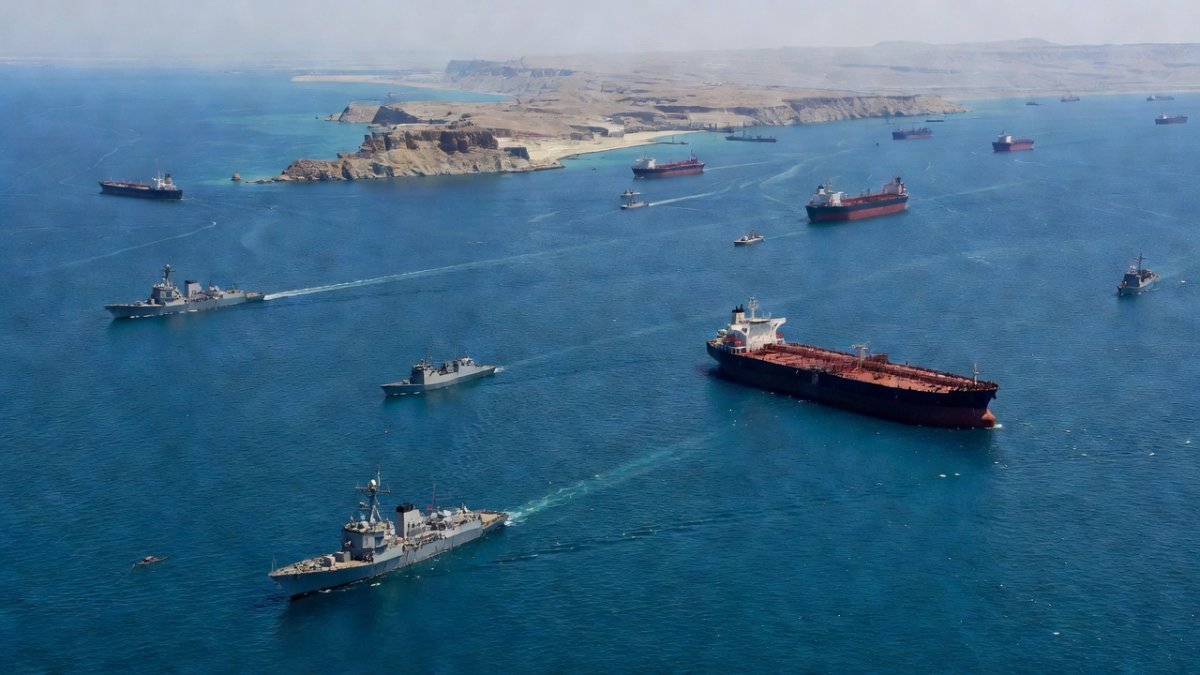
Only eight ships navigated the Strait of Hormuz on July 16, the second full day of the reinstated US naval blockade. Iran has effectively closed the chokepoint that handles about 20 percent of global oil supply to commercial traffic.
Brent crude oil prices surged to the range of 83 to 86 dollars per barrel following the closure. Earlier in July the benchmark had reached above 79 dollars with WTI crude topping 74 dollars.
The reduced traffic through the strait has created immediate supply concerns for energy markets worldwide. Shipping companies have rerouted vessels where possible to avoid the restricted zone.
Analysts note that sustained closure could pressure prices further in coming weeks. No immediate resumption of normal commercial passage has been indicated by either side.
According to shipping data from Lloyd's of London, global insurers have declared the Strait of Hormuz a war zone, pushing war-risk premiums from 0.3 percent to 2.8 percent of cargo value within ten days and adding roughly $1.4 million per transit for a typical very-large crude carrier, industry analysts calculated. Only eight vessels transited on July 16 compared with the normal 50-60 daily average, and analysts at S&P Global note that sustained closure beyond 45 days would push Brent above $110 and cut global GDP growth by 1.8 percentage points. US retail gasoline prices, which averaged $3.41 per gallon in early July, have climbed 19 cents in the first week of disruptions, with EIA models forecasting a potential $4.25 national average if flows remain choked. The 1973 embargo and 1990 Gulf War supply shocks each lasted under six months before diplomatic off-ramps emerged; current conditions suggest this blockade could trigger recessionary pressures faster because spare global capacity stands at just 1.2 million barrels per day versus 3.5 million in prior crises.
Domestic Sentiment Within Iran
A confidential report prepared for Iran's presidency found that only 9 percent of Iranians support the status quo. Meanwhile 81 percent reported struggling to afford food amid the ongoing conflict and economic pressures.
These figures highlight significant internal challenges facing Iranian leadership as military operations continue. Public discontent appears tied to both the war and domestic economic conditions.
The report's findings were compiled prior to the most recent escalation but reflect trends that have persisted through the conflict period. No official Iranian government response to the internal polling data has been released.
Economic hardship has intensified since the start of major combat operations in late February. Food affordability remains a primary concern for the majority of the population according to the assessment.
Inside Iran, a confidential report prepared for the presidency — obtained by Reuters — showed only 9 percent support for the status quo aligns with inflation data from the Central Bank of Iran that reached 47.6 percent year-over-year in June, driven by a 68 percent surge in food prices, the bank reported since the February outbreak of hostilities. The rial has lost 41 percent of its value against the dollar on the open market, according to foreign exchange tracking data, pushing the cost of imported wheat and medicine beyond reach for the 81 percent already reporting food insecurity. Public protests erupted in Tehran's Grand Bazaar on July 14 and spread to Isfahan and Mashhad, with crowds chanting against both the war and the regime's economic mismanagement; security forces detained 340 demonstrators within 48 hours, human rights monitors reported.
These figures mark a sharp reversal from pre-war polling that showed 31 percent approval for the government's foreign policy stance. The combination of Hormuz shipping paralysis, which has idled 14 Iranian tankers and cut oil export revenue by an estimated $2.9 billion monthly, according to tanker tracking data, and renewed US sanctions has left the regime with dwindling options to buy domestic calm. Analysts tracking social-media chatter inside Iran report a 240 percent increase in calls for leadership change since the June Memorandum of Understanding collapsed, suggesting that prolonged conflict risks internal fracture more than external victory.
US Government Response and Alerts
The US State Department issued a Worldwide Caution alert on July 18 advising Americans worldwide to exercise increased caution. Secretary of State Marco Rubio's department warned that groups supportive of Iran may target US interests overseas.
The alert covers all regions and emphasizes vigilance at diplomatic facilities and during travel. No specific new restrictions on American citizens were detailed beyond the general advisory.
Trump administration officials have maintained that the campaign will continue until Iran is prevented from obtaining nuclear weapons. Coordination between the State Department and Defense Department remains ongoing.
Embassies and consulates have increased security measures in response to the caution. American citizens abroad are encouraged to register with the nearest diplomatic post for updates.
Regional Condemnations and Diplomatic Fallout
Qatar condemned Iranian attacks on Jordan, Bahrain, and Kuwait in a statement following the July 19 incidents. Other Gulf states have similarly expressed concern over the widening scope of strikes.
The suspension of the US-Iran Memorandum of Understanding has removed one channel for potential de-escalation. Diplomatic efforts appear stalled as military actions dominate the current phase.
International media outlets including Al Jazeera, BBC, and others have documented the sequence of events across multiple countries. Britannica has added a dedicated entry on the 2026 Iran war to its reference materials.
Regional governments continue to monitor developments while bolstering their own defensive postures. No new multilateral talks have been scheduled in the immediate aftermath of the Jordan attack.
Broader Context of the Ongoing Conflict
The US-Iran war originated with President Trump's February 28, 2026 announcement of major combat operations involving joint US-Israeli strikes. The conflict has since expanded to include direct Iranian responses against American positions in several nations.
CENTCOM operations have maintained pressure on Iranian military infrastructure throughout the spring and summer months. Each phase of strikes has responded to specific Iranian actions in the region.
The involvement of multiple Gulf states as secondary targets has drawn in additional actors and complicated the strategic picture. Oil market volatility remains a direct consequence of the blockade and related disruptions.
US forces continue to operate under the framework established at the outset of Operation Epic Fury. Future developments will depend on Iranian responses to the latest round of strikes and the overall military balance.
The war's timeline began February 28 with President Trump's announcement of Operation Epic Fury and joint US-Israeli strikes on Iranian air-defense nodes, followed by six major US cruise-missile salvos through April that targeted missile production sites in Parchin and Khojir. The June Memorandum of Understanding paused major combat for 19 days before Iranian forces resumed attacks on commercial shipping, prompting the US naval blockade that shifted the fight from military targets to economic chokepoints. Reference sources have already documented 47 distinct phases and 312 separate strikes since the conflict began, underscoring how quickly the conflict has moved from limited retaliation to sustained economic warfare. With the Biden-era maximum-pressure framework now fully reinstated under Trump, the strategic emphasis on port and energy infrastructure indicates both sides have accepted a longer war of attrition rather than a quick negotiated settlement.
By Jessica Ali, Staff WriterThis article was produced with AI-assisted research and editorial support. Reporting is based on sources cited in the article.
What's Your Reaction?
 Like
0
Like
0
 Dislike
0
Dislike
0
 Love
0
Love
0
 Funny
0
Funny
0
 Wow
0
Wow
0
 Sad
0
Sad
0
 Angry
0
Angry
0

Editor-in-Chief at Global1.News. Atlanta-based journalist who cuts through the BS and tells it like it is. Lead anchor, host, and the voice you hear when the spin stops and the truth starts.













Comments (0)