
China-North Korea High-Level Exchanges Signal Beijing’s Push to Recalibrate Influence on the Peninsula
In mid-July 2026, North Korean leader Kim Jong Un held talks in Pyongyang with Wang Huning, a member of the Chinese Communist Party’s Politburo Standing Committee and one of Beijing’s most senior political figures. The meeting, part of a three-day Chinese delegation visit through Friday, marks the latest in a concentrated sequence of high-level contacts following Chinese President Xi Jinping’s trip to North Korea in June—the first such visit in seven years.
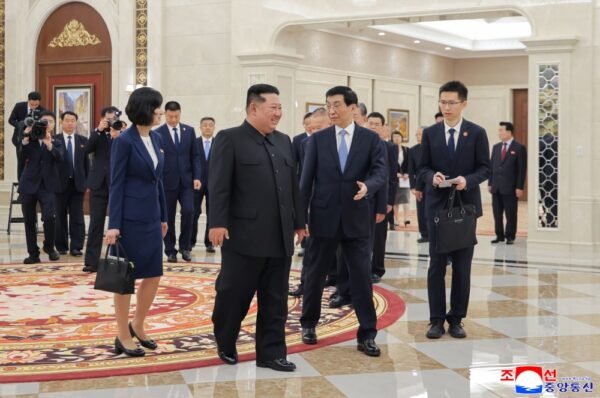
In mid-July 2026, North Korean leader Kim Jong Un held talks in Pyongyang with Wang Huning, a member of the Chinese Communist Party’s Politburo Standing Committee and one of Beijing’s most senior political figures. The meeting, part of a three-day Chinese delegation visit through Friday, marks the latest in a concentrated sequence of high-level contacts following Chinese President Xi Jinping’s trip to North Korea in June—the first such visit in seven years. Wang’s delegation arrived to commemorate the 65th anniversary of the Treaty of Friendship, Cooperation and Mutual Assistance between the two countries, a foundational security instrument that continues to structure their formal relationship.
According to reporting from Al Jazeera and Yonhap News, Kim and Wang pledged to deepen bilateral ties and to implement the agreements reached during Xi’s June summit. North Korean state media had described that earlier meeting as producing a “far-reaching blueprint” for what it called the “most powerful and strategic relations.” Wang conveyed Xi’s “best wishes and comradely greetings” to Kim; Kim reciprocated and framed the dispatch of such a senior Chinese delegation as evidence of Beijing’s commitment to follow through on those understandings. The exchanges are being read across the region as part of China’s effort to reinforce its traditional influence over Pyongyang at a moment when North Korea’s strategic alignment with Russia has grown markedly closer.
The July Summit and the Composition of the Chinese Delegation
Wang Huning ranks among the most influential figures in the Chinese political system. As a Politburo Standing Committee member often described as China’s fourth-highest-ranked official, his presence in Pyongyang carries symbolic and operational weight. The visit was not a ceremonial afterthought. It followed directly on Xi’s June trip and was explicitly linked by both sides to the implementation of the understandings reached then. Yonhap reported that the three-day itinerary ran through Friday and was timed to the treaty anniversary, giving the diplomacy a dual commemorative and forward-looking character.
Beyond the Kim-Wang talks, the Chinese delegation conducted a carefully staged set of visits that underscored historical and ideological continuity. Members toured a memorial dedicated to Chinese soldiers who died in the Korean War, a Workers’ Party cadre training school, and the mausoleum where the bodies of Kim Il Sung and Kim Jong Il are preserved. Earlier in the trip, Wang met Jo Yong Won, a top official in the Workers’ Party of Korea. These stops were not incidental tourism; they reaffirmed the shared revolutionary narrative, the blood cost of the 1950–53 war, and the organizational channels through which party-to-party relations are maintained. For an academic observer of Korean affairs, the itinerary reads as a deliberate re-anchoring of the relationship in historical sacrifice and Leninist institutional affinity at a time when Pyongyang’s external options have expanded.
Kim’s public posture during the talks emphasized continuity of policy. He described the vigorous development of “traditional friendly and cooperative relations” as a “steadfast policy” of the North Korean state. Wang, for his part, stated that China’s “firm support for the cause of Korean socialism led by Comrade General Secretary Kim Jong Un will never be changed.” The language is formulaic yet consequential: it restates Beijing’s political endorsement of the Kim leadership and of the socialist system on the northern half of the peninsula, while leaving operational details of military and law-enforcement cooperation to be filled in through subsequent working-level channels.
Implementing the June Blueprint: Diplomacy, Law Enforcement, and Military Channels
Xi Jinping’s June 2026 visit produced what North Korean media termed a far-reaching blueprint for stronger relations. Reporting indicates that Xi pushed for closer cooperation across diplomatic, law-enforcement, and military domains. The July Kim-Wang meeting was framed by both sides as a mechanism to translate that blueprint into practice. Kim explicitly linked the arrival of the high-level Chinese delegation to Beijing’s seriousness about implementation. This sequencing—summit-level political direction in June, senior follow-up in July—mirrors classic Chinese diplomatic practice of locking in consensus at the top and then driving execution through trusted intermediaries.
The emphasis on law-enforcement and military cooperation deserves particular scrutiny. Cross-border crime, sanctions evasion networks, and the management of the long land frontier have long been practical concerns for both capitals. Military-to-military contacts, while constrained by North Korea’s opacity and by China’s desire to avoid unnecessary escalation with the United States and its allies, remain a latent dimension of the 1961 treaty relationship. By elevating these portfolios in the June understandings and then reinforcing them in July, Beijing appears to be seeking denser institutional connective tissue at a moment when Pyongyang’s autonomy has increased. The resumption in March 2026 of China–North Korea cross-border passenger rail service between Beijing and Pyongyang—the first such service in six years—supplies a modest but tangible infrastructure counterpart to the political signaling.
From a Korean historical perspective, the pattern recalls earlier cycles in which Beijing has sought to reassert primacy after periods of drift or external distraction. The difference in 2026 is the altered strategic environment created by North Korea’s deepening military partnership with Russia, including the deployment of North Korean troops in support of Russia’s war in Ukraine under a strategic defence agreement. China remains North Korea’s largest economic partner, yet it no longer enjoys the near-monopoly on Pyongyang’s external lifelines that characterized much of the post-Cold War era.
The China-Russia-North Korea Triangle and Shifting Hierarchies
The July exchanges cannot be understood in isolation from the triangular dynamic among Beijing, Moscow, and Pyongyang. Over recent years, North Korea has moved from a position of heavy dependence on China toward a more multi-vector alignment in which Russia supplies diplomatic cover, military-technical cooperation, and a measure of strategic prestige. The dispatch of North Korean personnel to the Ukrainian theater represents a qualitative shift: Pyongyang is no longer merely a recipient of assistance but a contributor of force in a major inter-state conflict. That transformation has unsettled older assumptions in Beijing about North Korea as a dependent buffer whose external behavior could be modulated primarily through Chinese economic leverage.
China’s response, visible in Xi’s June visit and Wang’s July follow-up, has been to intensify high-level political engagement rather than to attempt outright obstruction of the Russia–North Korea axis. Beijing’s interests are clear even if its public rhetoric remains measured. It seeks to preserve stability on the Korean Peninsula, to prevent a collapse or uncontrolled escalation that would send refugees and military risk across its northeast border, and to ensure that it is not displaced as the principal external stakeholder in Pyongyang’s future. At the same time, China has no interest in a fully autonomous North Korean foreign policy that could drag the region into crises timed to Moscow’s needs rather than Beijing’s. The “far-reaching blueprint” and the subsequent implementation talks are instruments for re-embedding North Korea in a China-centric framework of consultation even as Russian ties continue.
For South Korean and broader Korean analytical communities, the triangle raises uncomfortable questions. A North Korea that can play Beijing and Moscow against each other, or that can extract benefits from both, is a more durable and potentially more assertive interlocutor. Inter-Korean diplomacy, already constrained by sanctions regimes, military tensions, and domestic politics in Seoul, becomes still more complicated when Pyongyang’s external sponsorship is diversified. The July meetings do not resolve that complexity; they illustrate Beijing’s determination not to be left behind.
Implications for Inter-Korean Relations and Peninsula Stability
Inter-Korean relations operate in the shadow of great-power alignments. When China tightens its political and symbolic embrace of Pyongyang, Seoul must recalibrate its own assumptions about leverage and timing. The June–July 2026 sequence signals that Beijing prioritizes the stability and ideological continuity of the North Korean system. Wang’s explicit pledge of “firm support for the cause of Korean socialism” under Kim Jong Un is a direct message that China does not entertain scenarios of externally driven regime transformation. For South Korean policymakers, that stance limits the space for strategies that assume Chinese acquiescence in pressure campaigns aimed at fundamental political change in the North.
At the same time, China’s interest in peninsula stability creates a potential, if narrow, overlapping interest with South Korea and the United States in crisis prevention. Closer Chinese-North Korean military and law-enforcement coordination could, in principle, improve border management and reduce certain forms of illicit trafficking; it could also harden North Korea’s internal security apparatus and reduce the information flows that have slowly eroded the information blockade. The net effect on inter-Korean people-to-people contact and on the long-term prospects for confidence-building measures remains ambiguous and will depend on how the “blueprint” is operationalized in the coming months.
Daily life in South Korea is unlikely to register immediate shocks from the Wang visit, yet the strategic community in Seoul—ministries, the National Assembly’s foreign affairs and unification committees, and research institutes—will treat the exchanges as evidence that the northern half of the peninsula is being more tightly woven into a continental alignment. That perception feeds debates over defense spending, extended deterrence consultations with Washington, and the wisdom of any renewed engagement initiatives. Chaebol with residual or potential exposure to North Korean projects, already operating under strict sanctions compliance regimes, will see little near-term change; the political risk premium on any future inter-Korean economic ventures remains elevated so long as Pyongyang’s external military partnerships expand.
Historical Resonance of the 1961 Treaty and Wartime Memory
The decision to time Wang’s visit to the 65th anniversary of the Treaty of Friendship, Cooperation and Mutual Assistance was not accidental. Signed in 1961, the treaty remains one of the few formal mutual defense commitments China maintains. Its commemorative invocation in 2026 serves to remind domestic and international audiences that the China–North Korea relationship rests on treaty obligation as well as on party affinity and geographic necessity. The delegation’s visit to a memorial for Chinese People’s Volunteers who died in the Korean War further activates historical memory of shared sacrifice against U.S.-led forces—a narrative that retains powerful resonance in both countries’ official historiographies.
For Koreans on both sides of the demilitarized zone, the Korean War is not remote history. In the North, it is foundational to regime legitimacy. In the South, it structures alliance politics and collective memory of national division. When Chinese officials lay wreaths at war memorials in Pyongyang while simultaneously advancing military cooperation language in bilateral blueprints, they are engaging in a form of strategic communication aimed at multiple audiences: the North Korean leadership, the Chinese domestic public, and outside powers that might underestimate the residual force of the alliance. Academic analysis must therefore treat the commemorative dimension as integral to the diplomacy, not as decorative cover for “real” transactions.
Economic Asymmetries and the Limits of Political Symbolism
Despite the intensification of political and security signaling, the material foundation of the relationship remains asymmetric. China is still North Korea’s largest economic partner by a wide margin. Trade, informal border economies, and limited investment flows continue to give Beijing instruments of influence that Moscow cannot fully replicate. The March 2026 resumption of passenger rail service between Beijing and Pyongyang after a six-year interruption is a modest indicator of normalized people-to-people and commercial connectivity, albeit still far from the denser integration that would imply structural dependence in the other direction.
Political symbolism and economic reality can diverge. High-level visits and treaty anniversaries do not automatically translate into large-scale aid packages, infrastructure corridors, or sanctions relief. Beijing has repeatedly calibrated its economic engagement to avoid both North Korean collapse and international opprobrium. The July talks, focused on implementing a political-military blueprint, do not appear from available reporting to have produced detailed public economic deliverables. Analysts should therefore resist the temptation to read every senior exchange as a prelude to a transformative aid commitment. The more durable story is one of managed interdependence in which China seeks to remain indispensable without underwriting every North Korean preference.
Strategic Outlook for Northeast Asian Geopolitics
The July 2026 China–North Korea exchanges form part of a broader reconfiguration of Northeast Asian geopolitics. The United States and its allies have watched the Russia–North Korea military partnership with alarm; China’s decision to accelerate its own high-level track with Pyongyang adds another layer of complexity to alliance coordination. Trilateral U.S.–Japan–South Korea mechanisms will need to account for a North Korea that is simultaneously more tightly consulted by Beijing and more operationally tied to Moscow. Deterrence messaging, sanctions enforcement, and contingency planning all become harder when the principal external stakeholders are themselves great-power rivals with partially overlapping and partially conflicting interests on the peninsula.
For Korean foreign policy, the episode underscores the enduring constraint of geography and history. South Korea’s strategic room for maneuver is shaped by the reality that China will not abandon its stake in North Korean stability, and that North Korea will continue to seek external partners willing to offset pressure. Education and public discourse in South Korea increasingly reflect this multipolar environment; younger cohorts encounter a narrative less centered on inevitable reunification under Seoul’s terms and more focused on prolonged competition among nuclear-armed neighbors. The academic task is to map these structural forces without collapsing into fatalism. Diplomacy retains agency, but only if it is informed by accurate readings of Chinese and North Korean priorities as revealed in sequences such as the June summit and the July Wang visit.
In sum, the Kim–Wang talks of July 2026 are best understood as a deliberate Chinese effort to convert the political capital of Xi’s June visit into ongoing institutional momentum, timed to a foundational treaty anniversary and executed through one of Beijing’s most senior ideologues and political operators. They reflect anxiety about losing relative influence to Russia, a continuing commitment to the Kim leadership and to Korean socialism as defined in Pyongyang, and a desire to thicken diplomatic, law-enforcement, and military ties without publicly rupturing China’s broader regional equities. For inter-Korean relations, the message is sobering: the northern system is being reinforced, not isolated, by its primary patron. For Northeast Asia, the triangle of China, Russia, and North Korea is becoming a more salient feature of the strategic landscape—one that Korean and allied policymakers will be obliged to factor into every major calculation in the period ahead.
By Prof. David Park, Staff WriterThis article was produced with AI-assisted research and editorial support. Reporting is based on sources cited in the article.
What's Your Reaction?
 Like
0
Like
0
 Dislike
0
Dislike
0
 Love
0
Love
0
 Funny
0
Funny
0
 Wow
0
Wow
0
 Sad
0
Sad
0
 Angry
0
Angry
0

East Asia/Technology Correspondent at Global1.News. Seoul-based voice covering Korean politics, technology, business, and culture. Analyzes how technology and geopolitics intersect across East Asia.













Comments (0)