
There's a Cooling Crisis Coming for AI Data Centers — and Independent Hosting Providers Need to Pay Attention
AI rack densities are pushing past 100 kilowatts per rack, far beyond air cooling limits. Eighty-eight percent of data centers are still air-cooled, and the transition to liquid is going to be expensive and slow. A hosting veteran on what this means for independent providers and what to do about it.
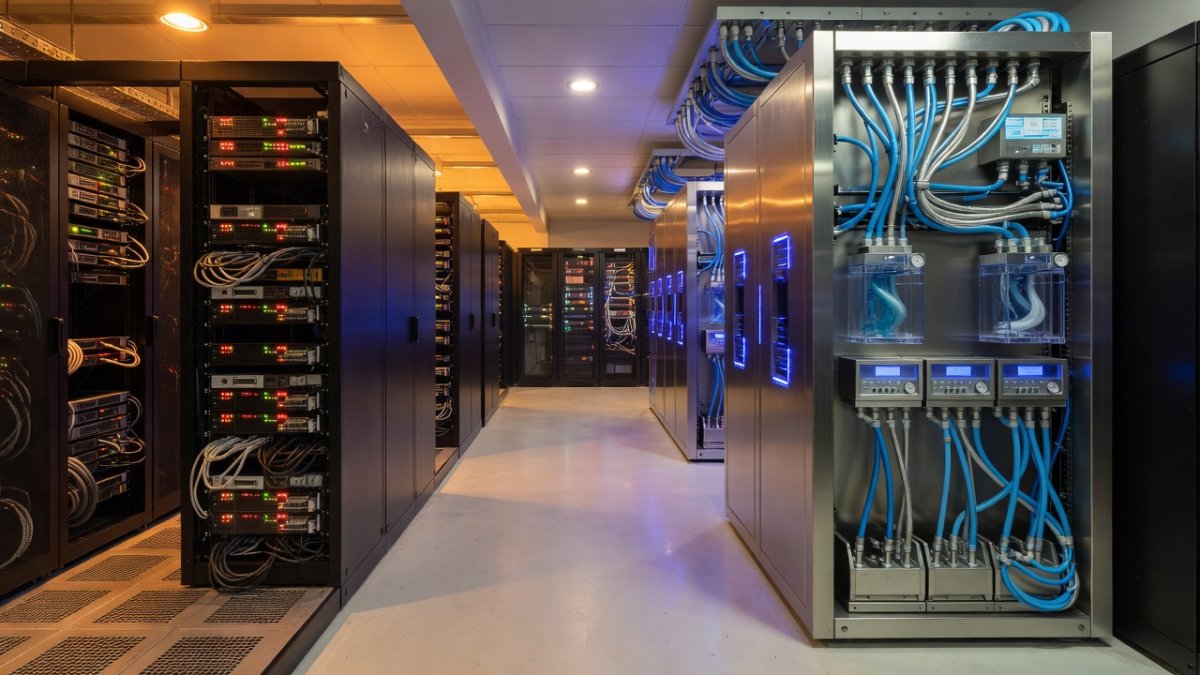
There's a Cooling Crisis Coming for AI Data Centers — and Independent Hosting Providers Need to Pay Attention
Let me tell you about something that's been sitting heavy on my mind after watching the data center landscape for the last decade. Everyone's been obsessing over GPU shortages, power constraints, and transformer lead times — and rightfully so, those are real problems. But there's a quieter bottleneck forming that's going to catch a lot of people off guard, and it has nothing to do with chips or substations.
I'm talking about cooling. Specifically, the fact that your standard air-cooled data center hits a hard ceiling at around 25 to 30 kilowatts per rack, and the latest AI GPU clusters are pushing 100 kilowatts and beyond. The math doesn't work anymore. And the transition to liquid cooling isn't going to be a graceful upgrade path — it's going to be a scramble.
The Density Problem Nobody's Modeling For
Let me give you some context on why this matters. For the last 20 years, the average data center rack sat comfortably between 5 and 10 kilowatts. You could cool that with standard computer room air conditioning, raised floors, and containment. It was boring, predictable infrastructure that any halfway competent facilities team could manage.
That world is gone. NVIDIA's Blackwell and Rubin architecture GPUs are pushing past 1,000 watts per accelerator. A single rack packed with 72 of those — the Vera Rubin NVL72 configuration that NVIDIA just announced for Japan's national AI factory — pulls over 70 kilowatts just for compute, before you account for networking and storage. Some AI clusters are now approaching 100 kW or even 200 kW per rack, which is an order of magnitude beyond what air cooling was ever designed to handle.
According to Blackridge Research, air cooling with containment is workable up to about 15 kW per rack. Between 15 and 30 kW, you need enhanced containment, rear-door heat exchangers, and increasingly expensive airflow management to stay within thermal limits. Past 30 kW? The physics stops cooperating. Cooling a single 30 kW rack with air requires 2,000 to 3,000 CFM of airflow, pushing fan speeds to 500-800 feet per minute and noise levels past 70 decibels. The fan power alone consumes 10 to 15 percent of the rack's total IT load. And at 100 kW? Air isn't even a serious option anymore.
88% of Data Centers Are Still Air-Cooled — That's About to Change Fast
Here's the number that should make everyone stop and think. Despite all the headlines about liquid cooling and immersion breakthroughs, an estimated 88 percent of data center cooling market revenue still comes from air-based systems, according to industry analysts. The installed base is overwhelmingly air-cooled, and the transition away from it is going to be massive in scale and expensive in practice.
The global data center liquid cooling market was valued at about $4.8 billion in 2025 and is projected to hit $6 billion in 2026, growing to $27.1 billion by 2035 at an 18.2 percent compound annual growth rate. That's not a niche anymore — that's a full-blown infrastructure shift. The overall data center cooling market is projected to grow from $17.4 billion to $50.6 billion by 2034.
But here's the thing about those growth projections: they assume the supply chain can deliver. And right now, it's not clear that it can. Liquid cooling retrofits require chilled water distribution mains, secondary piping loops, coolant distribution units, and specialized plumbing that most existing facilities simply don't have. This isn't swapping out a CRAC unit — it's a capital project that takes months of planning and execution.
The Secondary Bottleneck Nobody's Talking About — Retrofits Are Expensive and Slow
STL Partners published a study in May 2026 that found liquid cooling retrofits can cost roughly 80 percent less than building new AI-ready facilities from scratch. That sounds like good news until you realize that 80 percent less than a $50 million new build is still $10 million per facility. And that's just the CapEx — you also need the engineering expertise, the downtime windows, the coolant supply chains, and the trained technicians to maintain it all.
Directional cost estimates for retrofits vary wildly depending on facility age, rack density requirements, geography, and cooling architecture. There's no standard price card for converting an air-cooled hall to liquid. Every facility is a custom engineering project. And here's the kicker: most independent colocation providers and hosting companies don't have the balance sheets to absorb that kind of capital expenditure on a speculative basis. They need paying customers with committed density requirements before they can justify the retrofit.
But the customers with the highest density requirements — the AI training shops, the GPU-as-a-service providers, the hyperscaler overflow — they're not going to wait 12 to 18 months for a retrofit to complete. They're going to go where the liquid-ready capacity already exists, which right now means the hyperscalers and the large wholesale data center operators who built for this from day one.
What This Means for Independent Hosting Providers
This is the part that keeps me up at night as someone who runs actual hosting infrastructure. The independent hosting sector — the colocation providers, the regional data centers, the managed hosting shops that serve small and medium businesses — has been built on air-cooled infrastructure for two decades. And the density wall is approaching faster than most operators realize.
Here's what I'm seeing on the ground. Your typical managed hosting customer is still running standard 1U and 2U servers that pull 500 to 1,000 watts each. A fully populated standard rack comes in around 5 to 10 kW. That's well within air cooling's comfort zone. So for most of your existing customer base, nothing changes. But here's what does change: the customers you want to grow into — the AI inference workloads, the GPU rental shops, the machine learning training environments — they're pushing 20 to 50 kW per rack today and will be at 100 kW within the next cycle.
When that happens, you have three options. One, you invest in retrofitting existing space for liquid cooling — which means CapEx, downtime, and engineering complexity you probably don't have in-house. Two, you build new capacity with liquid cooling from day one — which means even more CapEx and a longer timeline. Or three, you let those customers go to the hyperscalers and wholesale operators who already have liquid-ready facilities.
None of those options are comfortable.
What Smart Operators Should Be Doing Right Now
Alright, I've spent enough time describing the problem. Let me give you some actionable advice based on what I've been watching in the market.
First — start the conversation with your largest customers now. Ask them what their rack density trajectory looks like over the next 24 to 36 months. If they're running AI inference today, they're going to be at densities that push past air cooling limits sooner than they think. You need to know this now, not when they submit a 50 kW per rack requirement next quarter and you have to tell them you can't support it.
Second — plan your liquid cooling retrofit as a phased rollout, not a forklift upgrade. Start with one hall or even one row. Direct-to-chip liquid cooling in the 30 to 100 kW range is the most practical entry point — it doesn't require full immersion, it's compatible with existing rack infrastructure, and it gives you the density headroom you need for AI workloads without committing to a full facility conversion. The hybrid approach — keeping standard air-cooled racks for your bread-and-butter customers while offering liquid-cooled rows for high-density tenants — is the most capital-efficient path forward.
Third — educate your facilities team now, not when the retrofit starts. Liquid cooling is a different discipline from air cooling. Your team needs to understand coolant chemistry, leak detection, pressure management, and the operational differences between direct-to-chip and immersion systems. The operators who train their staff ahead of the transition will have a massive advantage over those who learn on the job during an emergency retrofit.
Fourth — watch the colocation market for liquid-ready capacity in your region. If the economics of retrofitting don't pencil out for your facility, you need to know where you can send high-density customers. Partnering with a wholesale colo provider who has liquid-ready halls might be the most capital-efficient way to serve those customers without carrying the infrastructure risk yourself.
The Structural Reality — This Isn't a Blip, It's a Permanent Shift
I've been running hosting infrastructure for over a decade, and I've seen technology cycles come and go. Cloud repatriation, GPU shortages, power constraints — each one was a disruption, but each one also created opportunity for operators who paid attention and positioned themselves early.
The cooling transition is in that category, but it's bigger than most people realize because it touches the physical layer of the data center in a way that software and virtualization never did. You can't hack your way around thermal limits. You can't virtualize your way out of 100 kW per rack. The laws of thermodynamics don't care about your cloud strategy.
What makes this different from previous infrastructure cycles is the timeline. The transition from air cooling to liquid cooling won't happen overnight, but the window for independent operators to position themselves is narrower than most people think. The hyperscalers are already building liquid-ready capacity at scale. The wholesale colo providers are retrofitting. The chip vendors are designing for liquid from the silicon up. And if you're a regional hosting provider or an independent colocation operator waiting for the market to tell you when to act, by the time you get the signal, the window will have closed.
The Bottom Line — Thermal Limits Are the New Power Constraints
I wrote last week about how the US power grid can't keep up with AI data center demand. That's still true, but there's a more immediate constraint that operators need to confront: even if you have the power allocation, if your facility can't pull the heat out of those racks, the power is worthless.
Stop obsessing about which GPU model is fastest or which cloud provider has the best AI platform. Start paying attention to what your data center's cooling infrastructure can actually handle. Because the next bottleneck in the AI infrastructure boom isn't going to be the chips or the transformers — it's going to be the heat. And by the time you realize your air-cooled facility can't keep up, it'll be too late to retrofit without shutting down production.
Plan now. Train your team now. Have the hard conversations with your customers now. Because the cooling crisis is coming, and it doesn't care how prepared you think you are.
— Allan Ali, Founder
This article was produced with AI-assisted research and editorial support. Reporting is based on sources cited in the article.
What's Your Reaction?
 Like
0
Like
0
 Dislike
0
Dislike
0
 Love
0
Love
0
 Funny
0
Funny
0
 Wow
0
Wow
0
 Sad
0
Sad
0
 Angry
0
Angry
0

Publisher of Global1.News. Automation architect, systems builder, and the guy making sure the truth gets published.














Comments (0)