
Thongloun's China Visit Bolsters All-Weather Partnership
In the CGTN exclusive interview with LPRP General Secretary Thongloun Sisoulith, the Lao leader outlined priorities for bilateral ties during his June 2026 state visit to China, his first overseas trip after re-election. The discussion highlighted continuity in relations as both countries mark the 65th anniversary of diplomatic ties and the China-Laos Friendship Year. Thongloun
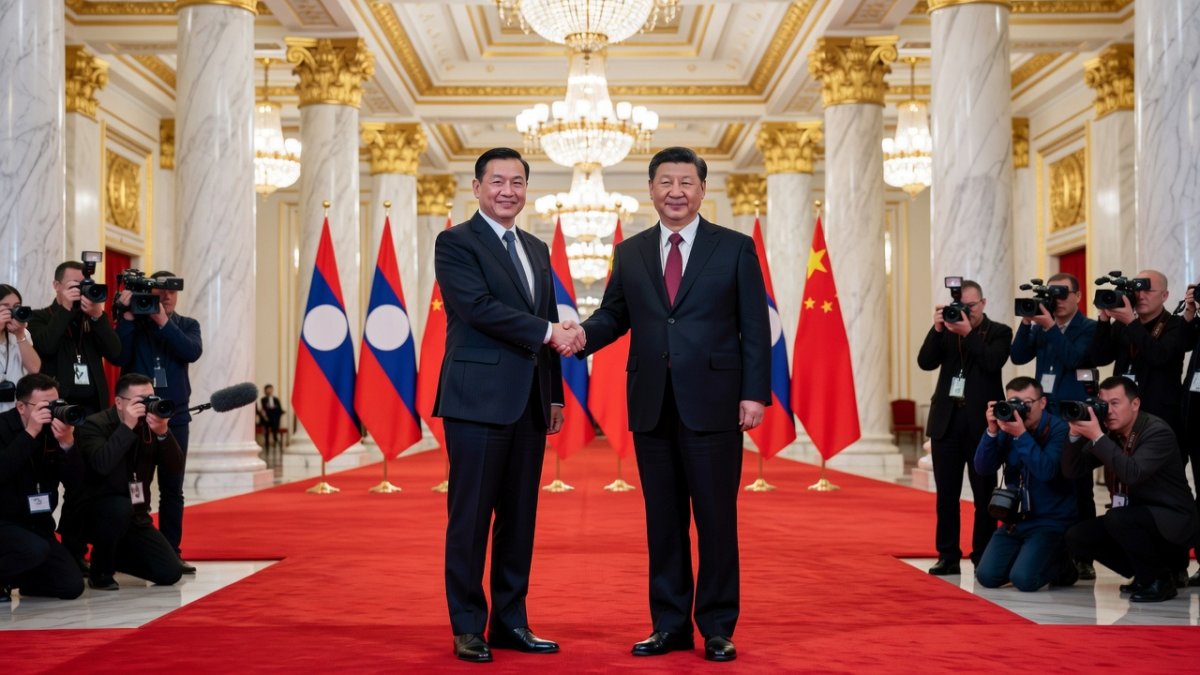 In the CGTN exclusive interview with LPRP General Secretary Thongloun Sisoulith, the Lao leader outlined priorities for bilateral ties during his June 2026 state visit to China, his first overseas trip after re-election. The discussion highlighted continuity in relations as both countries mark the 65th anniversary of diplomatic ties and the China-Laos Friendship Year. Thongloun's itinerary included meetings with Xi Jinping and tours of advanced facilities, underscoring practical cooperation alongside high-level diplomacy.
Thongloun's Visit in Strategic Context
Thongloun Sisoulith's June 2026 visit to China occurred at a pivotal moment for Laos, following his re-election as LPRP General Secretary in January and as President in March. This timing positioned the trip as a deliberate signal of continuity in Vientiane's foreign policy orientation. The visit aligned with the 65th anniversary of diplomatic relations and the designated China-Laos Friendship Year, providing a symbolic framework for substantive discussions on long-term partnership.
Xi Jinping and Thongloun agreed to advance an all-weather China-Laos community with a shared future in the new era. This formulation builds on earlier commitments and reflects China's neighborhood diplomacy priorities. The four-point plan outlined by Xi—covering political trust, security cooperation, transport connectivity, and shared future—offered a structured agenda that addressed both immediate and structural aspects of the relationship.
Laos assumes the ASEAN chair in 2026, adding regional weight to bilateral outcomes. Thongloun's engagement with Chinese counterparts, including coordination involving the MFA and MOFCOM, demonstrated how Vientiane seeks to leverage its chairmanship to advance connectivity initiatives. The visit thus served both bilateral and multilateral objectives without disrupting ASEAN consensus mechanisms.
China remains Laos's largest foreign investor and second-largest trading partner, facts that framed the economic dimension of the talks. Multiple cooperation documents were signed, covering areas from infrastructure to capacity building. These agreements illustrate the institutional depth of ties managed through regular high-level exchanges.
The BRI and China-Laos Railway: Infrastructure as Statecraft
The China-Laos Railway stands as the flagship BRI project linking the two countries, converting Laos from a landlocked position to a land-linked economy. During the visit, both sides reviewed operational progress and discussed further integration with regional networks. This infrastructure serves as tangible evidence of how connectivity projects reshape geographic constraints for smaller states.
China's approach through the BRI emphasizes transport corridors that support trade facilitation and industrial development. For Laos, the railway reduces reliance on traditional transit routes and opens pathways to seaports in neighboring countries. The strategic calculus involves balancing economic gains against the need to maintain diversified partnerships within ASEAN.
Policy coordination between NDRC and MOFCOM has supported project implementation, ensuring alignment with China's broader self-sufficiency goals in technology and supply chains. Laos benefits from technology transfer and skills development associated with railway operations. These elements demonstrate infrastructure's role beyond physical assets, extending into human capital formation.
Thongloun's inspection of related facilities during the visit reinforced the railway's centrality to future planning. Both sides view sustained investment in maintenance and feeder lines as essential for realizing full economic potential. This focus reflects a shared interest in long-term operational sustainability rather than one-time construction milestones.
Technological and Ecological Cooperation
Thongloun toured Deep Robotics in Hangzhou, highlighting interest in advanced manufacturing and automation technologies. Such visits illustrate Laos's efforts to move beyond resource-based growth toward higher-value sectors. China’s emphasis on tech self-sufficiency creates openings for selective technology partnerships that align with Lao development plans.
Ecological projects in Huzhou showcased sustainable development models that combine environmental protection with economic activity. These examples offer Laos practical references for managing its own natural resources amid infrastructure expansion. Cooperation in this domain supports mutual objectives of green growth under the broader BRI framework.
Discussions during the visit touched on capacity building in digital and environmental fields, complementing existing transport initiatives. Wang Yi's involvement in diplomatic channels has helped maintain steady dialogue on these emerging areas. The approach avoids overcommitment while allowing incremental progress tailored to Laos's institutional capacity.
Both countries recognize that technological cooperation must address local conditions rather than impose standardized solutions. Thongloun's itinerary balanced high-tech exposure with ecological site visits, signaling a pragmatic mix of priorities. This balance helps Laos pursue modernization without neglecting environmental safeguards.
Implications for ASEAN and Regional Order
Laos's 2026 ASEAN chairmanship amplifies the regional significance of its China engagement. Outcomes from the visit provide Vientiane with concrete examples to present during multilateral meetings. The all-weather community concept is framed as compatible with ASEAN centrality rather than an alternative framework.
China's neighborhood diplomacy seeks stable periphery relations that support broader strategic objectives. For ASEAN members, Laos's experience with the China-Laos Railway offers lessons on managing large-scale connectivity projects. Other capitals monitor how benefits are distributed and risks mitigated.
Security cooperation elements within Xi's four-point plan address non-traditional threats while respecting Laos's neutral posture. This measured approach helps maintain ASEAN unity amid varying member-state alignments. Thongloun's discussions avoided contentious issues that could complicate regional consensus.
The visit reinforced China's position as a key economic partner for Laos without displacing other ASEAN relationships. Strategic calculus for Vientiane centers on maximizing infrastructure and investment gains while preserving diplomatic flexibility. This equilibrium remains central to Laos's regional role in 2026.
The All-Weather Community: Rhetoric and Reality
The agreement on an all-weather China-Laos community with a shared future in the new era represents an evolution of existing language. It codifies political trust and practical cooperation under a single umbrella. Implementation will depend on follow-through through established mechanisms rather than new institutions.
Thongloun's public statements during the visit emphasized mutual benefit and respect for sovereignty. These formulations align with Laos's traditional foreign policy principles while accommodating deeper economic integration. The rhetoric serves to legitimize expanded cooperation domestically and regionally.
Reality on the ground centers on railway operations, trade facilitation, and selective technology transfers. Multiple signed documents provide roadmaps, yet outcomes will be measured by project execution and local impact. Both sides have incentives to demonstrate tangible results ahead of future anniversaries.
Ecological and robotics site visits during the trip illustrated the blend of symbolic and substantive elements. They signal openness to new cooperation domains without overpromising immediate deliverables. This incremental style matches the cautious approach both governments have maintained in recent years.
What to Watch For
Attention will focus on how Laos utilizes its ASEAN chairmanship to advance connectivity themes from the visit. Progress on railway feeder infrastructure and cross-border trade facilitation will serve as early indicators. Monitoring MOFCOM and NDRC project pipelines offers insight into implementation pace.
Further exchanges in technology and ecology will test the durability of new cooperation areas. Thongloun's emphasis on capacity building suggests continued interest in skills development alongside hardware. Outcomes here will influence perceptions of the partnership's adaptability.
Security cooperation under the four-point plan merits observation for its scope and limits. Non-traditional threat coordination can proceed without affecting Laos's ASEAN commitments. Any expansion into sensitive domains would require careful calibration.
Overall, the visit sets a steady trajectory rather than a dramatic shift. Sustained attention to operational details of existing projects will determine whether the all-weather framing translates into measurable advantages for Laos. Regional actors will assess these developments for their wider implications on ASEAN-China dynamics.
By Prof. Marcus Chen, Staff WriterThis article was produced with AI-assisted research and editorial support. Reporting is based on sources cited in the article.
What's Your Reaction?
 Like
0
Like
0
 Dislike
0
Dislike
0
 Love
0
Love
0
 Funny
0
Funny
0
 Wow
0
Wow
0
 Sad
0
Sad
0
 Angry
0
Angry
0

World Politics Analyst at Global1.News. Based in Beijing, covering US-China relations, global trade, and geopolitical strategy. Brings deep analytical perspective to the power dynamics shaping international affairs.














Comments (0)