
The world's carmakers are struggling to compete with China
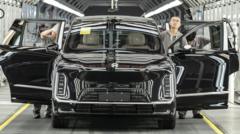
The world's carmakers are struggling to compete with China
Category: News
Beijing — A recent BBC investigation into China’s electric vehicle factories has laid bare a structural imbalance that legacy automakers in Europe, North America and Japan are struggling to reverse. From vertically integrated battery campuses in Sichuan to software-defined assembly lines in Hefei, Chinese manufacturers now control the critical nodes of the global EV ecosystem. The gap is no longer one of scale alone; it is one of speed, cost and policy coherence.
Factory floors that outpace rivals
During visits to BYD’s Shenzhen and Xi’an complexes, BBC reporters documented production cycles that compress what Western plants require weeks to achieve into days. At the Xi’an facility, a single line produces 2,400 battery packs daily, each incorporating blade cells with 60 percent higher volumetric energy density than the 2022 industry average. Adjacent to the line sit in-house semiconductor fabrication units turning out silicon-carbide inverters at costs 35 percent below imported equivalents.
These are not isolated showpieces. CATL’s new 200 GWh plant near Ningde integrates lithium refining, electrolyte mixing and cell formation under one roof. The company now supplies 37 percent of the world’s EV batteries, according to 2024 shipment data. Its condensed-matter cells, already entering mass production for NIO and Xiaomi vehicles, target 500 Wh/kg by 2026—figures that remain laboratory targets for most non-Chinese developers.
Supply-chain sovereignty built over a decade
China’s dominance rests on earlier strategic choices. State-backed investments secured processing capacity for lithium, cobalt and graphite exceeding 70 percent of global totals. When European and U.S. firms attempted to replicate these chains after 2022, they encountered permitting delays averaging 42 months versus China’s 18. The result is a cost curve that continues to diverge: Chinese pack prices fell to $98 per kWh in 2024, while comparable Western packs remain above $135.
Vertical integration extends beyond hardware. Chinese firms control the operating systems and over-the-air update architectures now standard in domestic models. This software layer allows rapid feature deployment—battery preconditioning algorithms, bidirectional charging protocols—without waiting for supplier certification cycles that slow legacy programs by 12–18 months.
Legacy automakers confront structural constraints
Volkswagen’s €10 billion investment in its Anhui joint venture has yet to close the price gap with BYD’s Seal model, which undercuts the ID.7 by roughly 25 percent while offering superior range. General Motors’ Ultium platform, launched with much fanfare in 2022, has captured less than 4 percent of China’s domestic EV market. Ford’s planned $2 billion Michigan battery plant, delayed by local opposition and raw-material sourcing issues, is now projected to begin volume production in 2027—two years after CATL’s comparable facility reached full output.
Japanese manufacturers face an additional handicap. Toyota and Honda retain strong hybrid portfolios, yet pure-EV platforms lag. Their reliance on external battery suppliers leaves them exposed to the same margin pressure afflicting European volume brands.
Policy and diplomacy shape the contest
Beijing’s 2023–2025 industrial guidance explicitly ties EV subsidies to domestic content thresholds and export performance. These rules have accelerated technology spillovers within China while complicating foreign attempts to replicate the model abroad. Meanwhile, the European Union’s provisional tariffs on Chinese EVs, announced in October 2024, average 21 percent—high enough to blunt some price advantages yet insufficient to offset the underlying cost differential.
Diplomatic efforts to secure alternative mineral supplies have produced mixed results. U.S. and Australian lithium projects remain years from meaningful output, while Indonesia’s nickel-processing partnerships with Chinese firms have effectively locked in supply commitments to Shanghai and Shenzhen rather than Detroit or Stuttgart.
Expert assessments from Beijing
Li Wei, director of the China Automotive Technology and Research Center, notes that the ecosystem advantage is self-reinforcing. “Once cell chemistry, BMS algorithms and charging infrastructure co-evolve inside one regulatory and industrial envelope, the learning-curve slope becomes extremely steep,” he told Global1 News. European analysts privately echo the assessment. A senior strategist at a German OEM, speaking on condition of anonymity, described the current five-year product cycle as “no longer competitive with Chinese iteration speeds of 18–24 months.”
Trade economists at the Chinese Academy of Social Sciences calculate that a sustained 20 percent tariff would still leave Chinese exports profitable in the European mid-market segment through 2027, given existing margins and logistics efficiencies via Belt and Road rail corridors.
Outlook for global rebalancing
Short-term relief for legacy carmakers appears limited to regulatory protection and brand loyalty in premium segments. Longer-term catch-up would require coordinated policy on permitting, raw-material financing and software standardization—measures that remain politically fragmented across the United States, Europe and Japan. Until those alignments materialize, the cost and capability gap documented by the BBC is likely to widen rather than close.
This is Marcus Chen for Global1 News, reporting from Beijing. 🇨🇳
This article was produced with AI-assisted research and editorial support. Reporting is based on sources cited in the article.
What's Your Reaction?
 Like
0
Like
0
 Dislike
0
Dislike
0
 Love
0
Love
0
 Funny
0
Funny
0
 Wow
0
Wow
0
 Sad
0
Sad
0
 Angry
0
Angry
0

World Politics Analyst at Global1.News. Based in Beijing, covering US-China relations, global trade, and geopolitical strategy. Brings deep analytical perspective to the power dynamics shaping international affairs.















Comments (0)