
The $549 Billion Accounting Trick That's Making AI Earnings Look Better Than They Are
Hyperscalers are spending $760 billion on AI infrastructure in 2026 but only recording $211 billion in depreciation. The $549 billion gap inflates current earnings while hiding a future headwind that will reshape cloud pricing, GPU availability, and the independent hosting market.
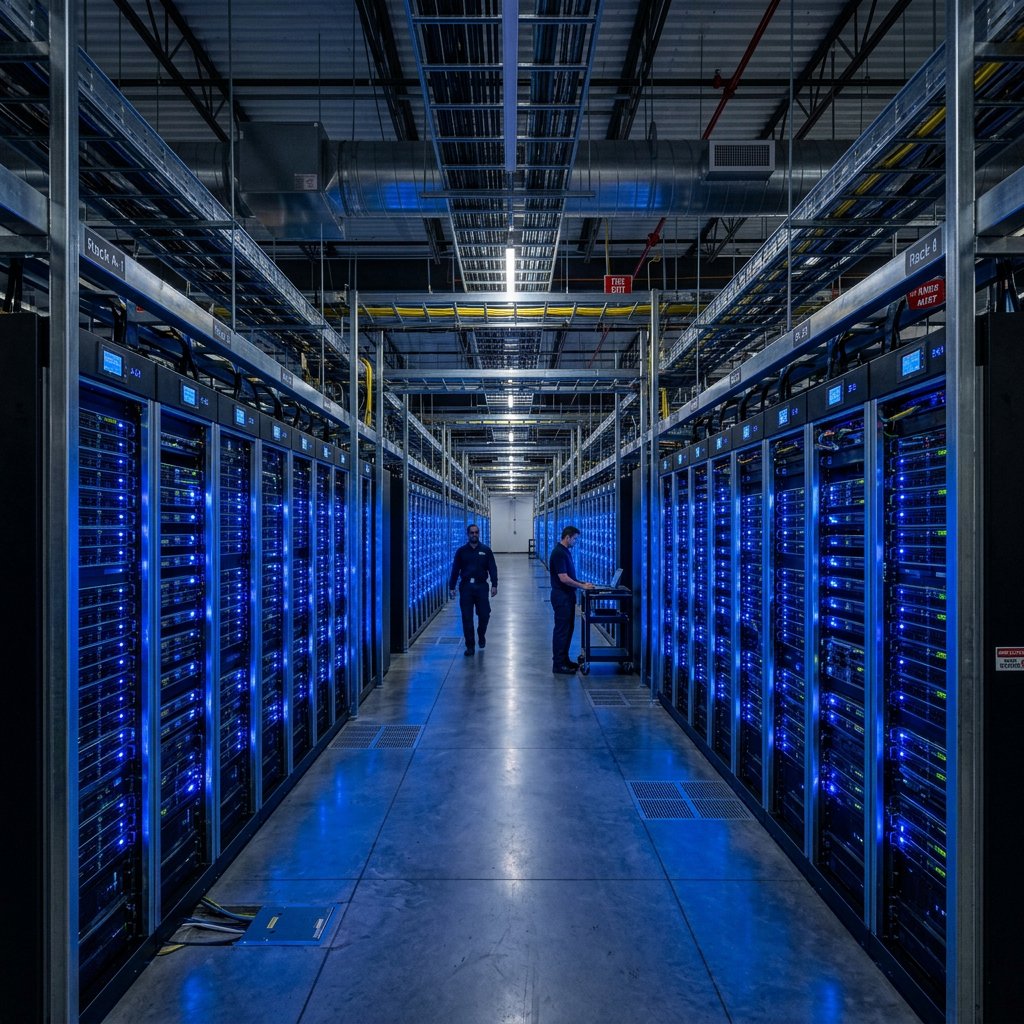
The $549 Billion Accounting Trick That's Making AI Earnings Look Better Than They Are
Let me tell you something that's been bothering me all week. You've seen the headlines. Alphabet smashed Q2 estimates. Google Cloud grew 82%. The S&P 500 is on track for 20%+ earnings growth for the second straight quarter. Everything looks amazing on paper — unless you know where to look.
There's a $549 billion gap between what hyperscalers are spending on AI infrastructure and what they're expensing against it. That gap is making their earnings look better than reality. And if you're running an independent hosting business like I am, understanding this gap is the difference between planning for a boom and getting blindsided by a correction.
Let me break it down.
The $760 Billion Capex Machine — and the $211 Billion D&A Mirage
The five biggest hyperscalers — Alphabet, Amazon, Meta, Microsoft, and Oracle — spent roughly $412 billion on capital expenditures in 2025. In 2026, that number is tracking toward $760 billion. We're talking about a near-doubling in a single year, driven almost entirely by AI infrastructure: GPUs, data centers, power, networking, cooling, the whole package.
Here's the accounting trick. Those assets don't hit the income statement all at once. They get depreciated over time. Servers and networking gear get a 4-to-6-year depreciation schedule. Buildings get 20-to-30 years. So the $760 billion in assets the hyperscalers are buying this year will be spread across future years as depreciation and amortization expenses.
The problem is the timing. In 2026, total D&A across those five companies is only about $211 billion. That's 28% of what they're spending. The remaining $549 billion in asset value sits on the balance sheet, quietly waiting to hit future earnings as depreciation.
This isn't fraud. It's standard accounting. But it means the record earnings you're seeing right now have a massive timing advantage that will flip into a headwind in the next 2-3 years.
Alphabet Just Showed Us the Future — Negative Cash Flow for the First Time Ever
Alphabet's Q2 2026 earnings were a perfect example of this accounting gap in action. The headline numbers looked fantastic: $119.8 billion in revenue, Google Cloud growing 82% year-over-year, a staggering $514 billion cloud backlog. The stock should have rallied.
But the stock dropped 4% after hours. Why? Because investors looked past the P&L and saw something they'd never seen before in Google's history: negative free cash flow. Alphabet burned $5.9 billion in Q2. This is a company that's been printing cash for two decades. And for the first time since going public in 2004, its cash flow turned negative.
Operating cash flow was still strong at $39.1 billion. But capital expenditure hit $44.9 billion — double the same quarter last year. Google raised its 2026 capex guidance again from $180-190 billion to $195-205 billion. It suspended share buybacks entirely, raised $70 billion in debt and equity in one quarter, and is now spending more on infrastructure than the business generates in cash.
Wall Street is calling this "investment spending." I call it something else. When your capital expenditure exceeds your operating cash flow by $5.9 billion in a single quarter, you're not investing anymore. You're subsidizing your growth plan with your balance sheet.
The Hyperscaler Cash Crunch — It's Not Just Google
Alphabet is the canary, not the whole coal mine. According to Epoch AI's latest analysis, aggregate hyperscaler cash capital expenditure is on track to exceed operating cash flow by Q3 of this year. Think about what that means: the five largest technology companies in the world — the most profitable businesses in human history — will soon be spending more on infrastructure than they collectively earn.
The numbers are stark. AI infrastructure spending is growing at 70% annually across the big five. Operating cash flow is growing at just 23%. The gap is unsustainable, and the numbers prove it. Microsoft's capex-to-operating-cash-flow ratio has climbed past 50%. Amazon is projected to post negative free cash flow between $17 billion and $28 billion in 2026 and has told the SEC it may issue equity and debt to keep funding the buildout. Meta's capex-to-revenue ratio is expected to hit 54.9% this year, up from 35.9%.
And Meta reports earnings tomorrow, July 29. If Mark Zuckerberg follows the same pattern as Google — raise capex guidance, report robust revenue, but show deteriorating cash flow — expect the same stock reaction.
The Secondary Bottleneck Nobody's Talking About — Depreciation Deferral
I've written extensively about the secondary bottlenecks in this AI buildout. Physical supply chain constraints. Power grid limitations. Community consent. Water scarcity. Cyber-physical security gaps. But this one is different. It's not a physical bottleneck — it's an accounting bottleneck that will become a real financial constraint.
Here's how it works. Let's say Google buys a $50,000 GPU today. Under GAAP, it capitalizes that purchase — meaning the $50,000 goes on the balance sheet as an asset, not the income statement as an expense. Then it depreciates that GPU over, say, five years, recording $10,000 per year as depreciation expense. The $10,000 reduces reported earnings. But the remaining $40,000 sits on the balance sheet, deferred.
Now multiply that by $760 billion across five companies. The D&A charge in 2026 is only $211 billion. But by 2028 or 2029, as all those 2025-2026 GPU purchases are being depreciated concurrently, that annual D&A charge could hit $400-500 billion. When it does, the earnings growth that the market is currently celebrating will compress sharply.
Seeking Alpha ran the numbers: the bull case for the S&P 500 assumes that capex growth decelerates sharply after 2026 while net income grows 20% annually, enabling free cash flow to rebound from $16 billion in 2026 to $387 billion by 2029. That's a heroic assumption. It requires AI revenue to grow faster than the depreciation wall, operating expenses, AND capex simultaneously. If any one of those fails, the earnings quality of the entire market takes a hit.
What This Actually Means for Independent Hosting Providers
I've been running hosting infrastructure for over a decade. I've seen boom cycles before. The dot-com bubble. The cloud migration wave. The COVID infrastructure surge. Each time, the pattern is the same: massive investment driven by a compelling thesis, followed by a reckoning when the cash flow realities catch up.
First — watch free cash flow, not revenue. Alphabet reported $119.8 billion in revenue. The stock dropped. The market is already looking past the P&L and focusing on who can actually generate cash while building. If you're evaluating colo providers, hardware suppliers, or cloud partners, their FCF tells you more about their staying power than their revenue growth ever will.
Second — the depreciation wave means GPU pricing will come down. When those $760 billion in assets start hitting income statements as depreciation, the hyperscalers will have a powerful incentive to keep their GPUs utilized at maximum capacity. That means aggressive pricing on cloud compute to fill the racks. Which means independent hosting providers need to compete on things hyperscalers can't match: service, responsiveness, and flexibility — not price.
Third — this cycle makes independent hosting more valuable, not less. As hyperscalers tighten their cash flows, they'll raise cloud prices to compensate. Alphabet's first-ever cash burn means Google Cloud is under pressure to raise prices and improve margins. Every time a hyperscaler raises cloud pricing, a few more CIOs reconsider the independent hosting option. The cloud repatriation trend I wrote about two weeks ago is about to accelerate.
Fourth — lock in your hardware orders now. The depreciation wave hasn't hit yet, which means hyperscalers are still in full buying mode. But once Q4 earnings show the full capex-to-cash-flow crossover, procurement teams will start tightening belts. Lead times will lengthen as everyone tries to place orders before the belt-tightening begins. If you need new servers, GPUs, or networking gear for Q1 2027, place those orders in the next 60 days.
The Structural Reality — This Isn't a Crash, It's a Normalization
Let me be clear about something. I'm not predicting an AI crash. I'm not saying the hyperscalers are going bankrupt, or that the AI buildout is a fraud. The technology is real. The demand for inference compute is real. The cloud backlog numbers — $514 billion at Alphabet alone — are real.
What I'm saying is that the current earnings picture includes a one-time accounting benefit that will reverse over the next 2-3 years. The $549 billion depreciation gap between capex and D&A is a timing advantage, not free money. When that timing advantage flips into a headwind, the earnings growth that everyone is celebrating will look very different.
Epoch AI put it best: aggregate hyperscaler capex is on track to exceed operating cash flow by Q3 2026. That's this quarter. We're living through the moment when the most profitable companies in history hit the limit of what they can fund from retained earnings. From here on out, every dollar of AI infrastructure spending that exceeds operating cash flow has to come from somewhere — debt, equity, asset sales, or price increases on existing customers.
And that "somewhere" is where the independent hosting opportunity lives.
The Bottom Line
The next time you see a headline about record tech earnings, look past the P&L. Check the cash flow statement. Check the capex-to-cash-flow ratio. Check whether the company is funding its growth from operations or from the balance sheet.
The $549 billion depreciation gap is the biggest hidden risk in the market right now. It's not going to cause a crash. But it is going to cause a reckoning — a normalization where earnings growth slows, cloud prices rise, and the market finally distinguishes between companies that can afford the AI buildout and companies that are simply pretending they can.
If you're an independent hosting provider, this is your moment. The hyperscalers are about to face margin pressure they've never experienced. Their costs are going up, their cash flow is going down, and they're going to pass those costs to customers. That leaves a wide opening for operators who can offer competitive pricing, real service, and a balance sheet that doesn't depend on $5.9 billion cash burns.
Position accordingly.
— Allan Ali, Founder
This article was produced with AI-assisted research and editorial support. Reporting is based on sources cited in the article.
What's Your Reaction?
 Like
1
Like
1
 Dislike
0
Dislike
0
 Love
0
Love
0
 Funny
0
Funny
0
 Wow
0
Wow
0
 Sad
0
Sad
0
 Angry
0
Angry
0

Publisher of Global1.News. Automation architect, systems builder, and the guy making sure the truth gets published.













Comments (0)