
Su-57 Crash That Exposed Russia's Aerospace Weakness
Russia's most advanced fighter jet crashed near Moscow on July 23, 2026, and official explanations from the Ministry of Defense cite only a preliminary technical fault. The Su-57 Felon went down in the Odintsovo district near Zvenigorod, about 65 kilometers west of the capital, after launching fr...
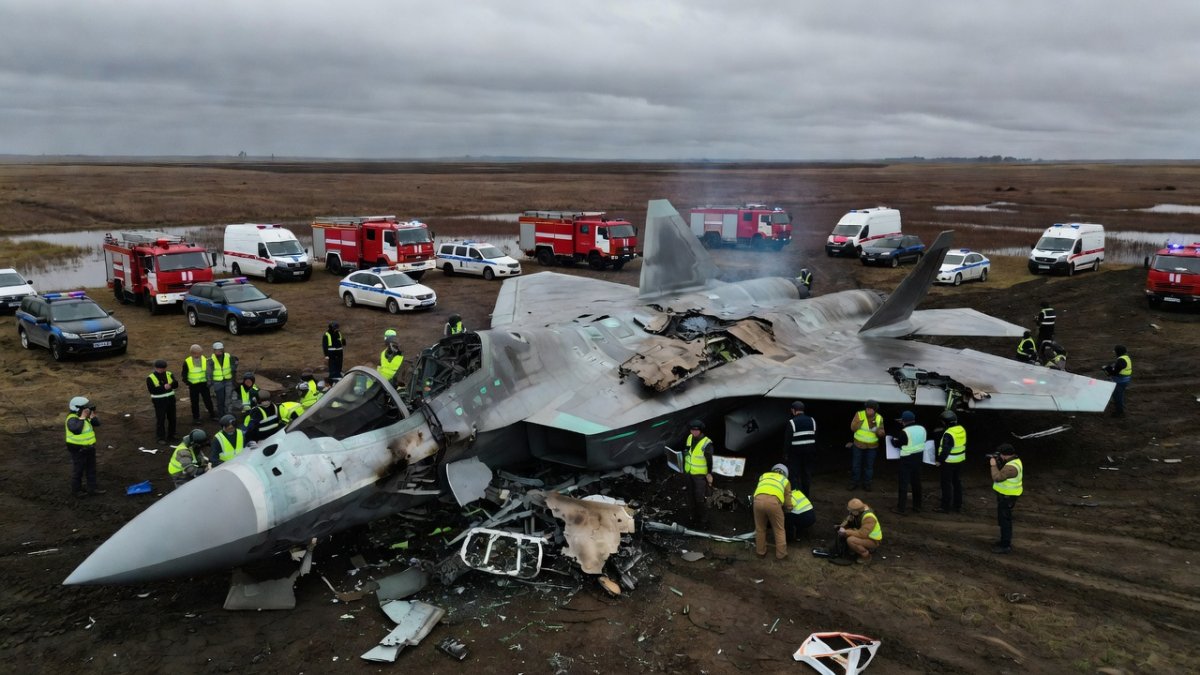
The Crash That Exposed Russia's Weakness
Russia's most advanced fighter jet crashed near Moscow on July 23, 2026, and official explanations from the Ministry of Defense cite only a preliminary technical fault. The Su-57 Felon went down in the Odintsovo district near Zvenigorod, about 65 kilometers west of the capital, after launching from Kubinka Air Base on a training flight. The pilot ejected and survived with minor injuries, according to reports from TASS and Kommersant, which identified the aircraft as an Su-57. Pro-Kremlin military bloggers also confirmed the type.
This incident marks the second known loss of the platform, following a June 2024 Ukrainian drone strike that damaged an Su-57 at Akhtubinsk airbase, as reported by the Kyiv Independent. Official Russian statements have avoided confirming the aircraft type or providing further details beyond the technical fault explanation. The aircraft is meant to represent Russia's top-tier stealth capability, yet it fell during what was described as a routine training mission inside Russian territory.
Friendly Fire Speculation Remains Unconfirmed
According to Indian Defense News, citing unnamed Russian sources, the fighter was mistakenly engaged by the BARS-Moscow Air Defence Unit, a volunteer territorial formation created to protect the capital from Ukrainian drone attacks. Aerospace Global News also reports friendly fire speculation circulating among Russian sources. These accounts remain unconfirmed reports rather than established facts — the Ministry of Defense has not addressed the theory, and no official confirmation exists.
If the speculation holds, it would mark an unprecedented case of a stealth fighter lost to friendly fire. Russian sources circulating in defense discussions have raised the same possibility, but attribution remains limited to unnamed sources. This comes against a backdrop where Russia has already lost more than ten fighter jets to friendly fire during the Ukraine war, according to patterns noted in Aerospace Global News' reporting on the conflict.
Production Shortfalls Reveal Systemic Problems
Russia fields somewhere between 21 and 32 Su-57s in total service. Production runs at just two to four aircraft per year — a pace that has persisted since the jet entered serial production in December 2020. Ambitious plans for more than 50 aircraft by 2026 were not achieved. A 2025 modernization introduced the new AL-51F engine, yet overall output continues to lag. The National Interest labeled the jet "Russia's Failed Stealth Fighter," reflecting the gap between announced goals and delivered results.
Sanctions have severed access to critical Western microelectronics and avionics components that Russian industry previously imported for the Su-57's radar and flight systems, forcing reliance on lower-yield domestic substitutes that slow assembly and raise failure rates. Titanium supply chains, once supplemented by Western partners, now face bottlenecks that directly constrain airframe production. Precision machine tools embargoed since 2022 have limited the ability to maintain tolerances on stealth surfaces. The Ukraine war has further compounded these constraints by redirecting skilled aerospace labor toward frontline needs. This stands in stark contrast to the F-35 program, which sustains output above 150 aircraft annually through integrated global supply networks.
Combat Record Confined to Standoff Launch
The Su-57 has never flown over Ukraine. It operates exclusively from Russian airspace, launching Kh-59 and Kh-69 cruise missiles from stand-off distances. 19FortyFive reported that Russia avoids flying the Su-57 over Ukraine entirely. Ukrainian air defenses, including Patriot, NASAMS, and IRIS-T systems, have made operations closer to the front lines too risky for the platform. The jet has not demonstrated integration of its intended R-77M or Kh-38 missiles in contested environments, and engine reliability issues have kept sortie rates low.
By contrast, the F-35 Lightning II has logged more than 800,000 flight hours across operational squadrons with documented combat deployments in the Middle East, the Pacific, and Europe. The F-22 Raptor flew combat sorties over Syria and maintains a refined air-to-air and air-to-ground loadout refined over two decades of exercises. Even China's J-20 has accumulated thousands of hours in large-scale drills. The Su-57's public record shows almost no integration of its intended armament in high-threat environments, while engine reliability issues have kept sortie rates low.
The F-16 Factor: Ukraine's Rising Air Power
On the same day the Su-57 went down, a Ukrainian F-16 downed a Russian fighter jet — confirmed by a U.S. general and reported by Defense News. The engagement marked the first confirmed air-to-air victory by a Ukrainian F-16, demonstrating that Western-supplied platforms and NATO-standard training can produce results against Russian aircraft. Ukrainian pilots, operating under NATO-derived tactics, have demonstrated effective integration of beyond-visual-range missiles and ground-controlled intercepts.
These engagements suggest that sustained Western support can erode Russia's traditional numerical edge in the theater. The emerging pattern implies that future Ukrainian operations may increasingly contest airspace previously considered secure for Russian standoff launches, narrowing the operational window for platforms like the Su-57.
Putin's Military Prestige Takes Another Blow
The Telegraph captured the moment's significance on July 27, 2026, writing that failing to protect the regime's most sophisticated aircraft inside its own borders signals deeper problems for the Kremlin. The timing — the same day a Ukrainian F-16 scored a confirmed kill — only sharpens the contrast.
The Su-57 loss fits a consistent pattern of flagship programs collapsing under real-world pressure. The Moskva cruiser sank after a single Ukrainian missile strike in 2022, exposing Black Sea Fleet vulnerabilities that later claimed multiple landing ships and submarines. The T-14 Armata, once touted as the future of Russian armor, remains in single-digit production because its active protection system and electronics proved too costly and unreliable for mass fielding. The Su-75 Checkmate never progressed beyond a static mockup, its promised low-cost export appeal evaporating amid sanctions and design shortfalls, as documented by 19FortyFive. These repeated failures trace back to systemic issues: corruption siphoning development funds, sanctions blocking critical components, and a military culture that prioritizes parades over rigorous testing.
Export Hopes Face an Uphill Climb
Despite these challenges, Russia continues pursuing export deals for the Su-57. Putin offered joint production to India in June 2026, as reported by India Today and Defense News. Algeria confirmed acquisition of the Su-57E export variant in February 2025. Yet these potential deals rest on a platform that has now recorded a second loss inside Russian territory.
India's ongoing evaluation of Su-57 joint production now occurs against visible evidence of production shortfalls and repeated losses inside Russian territory. Defense planners in New Delhi face pressure to accelerate diversification toward established Western alternatives such as additional Rafale squadrons or eventual F-35 integration. This shift also bolsters domestic efforts like the AMCA fifth-generation project, as Indian officials weigh the risks of technology transfer from a supplier whose export claims have outpaced delivery.
The Broader Failure of Russia's Wonder Weapons
The Su-57 difficulties are not an isolated case. Russia unveiled the Su-57, the T-14 Armata, and the Su-75 Checkmate as world-beating weapons. A decade later, the Armata exists in tiny numbers, the Checkmate has never flown, and the Su-57 trickles off the line at two to four aircraft annually. The gap between propaganda and reality keeps widening, documented consistently by 19FortyFive, The National Interest, and Defense News.
Each loss chips away at an already tiny fleet. With production crawling along at a handful of jets per year, every destroyed aircraft represents years of lost capability. The pattern of overpromise and underdelivery has become the defining characteristic of Russia's defense industrial base.
What This Means Going Forward
The July 23, 2026 Su-57 crash near Moscow reflects ongoing technical shortfalls, limited production, and operational constraints. Unconfirmed speculation from Russian military bloggers about friendly fire involvement, as reported by Indian Defense News and Aerospace Global News, adds another layer to questions about air defense coordination. The same day's confirmed Ukrainian F-16 victory, reported by Defense News with attribution to a U.S. general, underscores the shifting balance in the air war.
With the fleet estimated at 21 to 32 aircraft and output remaining at two to four per year, further losses compound existing limitations. The platform continues to operate from Russian airspace only, avoiding direct exposure to Ukrainian defenses. These factors together illustrate the distance between stated capabilities and demonstrated performance — a gap that no amount of Kremlin press releases can close.
By Jessica Ali, Staff Writer
This article was produced with AI-assisted research and editorial support. Reporting is based on sources cited in the article.
What's Your Reaction?
 Like
0
Like
0
 Dislike
0
Dislike
0
 Love
0
Love
0
 Funny
0
Funny
0
 Wow
0
Wow
0
 Sad
0
Sad
0
 Angry
0
Angry
0

Editor-in-Chief at Global1.News. Atlanta-based journalist who cuts through the BS and tells it like it is. Lead anchor, host, and the voice you hear when the spin stops and the truth starts.















Comments (0)