
The Amazons of African Cinema Triumph at the 4th Edition of FIFF Cotonou
The spirit of the Dahomey Amazons came alive in Cotonou this February as the 4th edition of the International Women's Film Festival — FIFF Cotonou — celebrated African women in cinema with a powerful showcase of storytelling, resilience, and creative triumph. The Amazons of African Cinema Triumph at the 4th Edition of FIFF Cotonou Cotonou, Benin — The 4th edition of FIFF Cotono
The spirit of the Dahomey Amazons came alive in Cotonou this February as the 4th edition of the International Women's Film Festival — FIFF Cotonou — celebrated African women in cinema with a powerful showcase of storytelling, resilience, and creative triumph.
The Amazons of African Cinema Triumph at the 4th Edition of FIFF Cotonou
Cotonou, Benin — The 4th edition of FIFF Cotonou ran from February 3 to 7, 2026, in Benin’s economic capital and drew more than 1,000 festivalgoers from across the continent. Launched in 2019 by Cornélia Glèlè of Écran Bénin, the biennial event under the theme “Women, Free Your Creativity” screened 18 short films from 14 African countries. The festival matters because it strengthens networks among African women filmmakers at a time when their stories reach wider audiences through platforms such as those at FESPACO and international markets.
A Gathering of African Women Filmmakers
FIFF Cotonou opened its doors at three main venues: the Institut Français de Cotonou, Majestic Hall in Wologuèdè, and the open-air Place de l’Amazone. Cornélia Glèlè, founder and director through her organization Écran Bénin, coordinated the program with support from the Swiss Cooperation in Benin, Canal+ Benin, UNICEF, and the Government of Canada. These partnerships supplied equipment, travel grants, and technical training that allowed filmmakers from Central, West, and East Africa to attend.
More than 1,000 festivalgoers filled screening rooms and outdoor spaces during the five-day run. The 18 competing short films represented 14 countries, creating daily conversations about financing, distribution, and censorship that directly affect women directors on the continent. Participants noted that such gatherings reduce isolation for creators who often work without national film funds.
Franco-Malian actress, filmmaker, and author Aïssa Maïga served as patron and delivered the opening address. Her presence linked the Benin event to broader Francophone cinema circuits that include festivals in Ouagadougou and Dakar. Maïga emphasized that African women must control their own narratives rather than wait for external validation.
Masterclasses in acting and screenwriting ran each afternoon at the Institut Français. Industry panels examined film financing models used in Nigeria and South Africa, giving Beninese participants concrete examples they could adapt locally. The sessions concluded with networking dinners that produced several co-production agreements announced before the closing ceremony.
The festival’s scale reflects steady growth since its 2019 launch. Attendance has risen each edition, and the 2026 program introduced a Docubox evening dedicated to East African shorts, expanding the geographic reach beyond West Africa. This deliberate inclusion signals FIFF Cotonou’s ambition to serve as a continental hub.
Local media coverage in Cotonou highlighted how the event boosts tourism and cultural infrastructure. Hotel bookings in Wologuèdè increased during the festival week, and street vendors near Place de l’Amazone reported higher sales of traditional fabrics and snacks. Such economic ripple effects matter for a city that positions itself as Benin’s creative gateway.
Douwé: Amplifying Adolescent Girls' Voices Through Cinema
The opening film, “Douwé,” was written and directed by 12 Beninese teenage girls through the UNICEF-supported Kino Wendia project backed by the Government of Canada. The 12-minute short follows a high-achieving female student forced to drop out of school because of family pressure and economic hardship. The story directly confronts girls’ education barriers, family expectations, and gender inequality in Benin.
Training for the young directors covered screenwriting, directing, editing, leadership skills, and gender-based violence prevention. UNICEF Benin supplied cameras and editing software while Canadian instructors led daily workshops at a Cotonou community center. The girls completed the film in six weeks, demonstrating that structured mentorship can produce festival-ready work quickly.
Aminatou Sar, UN Resident Coordinator in Benin, attended the premiere at Majestic Hall. In her remarks she noted that the film aligns with national efforts to raise girls’ secondary-school completion rates. Sar later arranged for “Douwé” to screen again at the Institut Français in May 2026 for secondary-school students across Cotonou.
The choice of an opening film made by adolescents sent a clear signal about intergenerational transmission. Festival organizers deliberately placed the girls’ work first to show that the next generation already possesses the tools to shape African cinema. Audience members left the screening discussing how similar projects could be replicated in rural departments.
Post-screening conversations revealed that several of the 12 directors now plan to apply for film-school scholarships. Their participation has already altered family attitudes toward girls pursuing creative careers, illustrating the festival’s reach beyond the screen.
The Amazone Awards: Honouring African Women's Cinema
The awards, named Amazones in tribute to Benin’s legendary Dahomey Amazons, were presented on the final evening. The Amazone d’Or went to “The Incredible Sensational Fiancée of Sèyí Àjàyí,” directed by Nigerian-American filmmaker Abbesi Akhamie. The comedy follows a brilliant but overlooked woman scholar who learns her fiancé is engaged to someone else and transforms distress into daring revenge.
Akhamie accepted the prize by stating that the film shows women refusing to remain silent when betrayed. The story’s sharp dialogue and Lagos setting resonated with audiences familiar with similar social pressures across West Africa. The win positions Akhamie for wider international distribution deals.
Best Documentary was awarded to “Les Chaînes du Deuil” by Beninese director Dorcas Ganmagba. The film denounces the inhumane conditions imposed on women in mourning in southern Benin communities, where widows are sometimes denied the right to wash, go out, or comb their hair. Ganmagba described the work as a call to end practices that strip women of basic dignity.
Best Performance honors went to “Mia,” directed by Burkinabe filmmaker Hana Halia Lebo Traoré. The drama depicts a teenager blackmailed with an intimate video by her boyfriend. Traoré said the film holds a mirror to society so viewers confront the realities of digital exploitation facing young women today.
A Special Mention was given to Nadia Salem for her documentary on Algerian women’s role in the independence struggle. The jury praised the film’s archival research and its contribution to rewriting North African history from women’s perspectives. Salem’s recognition underscored the festival’s commitment to stories from across the continent.
Other participating filmmakers included Divine Kondembi from the Central African Republic with “Black Skin and That’s My Father” and Fatoumata Coulibaly from Mali with “Le silence des origines.” Their presence expanded the conversation to Central and Sahelian experiences, reinforcing FIFF Cotonou’s pan-African scope.
Place de l'Amazone: History Meets Cinema
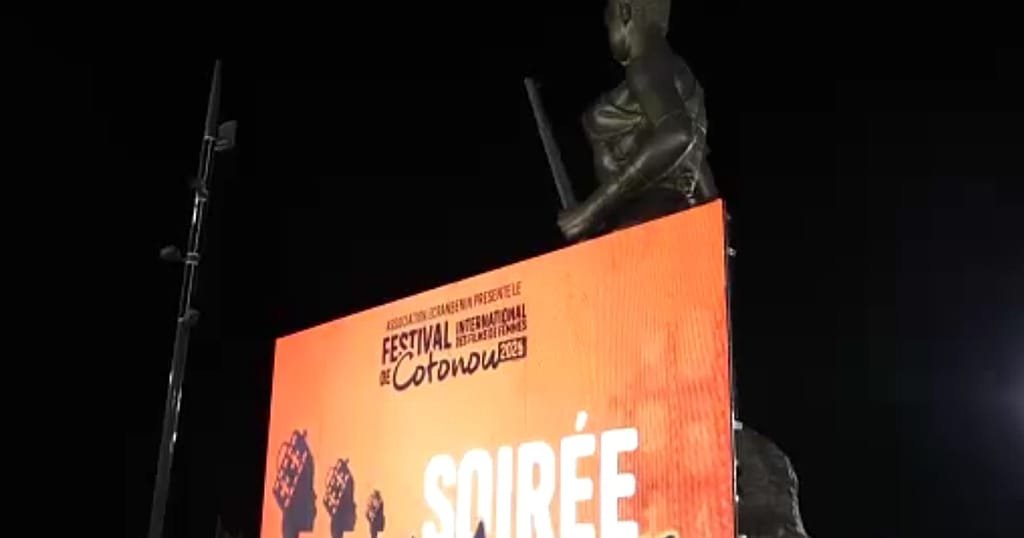
The closing ceremony took place at Place de l’Amazone, a public square named after the legendary female warriors of the Kingdom of Dahomey. Young girl drummers performed traditional rhythms that echoed the discipline of the Mino regiments. Their presence created a direct visual link between historical military valor and contemporary creative courage.
The Dahomey Amazons, known as Mino, formed elite all-female warrior units that defended the kingdom until the late nineteenth century. Their monument statue in Cotonou served as the symbolic backdrop for the awards. Organizers positioned the statue behind the stage so that every prize recipient stood beneath the gaze of these ancestors.
The festival explicitly draws inspiration from this warrior legacy, framing women filmmakers as modern Amazons who battle industry exclusion rather than battlefield enemies. This framing resonated with audiences who see cinema as another arena where African women claim space and authority.
Connections to the 2022 film “The Woman King,” which dramatized the Agojie warriors, surfaced in post-ceremony discussions. Several attendees noted that the Hollywood production had introduced global audiences to the same history now celebrated locally through FIFF Cotonou. The festival thus extends that visibility into sustained African-led programming.
Place de l’Amazone’s open-air setting allowed hundreds of Cotonou residents to attend the ceremony without tickets. Families spread mats on the surrounding grass, turning the event into a communal celebration that blurred lines between formal festival programming and everyday public life.
Pan-African Cinema: A Growing Movement
FIFF Cotonou forms part of a widening network of African women’s film festivals that includes events in Nairobi, Accra, and Dakar. These gatherings share programming strategies and increasingly exchange films, creating circuits that bypass traditional European gatekeepers. The Benin edition’s inclusion of a Docubox evening showcasing East African shorts exemplified this cross-regional exchange.
Masterclasses and panels addressed creativity, film financing, and industry development with concrete case studies from successful African productions. Participants learned how directors from Senegal and Burkina Faso have secured streaming deals that fund subsequent projects. Such knowledge transfer accelerates professional growth for emerging voices.
Francophone and Anglophone collaboration was evident in the lineup, with films from Nigeria, Mali, and the Central African Republic screened side by side. Subtitles in both French and English encouraged dialogue between linguistic regions that sometimes operate separately. This bilingual approach mirrors the continent’s actual viewing habits.
African women filmmakers are gaining recognition at Cannes, TIFF, and FESPACO, yet many still lack consistent national support. FIFF Cotonou addresses this gap by offering a dedicated platform that celebrates their work without requiring them to compete in mixed-gender categories. The resulting visibility helps attract future funding.
The festival’s growth parallels broader investment in African cinema infrastructure, including new training centers and post-production facilities in several capitals. As these resources expand, events like FIFF Cotonou become essential meeting points where partnerships form and careers advance.
What to Watch For
FIFF Cotonou operates on a biennial schedule, with the next edition planned for 2028. Organizers intend to increase the number of competing films and add a feature-length section, building on the momentum of the 2026 success. Advance planning has already begun with the same institutional partners.
The festival continues to inspire and promote female voices by placing adolescent creators alongside established directors. This deliberate mix ensures that mentorship flows in both directions and that the Amazone Awards remain relevant to successive generations.
Growing investment in African cinema infrastructure, combined with streaming-platform interest, opens new markets for women directors. Abbesi Akhamie, winner of the Amazone d’Or, already fields offers from international producers, illustrating how a Benin-based prize can launch careers onto global stages.
By centering women’s stories and historical memory at Place de l’Amazone, FIFF Cotonou demonstrates that African cinema can honor its past while shaping its future. The 2026 edition proved that when women filmmakers gather in Cotonou, the continent’s creative landscape shifts measurably.
By Amara Diop, Staff WriterThis article was produced with AI-assisted research and editorial support. Reporting is based on sources cited in the article.
What's Your Reaction?
 Like
0
Like
0
 Dislike
0
Dislike
0
 Love
0
Love
0
 Funny
0
Funny
0
 Wow
0
Wow
0
 Sad
0
Sad
0
 Angry
0
Angry
0

West Africa/Sahel Correspondent at Global1.News. Dakar-based journalist covering politics, security, climate, and development across Francophone and Anglophone West Africa. Tells the stories of a region undergoing profound transformation.











Comments (0)