
SpaceX IPO at $135: Biggest IPO in History Starts Tomorrow
Opening Hook — Why This Matters RIGHT NOW Listen up, people — June 11, 2026 is the day the space economy stops being sci-fi and becomes the biggest money printer on Wall Street. SpaceX is finally pricing its IPO at $135 a share, and shares start trading tomorrow under SPCX on NASDAQ. This isn’t some cute tech debut; it’s a $75 billion cash explosion that instantly makes Elon Mu
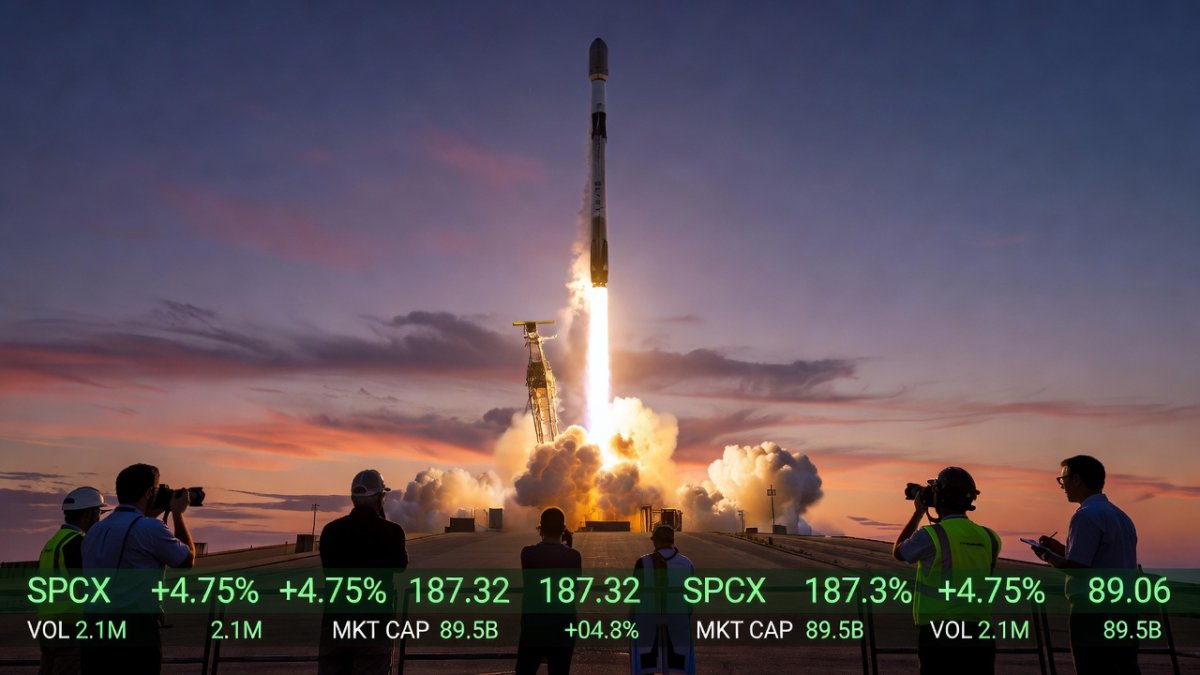
Opening Hook — Why This Matters RIGHT NOW
Listen up, people — June 11, 2026 is the day the space economy stops being sci-fi and becomes the biggest money printer on Wall Street. SpaceX is finally pricing its IPO at $135 a share, and shares start trading tomorrow under SPCX on NASDAQ. This isn’t some cute tech debut; it’s a $75 billion cash explosion that instantly makes Elon Musk’s rocket company the most valuable newcomer in market history. Reuters and Bloomberg are calling it the largest IPO ever, and they’re not exaggerating. With a valuation between $1.75 and $1.8 trillion, SpaceX is leaping past every traditional automaker, bank, and even most oil giants in one shot. The implications hit every investor’s portfolio: Starlink alone is already pulling in 80 percent of revenue, and the addressable market per SEC filings sits at a jaw-dropping $28.5 trillion. That means your 401(k), your kid’s college fund, even your side-hustle brokerage account could feel the ripple tomorrow morning. I’m fired up because this isn’t just about rockets — it’s about who controls the next century of data, defense, and interplanetary infrastructure. Miss this and you’re watching from the cheap seats while institutions feast.
The Basics — Price, Shares, Valuation, Timing
Let’s cut straight to the numbers that actually matter. SpaceX is offering 555.6 million shares at a fixed price of $135 each, raising roughly $75 billion in fresh capital. That values the company at $1.75 to $1.8 trillion right out of the gate. Pricing lands today, June 11, 2026, with trading kicking off tomorrow — a deliberate move to let the hype build overnight. Lead underwriters Morgan Stanley, Goldman Sachs, and JPMorgan are running the show, and they’ve already locked in massive institutional demand. The 4x-plus oversubscription tells you everything: big money wants in yesterday. Founded back in 2002 by Elon Musk and private for 24 years, this is the moment the company opens its books to the public. Proceeds are earmarked for Starship development and Mars ambitions, not some vague “growth initiatives.” CNBC sources confirm the timing was chosen to ride the tailwinds of recent Starlink subscriber surges and the early-2026 acquisition of xAI. Bottom line: these basics aren’t boring — they’re the launchpad for the most aggressive valuation the market has seen since the dot-com era, except this time the technology actually works.
Record-Shattering Scale — Comparison to Other IPOs
Step aside, Saudi Aramco and Alibaba — SpaceX just rewrote the IPO record book. At $75 billion raised, this dwarfs Aramco’s $29.4 billion haul and crushes Alibaba’s $25 billion 2014 debut. Bloomberg analysts are already labeling it the largest IPO in history by a wide margin, and the $1.8 trillion valuation puts it in the same stratosphere as Apple and Microsoft on day one. Think about the context: when Facebook went public it was valued at around $104 billion; SpaceX is nearly 18 times that size. The oversubscription rate of 4x-plus also beats the frenzy we saw with Snowflake or Rivian. What makes this scale terrifying is the speed — 24 years private, then boom, the biggest public offering ever. Implications for the broader market are huge: expect rotation out of mega-cap tech into anything space-adjacent. Retail platforms are bracing for volume spikes that could rival meme-stock days. This isn’t incremental growth; it’s a structural shift in how capital allocates to frontier industries. If you’re not positioned, you’re going to feel this one in your returns for years.
Institutional Frenzy — Who’s Buying, Why Oversubscribed
Institutional investors are behaving like it’s Black Friday at a rocket factory. Reports from Reuters and Bloomberg show more than $10 billion in firm orders, with some whispers of $150 billion-plus in total demand. Sovereign wealth funds, pension giants, and tech-heavy mutual funds are all elbowing for allocation. The 4x oversubscription isn’t hype — it’s cold math. Starlink’s recurring revenue stream looks like a high-margin utility business, and the xAI integration adds an AI upside that wasn’t priced in six months ago. Why the frenzy? Because institutions finally see a clear path to Mars-scale returns without waiting another decade. They’re also hedging against terrestrial slowdowns by grabbing exposure to orbital infrastructure. Goldman Sachs noted in its roadshow materials that defense contracts and Starlink government deals provide downside protection rarely seen in growth names. The result is a feeding frenzy that leaves little room for late entrants at the IPO price. This level of demand signals that smart money views SpaceX as a multi-decade compounder, not a one-quarter trade. If you’re an institution that missed the boat, good luck explaining that to your LPs.
Retail Access — How Regular Folks Can Participate
Here’s the part that actually affects normal people: up to 30 percent of the offering is being routed through Robinhood, Fidelity, and Charles Schwab for retail allocation. That’s not charity — it’s a calculated move to create broad ownership and reduce post-IPO volatility. If you’ve got a brokerage account at any of those platforms, you likely received or will receive an invitation to place an indication of interest. The catch? Allocations will be pro-rata and capped, so don’t expect to load up on thousands of shares unless you’re already a whale. Still, this is one of the most retail-friendly IPOs in recent memory. Fidelity’s research desk has already published a primer walking clients through the risks and the Starlink revenue math. Robinhood added educational modules on orbital economics. My take: if you believe in the long-term story, set a limit order for tomorrow’s open and size it responsibly. But don’t FOMO in at any price — the lock-up expirations and Elon’s history of volatility mean this ride will be bumpy. Regular folks finally have a seat at the table; just don’t overpay for it.
The Business Breakdown — Starlink, Rockets, xAI
Strip away the hype and the business is brutally simple: Starlink drives 80 percent of revenue today, with Falcon 9, Falcon Heavy, Starship, and Dragon filling the rest. The early-2026 acquisition of xAI folded advanced AI capabilities directly into the SpaceX stack, creating a vertical that spans satellites, compute, and autonomous systems. SEC filings peg the total addressable market at $28.5 trillion, covering everything from global broadband to Mars colonization logistics. Starlink’s subscriber growth has been relentless, and government contracts for secure comms are accelerating. Meanwhile, Starship development is the high-risk, high-reward bet that could unlock point-to-point Earth transport and deep-space missions. The xAI piece adds an AI layer that could monetize orbital data centers. This isn’t a single-product company anymore — it’s an ecosystem play with multiple revenue engines firing at once. Investors buying SPCX are essentially long the entire stack: connectivity, launch services, and next-gen intelligence. The financials are finally transparent enough for public scrutiny, and the margins on Starlink look better than most terrestrial telecoms.
The Elon Factor — Leadership Risks and Rewards
Elon Musk is both the rocket fuel and the potential black swan. His dependency is real — the stock will move on his tweets, his Mars timelines, and his occasional drama. Yet that same vision built a 24-year private company into a $1.8 trillion public entity. The 2022 X acquisition and subsequent xAI fold-in show he’s consolidating power across social, AI, and space. Rewards are obvious: when Musk focuses, execution can be blistering. Risks are equally clear — regulatory scrutiny, divided attention, and the possibility of another Twitter-style distraction. Bloomberg’s risk section in the prospectus flags “key-person dependency” in bold. Still, the board and institutional backers appear comfortable with the trade-off. For shareholders, the Elon factor means outsized upside if Starship lands on cadence, but also headline risk that can swing the stock 10-15 percent in a day. Love him or hate him, he’s the variable you’re underwriting when you buy SPCX.
Competition and Risks — Kuiper, Regulatory, Execution
Amazon’s Project Kuiper is the most direct competitor, and it’s not going away. Regulatory hurdles around spectrum, orbital debris, and national security clearances could slow Starlink’s global rollout. Execution risk on Starship remains the biggest wildcard — delays have happened before and will happen again. The prospectus lists concentration in Starlink revenue and Musk dependency as primary concerns. Yet SpaceX’s launch cadence and reusable technology still give it a multi-year lead. Investors need to price in the chance that Kuiper catches up on cost or that governments impose new orbital taxes. The $28.5 trillion addressable market is theoretical until contracts convert. My view: the risks are real but already baked into the 4x oversubscription. Smart money is betting that SpaceX’s first-mover advantage and vertical integration outweigh the threats. Still, anyone allocating serious capital should size positions for volatility, not assume a straight line to Mars.
What Happens Next — Market Impact, Where Money Goes
Tomorrow’s open will set the tone for the entire space sector. Expect SPCX to trade with massive volume and possible early pops followed by profit-taking. Proceeds flow directly into Starship and Mars infrastructure, accelerating timelines that were previously capital-constrained. Broader market impact includes rotation into satellite, defense, and AI names. Rival launch providers may see pressure as SpaceX’s cost advantage widens. Over the next 12-24 months, watch for lock-up expirations and any secondary offerings. The $75 billion war chest gives SpaceX options that competitors simply don’t have. For the economy at large, this IPO marks the moment private space becomes a public asset class. Indices will eventually add the stock, passive funds will buy, and retail will chase. The money isn’t just going to Mars — it’s going to reshape how capital values frontier technology for the next decade.
Bottom Line and Action Steps for Readers
SpaceX at $135 is the biggest IPO lottery ticket most of us will ever see, but it’s not a guaranteed moonshot. The business fundamentals are strong, the oversubscription is real, and the retail window is open. My actionable advice: first, confirm your eligibility on Robinhood, Fidelity, or Schwab today and submit an indication of interest if the allocation math works for your risk tolerance. Second, set a post-IPO limit order rather than chasing the open — volatility will be extreme. Third, size the position so it doesn’t exceed 5-7 percent of your growth sleeve; the Elon factor demands respect. Fourth, keep powder dry for any lock-up related dips in the coming months. Finally, treat this as a 5-10 year hold tied to Starship milestones, not a quick flip. If you believe orbital infrastructure is the next internet, this is your entry point. If you’re skeptical of the timelines, there’s no shame in watching from the sidelines. Either way, the tea is piping hot — decide before the bell rings tomorrow.
By Jessica Ali, Staff Writer
This article was produced with AI-assisted research and editorial support. Reporting is based on sources cited in the article.
What's Your Reaction?
 Like
0
Like
0
 Dislike
0
Dislike
0
 Love
0
Love
0
 Funny
0
Funny
0
 Wow
0
Wow
0
 Sad
0
Sad
0
 Angry
0
Angry
0

Editor-in-Chief at Global1.News. Atlanta-based journalist who cuts through the BS and tells it like it is. Lead anchor, host, and the voice you hear when the spin stops and the truth starts.















Comments (0)