
South Korea Youth Employment: Why Part-Time Job Advice No Longer Applies
The Youth Employment Landscape in South Korea The KOREA NOW video from Yonhap News underscores why recommendations to accept part-time work often prove inadequate for young South Koreans facing entrenched labor market obstacles. Official bodies such as the Ministry of Employment and Labor have documented persistent difficulties in transitioning from education to stable position
The Youth Employment Landscape in South Korea
The KOREA NOW video from Yonhap News underscores why recommendations to accept part-time work often prove inadequate for young South Koreans facing entrenched labor market obstacles. Official bodies such as the Ministry of Employment and Labor have documented persistent difficulties in transitioning from education to stable positions. These patterns reflect deeper structural constraints rather than individual choices alone.
Institutions including the Korea Employment Information Service regularly track entry-level opportunities, revealing limited pathways outside major conglomerates. The analysis connects these realities to broader economic concentration that shapes hiring practices across sectors. Young workers encounter repeated barriers when seeking roles that match their qualifications and long-term aspirations.
Demographic Crisis and Fertility Decline
South Korea’s record-low fertility rates have produced a shrinking youth cohort that intensifies pressure on the available labor pool. Statistics Korea has highlighted how this demographic contraction coincides with an aging population, altering workforce dynamics over time. Policymakers at the Ministry of Economy and Finance continue to assess the implications for future economic output and social support systems.
The Korea Development Institute has examined linkages between low birth rates and reduced domestic consumption, which in turn affects job creation in multiple industries. This situation compounds challenges for young adults seeking secure employment amid fewer peers entering the market. Sustained attention from the Bank of Korea remains necessary to monitor related macroeconomic effects.
Education System and CSAT/SKY Mismatches
The emphasis on the College Scholastic Ability Test and admission to elite universities such as Seoul National, Korea, and Yonsei creates pronounced mismatches between academic credentials and labor market demands. Many graduates possess specialized knowledge that does not align with available positions outside narrow professional tracks. The KOREA NOW video illustrates how this educational pathway often leaves individuals underprepared for practical employment realities.
Reports from the Korea Employment Information Service suggest that skills acquired through higher education frequently require additional adaptation once graduates enter the workforce. This disconnect contributes to prolonged job searches and underutilization of talent. Academic institutions and government agencies have begun exploring curriculum adjustments, yet progress remains gradual.

Chaebol Dominance and Labor Market Barriers
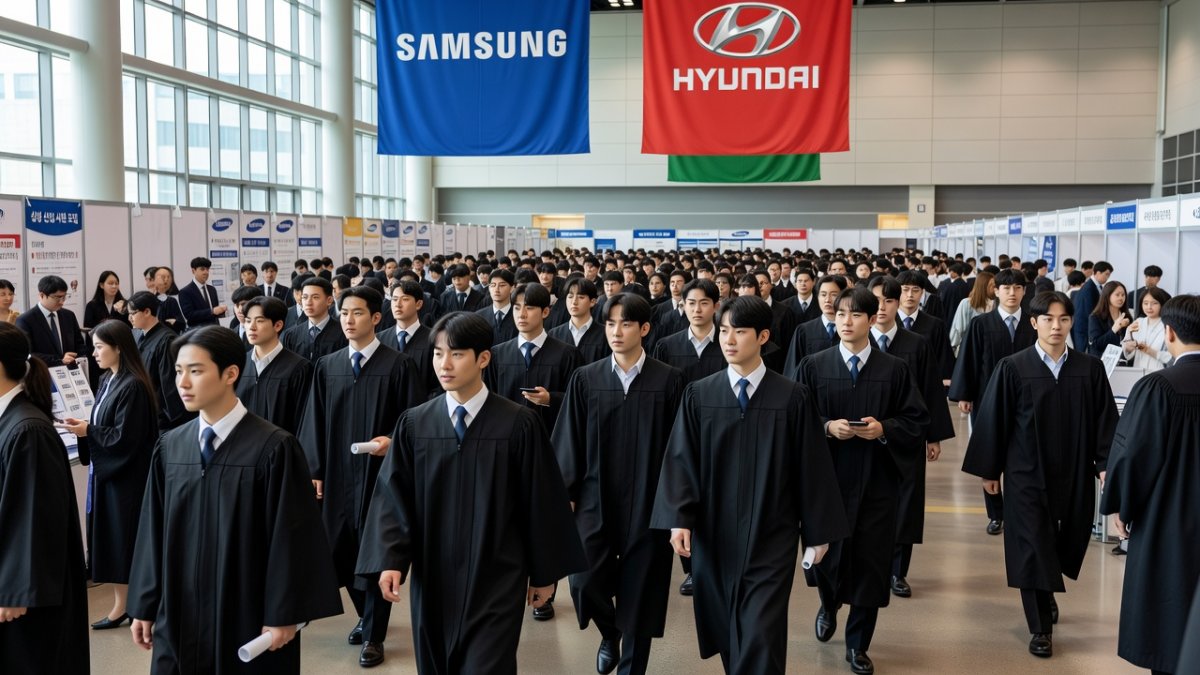
Major conglomerates including Samsung, Hyundai, SK, and LG continue to dominate hiring and set standards that smaller firms struggle to match. This concentration limits opportunities for those outside established networks or without connections to these groups. The Ministry of Employment and Labor has noted the resulting segmentation within the overall employment structure.
Analyses by the Korea Development Institute indicate that chaebol-centric growth models can restrict mobility for young entrants lacking specific credentials or experience. Such barriers reinforce reliance on a narrow set of employers and heighten competition for limited openings. Diversification efforts have received attention from the Ministry of Economy and Finance, though outcomes vary across regions.
Rise of NEETs and Part-Time Work Realities
The expansion of the NEET category among young adults reflects discouragement with traditional job-search routes and the perceived instability of part-time arrangements. The KOREA NOW video emphasizes that such roles rarely provide pathways to long-term security or benefits. Korea Employment Information Service data collection helps track these trends without overstating short-term fluctuations.
Ministry of Employment and Labor initiatives have sought to address inactivity through targeted support programs, yet structural factors persist. Young individuals often weigh the trade-offs between immediate income and investment in further qualifications. This balance influences decisions that extend beyond individual circumstances to affect aggregate labor participation rates.
AI Disruption and Future Job Prospects
Advances in artificial intelligence introduce additional uncertainty for entry-level positions across manufacturing, services, and administrative fields. The Bank of Korea has monitored automation trends that may accelerate displacement in routine tasks traditionally filled by younger workers. These developments intersect with existing education and chaebol-related constraints.
Policy discussions at the Ministry of Economy and Finance increasingly incorporate reskilling considerations to mitigate potential disruptions. The Korea Development Institute has contributed research on how technological change interacts with demographic decline. Such analyses underscore the need for adaptive strategies that account for both innovation and workforce composition shifts.
Policy Responses from Government Institutions
Coordinated efforts among Statistics Korea, the Ministry of Employment and Labor, and the Korea Development Institute aim to refine labor market statistics and program design. These agencies examine ways to ease transitions for recent graduates while addressing regional disparities. The KOREA NOW video places these initiatives within the context of ongoing youth employment difficulties.
Measures supported by the Ministry of Economy and Finance include incentives for smaller enterprises and expanded vocational training options. The Bank of Korea contributes macroeconomic perspectives that inform broader fiscal planning. Implementation remains subject to evaluation as demographic and technological pressures evolve.
Implications for Global Competitiveness
Sustained youth employment challenges carry consequences for South Korea’s position in international innovation and productivity rankings. The concentration of opportunities within chaebol structures and education mismatches may limit the diversity of talent contributing to economic output. Institutions such as the Korea Development Institute continue to assess these linkages with caution.
Global observers note that unresolved demographic and labor issues could affect long-term adaptability in sectors facing AI integration. Policy responses coordinated across the Ministry of Employment and Labor and related bodies seek to preserve competitive advantages. Continued monitoring by Statistics Korea and the Bank of Korea will inform adjustments as conditions develop.
By Prof. David Park, Staff Writer
This article was produced with AI-assisted research and editorial support. Reporting is based on sources cited in the article.
What's Your Reaction?
 Like
0
Like
0
 Dislike
0
Dislike
0
 Love
0
Love
0
 Funny
0
Funny
0
 Wow
0
Wow
0
 Sad
0
Sad
0
 Angry
0
Angry
0

East Asia/Technology Correspondent at Global1.News. Seoul-based voice covering Korean politics, technology, business, and culture. Analyzes how technology and geopolitics intersect across East Asia.















Comments (0)