
Expo 2025 Osaka Demolition: Japan Showcases Engineering Legacy and Circular Economy
**Meta Description:** NHK documentary examines post-Expo 2025 Osaka dismantling of the Grand Ring and use of Japan's top-down demolition methods for high recycling rates and quiet urban renewal. Expo 2025 Osaka Concludes with Focus on Lifecycle Planning The Expo 2025 Osaka, Kansai, held from April 13 to October 13, 2025 on Yumeshima island in Osaka Bay, attracted approximately
Expo 2025 Osaka Concludes with Focus on Lifecycle Planning
The Expo 2025 Osaka, Kansai, held from April 13 to October 13, 2025 on Yumeshima island in Osaka Bay, attracted approximately 28 million visitors across 161 participating countries and regions under the theme “Designing Future Society for Our Lives.” This marked Osaka’s second World Expo after the landmark 1970 event. Organizers embedded lifecycle planning from the outset, ensuring that temporary pavilions and infrastructure would transition into permanent urban assets rather than becoming waste streams. METI coordinated inter-ministerial guidelines that aligned event infrastructure with Japan’s broader resource efficiency targets, requiring detailed material passports for every major structure.
These policies reflected the principles of Society 5.0, which integrates cyber-physical systems to optimize societal outcomes including sustainable construction cycles. Post-event audits tracked every ton of steel, timber, and composite material, feeding data into national dashboards maintained by METI. The approach contrasted sharply with earlier expos where demolition often produced low-value landfill inputs. Corporate participants such as major trading houses and construction firms were contractually obligated to achieve minimum 85 percent material recovery rates, establishing precedents for future large-scale events.
Green Transformation (GX) financing mechanisms supported these efforts by channeling low-interest loans toward companies demonstrating verifiable circular practices. The result was a documented reduction in projected embodied carbon compared with conventional teardown scenarios. Analysts note that the Expo served as a living laboratory for testing digital twins that modeled end-of-life scenarios months before physical dismantling began.
The Grand Ring: World's Largest Wooden Structure and Its Next Chapter
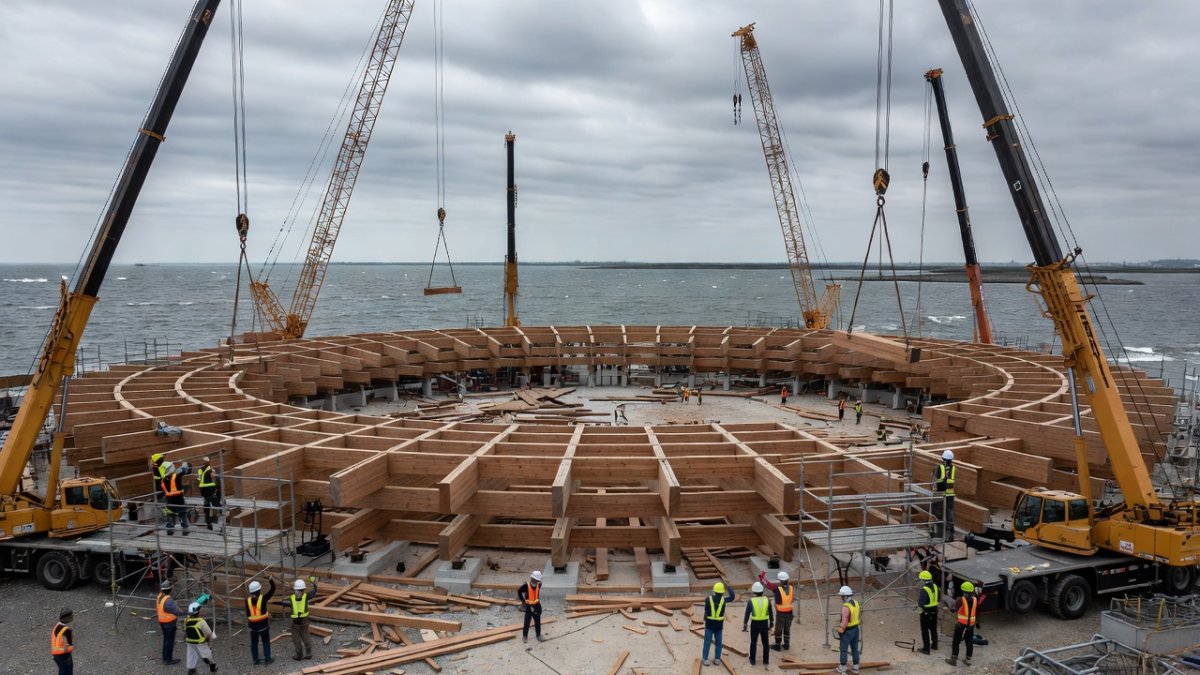
Designed by architect Sou Fujimoto, the Grand Ring covered 61,035 square meters and earned Guinness World Records certification as the largest wooden architectural structure ever built. Its lattice framework, assembled from sustainably sourced Japanese cedar and engineered connectors, functioned as the Expo’s central gathering space. Dismantling crews began systematic deconstruction in late 2025, labeling each beam with RFID tags that linked to a shared database tracking destination projects. The structure is scheduled to be reborn as a signature tower in a nearby urban park, preserving both material value and cultural symbolism.
Engineering teams employed parametric modeling software to optimize disassembly sequences, minimizing damage to individual members during extraction. This process aligned with METI’s resource efficiency roadmap, which prioritizes cascading use of timber in higher-value applications before energy recovery. Corporate Japan, including major developers and timber processors, formed consortia to absorb the reclaimed wood, ensuring continuity of supply chains that support carbon-negative construction.
The Grand Ring’s lifecycle illustrates how Society 5.0 technologies—sensor networks, blockchain provenance records, and AI-driven logistics—can transform temporary assets into long-term infrastructure. GX strategy incentives further encouraged the reuse pathway by offering tax credits proportional to verified emissions reductions. Observers expect the tower project to become a reference case for future wooden mega-structures worldwide.
Japan's Top-Down Demolition Method: Engineering Without Explosives
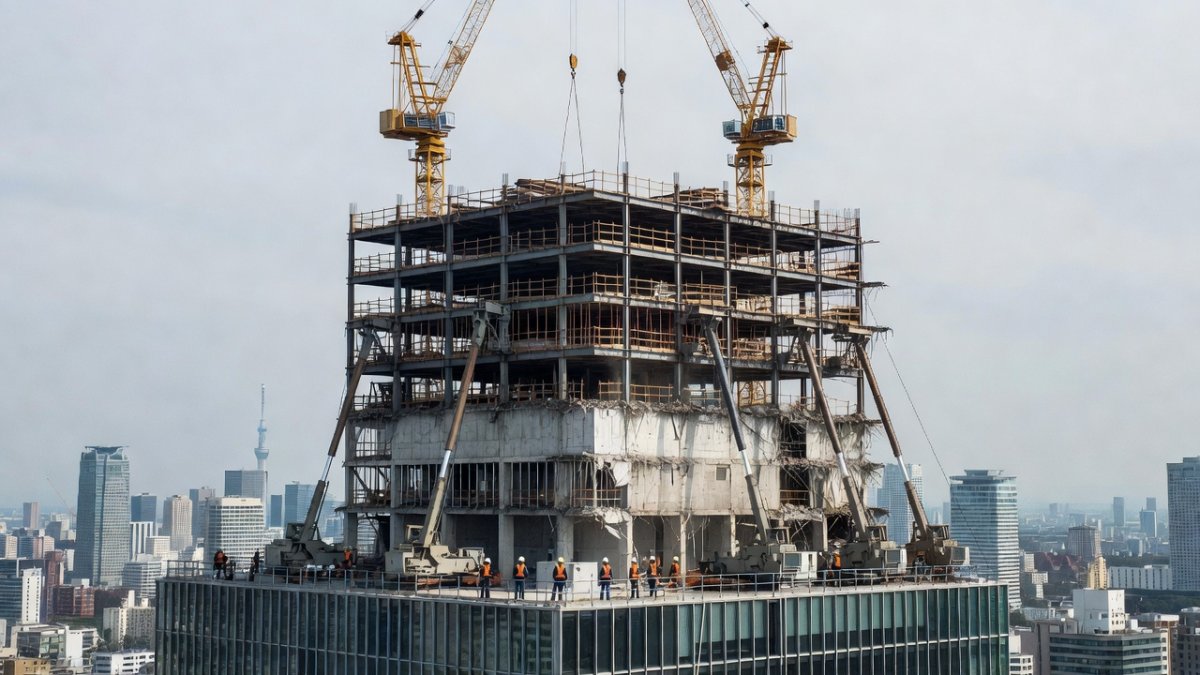
Japan’s top-down demolition technique dismantles high-rise buildings floor by floor from the interior outward using specialized hydraulic jack systems developed by Taisei Corporation. The method eliminates the need for explosives, dramatically reducing noise, vibration, and dust emissions in dense urban environments. Applied to structures exceeding 100 meters, the process achieves material recycling rates approaching 90 percent by allowing systematic separation of steel, concrete, and non-ferrous metals at source.
METI has incorporated performance metrics from these operations into national Green Transformation guidelines, requiring contractors to report real-time emissions and recovery data. The technology supports Society 5.0 objectives by integrating IoT sensors that monitor structural integrity during progressive floor removal. Approximately 800 buildings taller than 100 meters are projected to reach end-of-life in Japan over the coming two decades, creating sustained demand for such precision methods.
Corporate adopters highlight the technique’s compatibility with tight regulatory frameworks governing urban redevelopment. Unlike conventional implosion, top-down demolition permits continued occupancy of lower floors during upper-level work, preserving economic activity. Policy analysts note that METI subsidies for equipment retrofits have accelerated adoption among mid-sized contractors previously reliant on older, less efficient practices.
World Trade Center Building: A Case Study in Controlled Deconstruction
The former World Trade Center Building in Tokyo, standing 162 meters and completed in 1970 when it briefly held the title of Japan’s tallest structure, underwent top-down demolition beginning in 2025. Taisei Corporation’s hydraulic jack arrays supported each floor slab while interior columns were sequentially cut, allowing the building to descend in controlled increments. The project achieved a 92 percent material recovery rate, with structural steel directed to new high-speed rail components and concrete aggregate reused in port infrastructure.
Real-time monitoring systems transmitted structural load data to a central control room, enabling immediate adjustments that prevented unexpected stress concentrations. This case directly informed METI’s updated demolition permitting standards under the GX framework. The operation also generated datasets that feed into Society 5.0 urban simulation models used for predicting city-scale material flows over 30-year horizons.
Stakeholders from corporate Japan emphasized the project’s role in demonstrating export potential for Japanese demolition technology. Several Southeast Asian municipalities have since requested technical briefings. The successful outcome reinforced policy arguments for extending tax incentives to precision demolition equipment, accelerating fleet modernization across the construction sector.
Aging High-Rise Stock Drives Innovation in Demolition Technology
Japan’s inventory of approximately 800 buildings over 100 meters approaching end-of-life has catalyzed sustained R&D investment by leading contractors. METI’s resource efficiency policies now mandate lifecycle assessments that favor top-down methods when proximity to occupied structures precludes explosive techniques. These regulations have spurred development of next-generation jack systems capable of handling irregular floor plans and mixed-material facades common in 1970s-era towers.
Integration with digital twins allows engineers to simulate entire deconstruction sequences before crews mobilize, optimizing crane placement and material staging. Society 5.0 initiatives further embed AI-driven predictive maintenance that extends service life where economically viable, reducing the demolition burden. Corporate consortia are exploring hybrid approaches that combine robotic cutting arms with automated sorting conveyors to push recycling rates beyond 95 percent.
Green Transformation financing has lowered the cost of capital for firms investing in these technologies, creating competitive advantages for Japanese contractors in global markets. Analysts project that domestic demand alone will sustain a multi-billion-yen equipment market through 2040. The policy ecosystem thus links aging infrastructure challenges directly to innovation and export strategies.
Expo Materials Find New Life Through Circular Economy Principles
Post-Expo material flows were governed by circular economy protocols developed jointly by METI and event organizers. Timber from the Grand Ring, steel from temporary pavilions, and modular components from national exhibits were catalogued and matched to active construction projects across the Kansai region. This systematic approach prevented the typical post-event waste surge and generated measurable reductions in virgin material demand.
Blockchain-based tracking systems provided immutable records of material provenance, satisfying both regulatory reporting and corporate sustainability disclosures. GX strategy incentives rewarded participants that exceeded baseline recovery targets, creating financial motivation aligned with environmental outcomes. Society 5.0 data platforms aggregated these flows into national resource dashboards used for macroeconomic planning.
Corporate Japan’s involvement extended beyond contractors to include logistics firms and material processors that developed specialized handling protocols for Expo-derived streams. The resulting supply-chain efficiencies are expected to inform future large-scale events, including potential Osaka bids for subsequent international gatherings. Policy reviews conducted by METI have already cited the Expo as a benchmark for circular construction practices.
Yumeshima Redevelopment: From Expo Site to Future Urban Asset
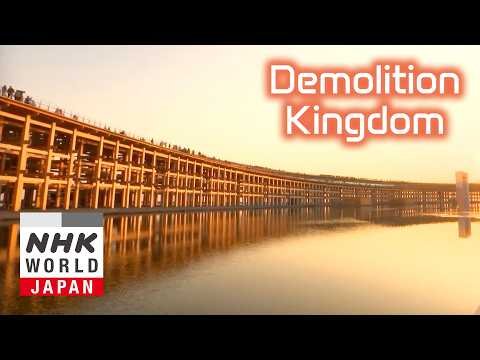
Following the Expo’s closure, the Yumeshima site entered a phased redevelopment program designed to convert temporary infrastructure into permanent urban functions. METI-supported master planning integrated residual utilities and foundations into new commercial and logistics facilities. The approach exemplifies resource efficiency policies that treat event venues as catalysts rather than isolated projects.
Top-down demolition techniques applied to remaining temporary structures minimized disruption to ongoing site preparation works. Digital twins updated in real time allowed planners to adjust phasing based on actual material recovery volumes. Society 5.0 principles guided the incorporation of smart-grid and mobility systems that leverage data collected during the Expo period.
Green Transformation financing facilitated public-private partnerships that accelerated redevelopment timelines. Corporate participants retained equity stakes in repurposed assets, aligning long-term incentives with circular outcomes. The Yumeshima model is now referenced in national urban policy documents as a replicable template for post-event site conversion.
Broader Implications for Japan's Construction and Resource Efficiency Policy
The Expo 2025 experience has prompted METI to revise national construction guidelines, embedding mandatory material passports and digital tracking for all public projects exceeding specified thresholds. These updates reinforce Society 5.0 objectives by creating interoperable data ecosystems that span design, operation, and end-of-life phases. Green Transformation funding streams have been expanded to cover additional categories of precision demolition equipment.
Corporate Japan has responded with increased R&D budgets targeting automated sorting and robotic disassembly technologies. Resource efficiency metrics now appear in quarterly corporate disclosures, reflecting investor expectations shaped by GX disclosure rules. The policy linkage between event-scale demonstrations and nationwide standards accelerates technology diffusion across the sector.
International observers note that Japan’s integrated approach—combining regulatory mandates, financial incentives, and digital infrastructure—offers a distinctive model compared with purely market-driven or subsidy-heavy alternatives. Continued monitoring by METI will determine whether these frameworks scale effectively to routine building stock renewal.
What to Watch For
Upcoming milestones include completion of the Grand Ring tower conversion and publication of METI’s first post-Expo circular economy performance report. Further deployments of top-down demolition on aging Tokyo high-rises will provide additional datasets for refining Society 5.0 simulation models. GX strategy reviews scheduled for 2027 are expected to adjust incentive levels based on measured emissions reductions.
International technology transfer agreements involving Taisei Corporation’s hydraulic systems may expand, particularly in markets with dense urban cores. Continued integration of material tracking platforms will test the scalability of blockchain provenance systems beyond single-event applications. Policy analysts will monitor whether resource efficiency gains translate into measurable improvements in Japan’s overall material footprint indicators.
Stakeholders should also track corporate adoption rates of digital twin methodologies for routine redevelopment projects. Success in these areas will determine the long-term legacy of Expo 2025’s lifecycle planning innovations within Japan’s broader Green Transformation trajectory.
By Kenji Tanaka, Staff Writer
This article was produced with AI-assisted research and editorial support. Reporting is based on sources cited in the article.
What's Your Reaction?
 Like
0
Like
0
 Dislike
0
Dislike
0
 Love
0
Love
0
 Funny
0
Funny
0
 Wow
0
Wow
0
 Sad
0
Sad
0
 Angry
0
Angry
0

Japan Correspondent at Global1.News. Tokyo-based voice covering Japanese politics, technology, economy, and culture. Tracks the intersection of tradition and innovation in one of the world's most dynamic societies.














Comments (0)