
Trump and Israel's Reckoning: Has America's Last Zionist President Finally Lost His Allies?
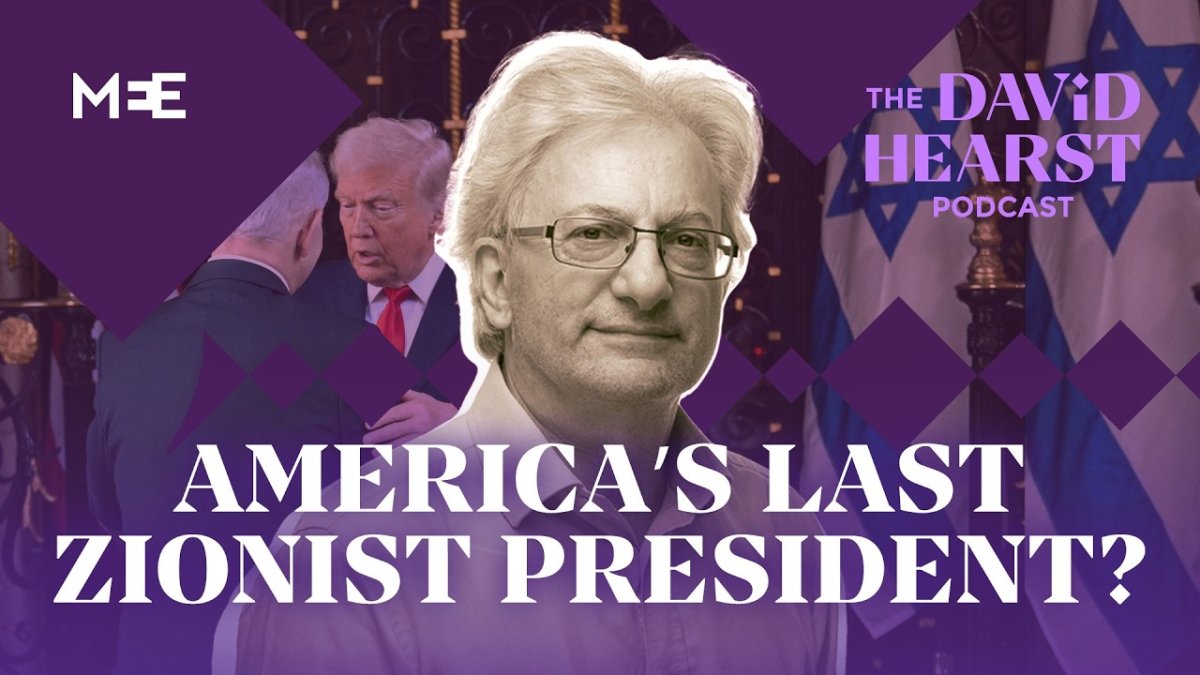
In a recent Middle East Eye report, editor-in-chief David Hearst examines how Israeli pro-government commentators have dramatically turned against US President Donald Trump — the same president who gave Israel recognition of Jerusalem as its capital, annexation of the Golan Heights, and unwavering support for its war on Gaza. This remarkable rift between Tel Aviv and Washington
In a recent Middle East Eye report, editor-in-chief David Hearst examines how Israeli pro-government commentators have dramatically turned against US President Donald Trump — the same president who gave Israel recognition of Jerusalem as its capital, annexation of the Golan Heights, and unwavering support for its war on Gaza. This remarkable rift between Tel Aviv and Washington raises a fundamental question: has America's last Zionist president finally lost his allies?
Trump and Israel's Reckoning: Has America's Last Zionist President Finally Lost His Allies?
London, United Kingdom – July 11, 2026 — In the space of just a few weeks, US President Donald Trump has gone from being so popular in Israel that he boasted he could be its next prime minister to a man denounced as "a loser" and compared to Neville Chamberlain by the same Israeli commentators who once celebrated him. The dramatic reversal, documented in a Middle East Eye investigation by David Hearst, reveals deep fractures in what was long considered an unshakeable alliance.
The Abrupt Shift in Israeli Sentiment
Israeli media figures aligned with Prime Minister Benjamin Netanyahu have issued withering criticisms of Trump in recent weeks. Yinon Magal, host of a primetime show on Channel 14, called the US president "a loser" and branded his son-in-law Jared Kushner and envoy Steve Witkoff as "little Jews." Yaakov Bardugo, an Israeli political commentator, said Trump and Vice President JD Vance were becoming "the modern Chamberlain" — a reference to the British prime minister associated with appeasing Hitler in 1938.
Amit Segal, chief political analyst for Channel 12 and Israel Hayom — which is owned by billionaire Miriam Adelson, a major Trump donor — declared that Trump had "completely surrendered" by allowing Iran to enrich uranium. Shimon Riklin, an anchor on Israel's right-wing Channel 14, posted on X that the United States "was weaker than ever" and that no one would want to be its ally.
These commentators are widely considered mouthpieces for Netanyahu. Their collective about-face is all the more striking given that this is the same president who, in his first term, granted US recognition of the annexation of the occupied Golan Heights and Jerusalem as Israel's capital — steps that a long line of his predecessors in the White House had avoided.
From Loyal Ally to Branded Traitor
Trump's transformation from loyalist to target happened with breathtaking speed. As a presidential candidate, Trump accepted Adelson as the third-largest donor of his re-election campaign in 2024. He appointed David Friedman, an advocate for settlers, as US ambassador to Israel — a man who abandoned all pretense of neutrality by famously taking a sledgehammer to open a tunnel under the Palestinian neighborhood of Silwan in occupied East Jerusalem.
Trump stood fully with Israel's genocide in Gaza and continues to do so. Jared Kushner was the architect behind the "Board of Peace" plan that envisioned turning Gaza into Mediterranean beach resorts. There is little dispute that Trump's decision to go to war with Iran was made after a briefing by Netanyahu and then-Mossad director David Barnea in the White House situation room — an unprecedented breach of diplomatic protocol that saw a foreign leader granted access to the most sensitive US national security space.
"Never before had a US president been so suggestible, and never before had a prime minister of Israel been so close to the beating heart of a US administration," wrote David Hearst. "This is the man they now brand a traitor."
Historic Pattern: Zionists Turning on Their Patrons
The current rift is not without historical precedent. When Britain, which issued the Balfour Declaration in 1917 calling for a Jewish homeland in Palestine, later restricted Jewish immigration after World War II, Zionist underground groups turned violently against their former patron. Between 1945 and 1948, over 780 British soldiers, police officers, and civilians were killed in Palestine, many targeted by the Irgun and the Stern Gang.
The deadliest attack was the bombing of the King David Hotel on July 22, 1946 — the British administrative headquarters in Jerusalem — killing 91 people, including 28 British subjects. Israel to this day refuses to honor their graves, while commemorating those who carried out the bombing. The Menachem Begin Heritage Center, named after the former Irgun leader who approved the attack and later became prime minister, held a commemoration event for the bombing in 2006.
The Stern Gang also assassinated Swedish diplomat Count Folke Bernadotte in 1948 — the same man who had negotiated the release of over 4,000 Jews from Nazi concentration camps. Bernadotte's sin, in the eyes of the extremists, was serving as the first UN mediator in the conflict and laying groundwork for early relief efforts.
Obama, Biden, and the Recurring Pattern of Biting the Hand That Feeds
Former US President Barack Obama's parting gift to Israel was a military aid package worth $38 billion over ten years — the largest in US history at the time. Israeli historian Avi Shlaim wrote that Netanyahu "invariably repaid Obama's generosity with ingratitude and abuse," intervening in the 2012 presidential election to back the Republican candidate, and abusing the privilege of a congressional address to insult the sitting president.
"One is hard put to think of a more blatant example of biting the hand that feeds you," Shlaim wrote. "Netanyahu's conduct marks him out as the special ally from hell."
Former President Joe Biden, described as an instinctive liberal Zionist, received the same treatment. General Amos Gilead described Netanyahu's "unprecedented berating" of Biden as an extreme manifestation of ingratitude and a "first-rate strategic failure," noting that "the United States is Israel's only true ally, and Joe Biden is the friendliest president to Israel in history."
Zionism's True Face and the Settler Colony Dynamic
For some commentators, the current rift reveals Zionism's true supremacist character. Moshe Ya'alon, a former Israeli defense minister under Netanyahu, stated in an interview that factions within the religious Zionist movement hold a "Jewish supremacy ideology." "What is Jewish supremacy?" Ya'alon asked. "Eighty years after the Holocaust, it's Mein Kampf in reverse. The superior race is us."
David Hearst argues that Israel's feud with Trump may simply be "the shock a settler colony experiences when it realizes it has lost control of its parent." The shock, he writes, consists of a US president telling Israel to stop waging war — and the realization that Washington is no longer a tool to be wielded but an independent actor with its own interests.
What This Means for Palestinians
For Palestinians living under occupation, these high-level political dramas in Washington and Tel Aviv carry life-and-death consequences. When US support for Israel is unconditional, settlement expansion accelerates, home demolitions continue, and the military occupation tightens. When rifts emerge, uncertainty follows — but so do possibilities.
Recent polling shows dramatic erosion of bipartisan US support for Israel. An AP-NORC poll published in July 2026 found declining support among Democrats and growing fractures among Republicans. AIPAC-backed candidates have been defeated in Democratic primaries. The Intercept reported that "support for Israel is now toxic" in some political circles.
"The lobby is not about to roll over and will stage a ferocious rearguard action in US politics," Hearst writes. "But the more supporting Israel becomes an act of force, and the less it is an article of faith, the bigger the trouble Zionism is in."
Analysis and Implications
The question posed by Middle East Eye's David Hearst — whether Trump will be remembered as "America's last Zionist president" — points to a possible realignment of US foreign policy that has been decades in the making. The erosion of unconditional support for Israel among American voters, particularly younger generations, combined with Israel's increasingly open embrace of far-right politics, suggests that the old consensus is fraying.
For Netanyahu, stymied over Iran but permitted to maintain territorial gains in Lebanon and Syria, the most likely response is to restart the war to take over all of Gaza — a move necessary to keep the extreme right in his cabinet and alongside his election campaign. But renewed slaughter in Gaza will only deepen the sense of revulsion in the US on both sides of the political spectrum, accelerating the very shift that Israel's right-wing commentators fear most.
The question of whether Trump is America's last Zionist president may not be answered in this election cycle. But the forces that are reshaping US-Israel relations — demographic change, shifting public opinion, and Israel's own increasingly open embrace of supremacist ideology — are not going anywhere. For Palestinians, the hope is that a future US administration might finally reckon with the human cost of unconditional support for occupation.
By Fatima Al-Rashid, Staff Writer
This article was produced with AI-assisted research and editorial support. Reporting is based on sources cited in the article.
What's Your Reaction?
 Like
0
Like
0
 Dislike
0
Dislike
0
 Love
0
Love
0
 Funny
0
Funny
0
 Wow
0
Wow
0
 Sad
0
Sad
0
 Angry
0
Angry
0

Gulf/MENA Correspondent at Global1.News. Based in Doha, covering Gulf politics, energy markets, diplomacy, and development across the Middle East and North Africa. Tracks the economic transformation of the Gulf states.













Comments (0)