
Russia Launches 'Most Massive Attack' on Kyiv — 22 Killed
In a recent BBC News report, Russian forces launched what Kyiv's mayor described as the most massive attack on the Ukrainian capital, killing at least 22 people and wounding 85 others in an 11-hour onslaught of missiles and drones. Russia Launches 'Most Massive Attack' on Kyiv — At Least 22 Killed in 11-Hour Barrage Kyiv, Ukraine – 2 July 2026 — The Ukrainian capital endured it
In a recent BBC News report, Russian forces launched what Kyiv's mayor described as the most massive attack on the Ukrainian capital, killing at least 22 people and wounding 85 others in an 11-hour onslaught of missiles and drones.
Russia Launches 'Most Massive Attack' on Kyiv — At Least 22 Killed in 11-Hour Barrage
Kyiv, Ukraine – 2 July 2026 — The Ukrainian capital endured its deadliest night in months as Russian forces unleashed an unprecedented wave of missile and drone strikes across multiple districts, killing at least 22 civilians and wounding 85 others in what officials described as the largest single assault on the city since the war began.
The Overnight Assault — 11 Hours of Hell
Kyiv endured its most sustained aerial assault since the early months of the war when Russian forces launched wave after wave of missiles and drones against the Ukrainian capital in an 11-hour blitz that began on the evening of July 1 and continued until dawn on July 2. The attack, which Mayor Vitaly Klitschko described as the "most massive" to hit the city, killed at least 22 people and wounded 85 others, including two children, according to Ukraine's State Emergencies Service. What made this barrage different from previous attacks was not merely the death toll — although 22 civilians killed in a single night is devastating — but the sheer scale and coordination of the weapons deployed across multiple waves targeting different districts simultaneously.
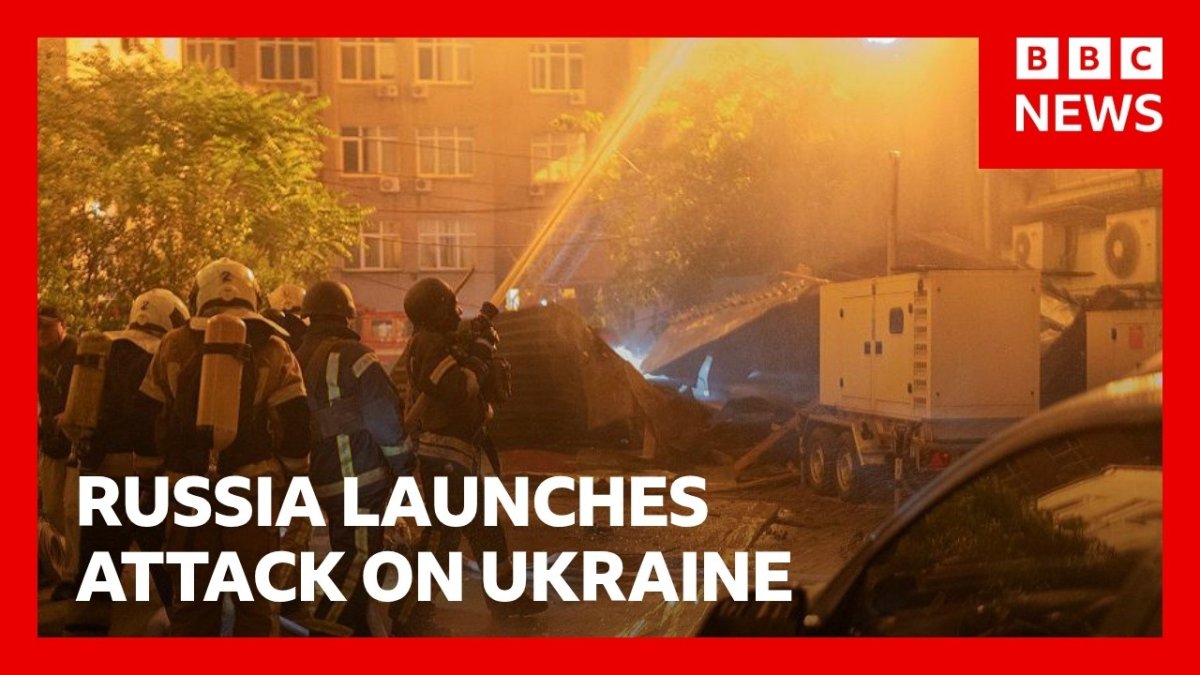
The assault began with a drone strike on Kyiv's historic quarter, setting off a fire in a hotel in the city centre. At 01:00 local time (23:00 GMT), dozens of ballistic and cruise missiles were launched in rapid succession. After a brief lull, another 12 cruise missiles struck at 03:00, followed by a swarm of drones that targeted the capital until daylight. The Ukrainian Air Force said the attacks involved multiple missile types launched from strategic bombers, naval platforms, and ground-based systems, testing the city's layered air defences to their breaking point.
The attacks came just hours after President Volodymyr Zelensky had publicly warned that Russia was preparing a large-scale strike. In a sombre address, he urged residents to take air raid warnings seriously and seek shelter. By dawn, 52,500 people — including 4,500 children — had packed into Kyiv's underground metro stations, which authorities said was the highest number in "recent years." The scenes recalled the darkest days of the war's first months in 2022, when families slept on platform floors as sirens wailed overhead. Ukrainian officials noted that the prolonged duration forced repeated shifts in shelter usage, with many residents unable to return home until well after sunrise. Emergency services coordinated across multiple districts to manage the influx, highlighting the strain on civil defence infrastructure built over three years of conflict.
Journalists including Sarah Rainsford, the BBC Eastern Europe correspondent based in Kyiv, reported from the scene as rescue operations unfolded. The coordinated nature of the strikes, involving both drones and advanced missiles, indicated a deliberate effort to saturate defences and create overlapping threats. This approach extended the period of vulnerability for civilians, as air raid alerts sounded continuously through the night. The State Emergencies Service confirmed that the 11-hour window represented one of the longest sustained operations against the capital in recent memory, surpassing earlier barrages in both volume and persistence.
Civilians in the Crosshairs — Residential Areas Targeted
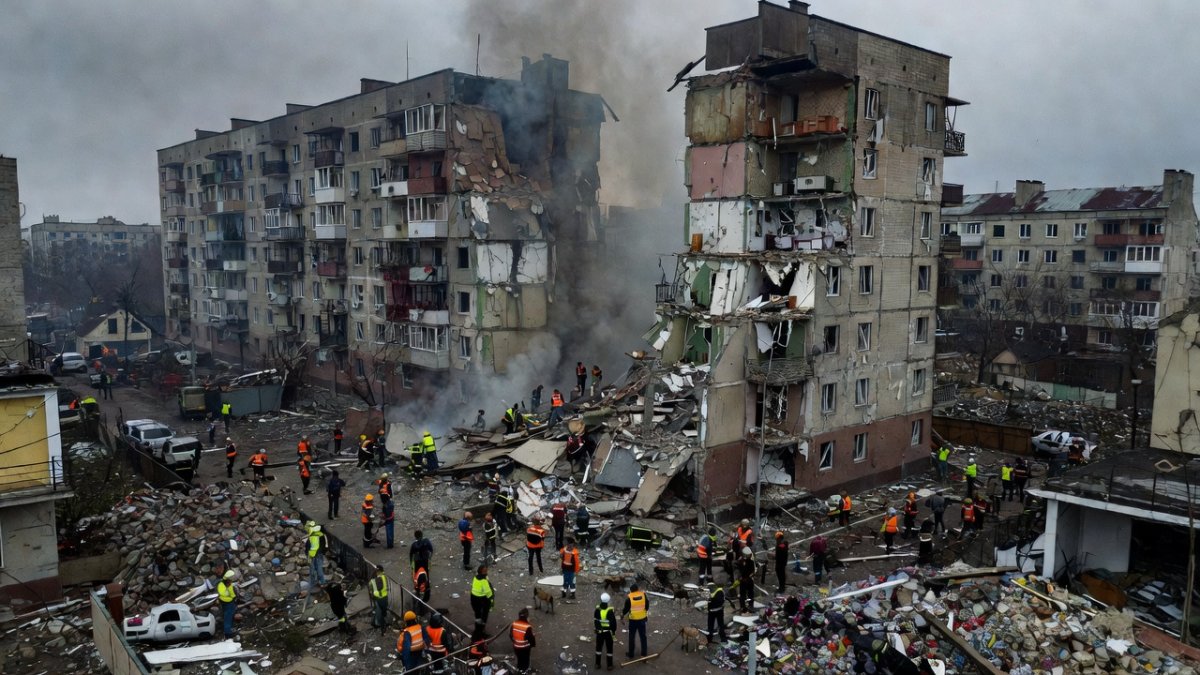
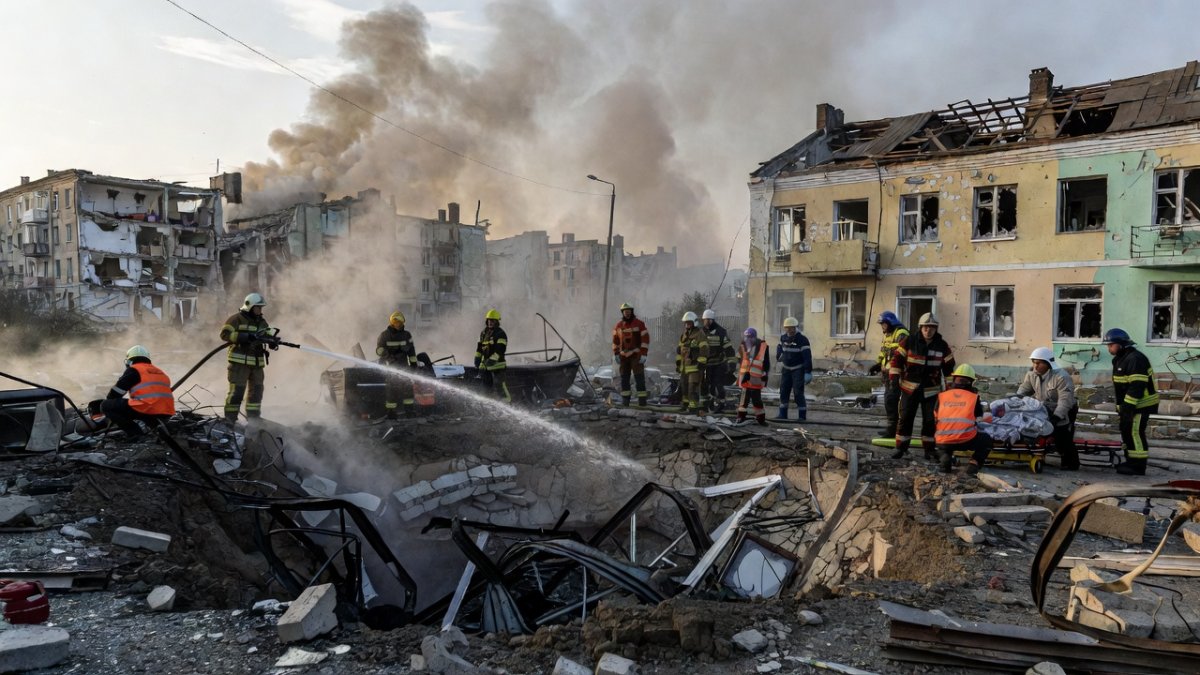
The most devastating single strike of the night occurred in the Darnitskyi district in south-east Kyiv, where two missiles struck within metres of each other. The first missile left a massive crater next to a kindergarten, with the blast gutting nearby buildings by fire, twisting metal balconies and shattering every window for blocks. The second missile hit the end of a nine-storey block of flats, causing it to collapse into a heap of rubble that slid off the face of the building. Rescue workers spent hours digging through the debris as relatives watched in tears, waiting for news of neighbours and family members. One local told BBC correspondents that several people were missing and may have been sheltering in the basement when the building came down.
Tymur Tkachenko, the head of Kyiv's military administration, confirmed that children were among the "significant number" of casualties. "The enemy is once again deliberately targeting residential areas and killing civilians," he said early on Thursday. An ambulance station was also hit by the barrage, though it was not immediately clear how many medical personnel were injured. The brazen targeting of emergency infrastructure drew condemnation from the Red Cross, whose own warehouse was destroyed in the strikes. The charity said it had lost supplies worth more than £1.3 million (79 million Ukrainian Hryvnia) — approximately 320,000 relief items that would have supported emergency response and humanitarian operations across the country.
Additional damage extended to surrounding residential blocks, where fires continued to burn into the morning. Rescue teams from the State Emergencies Service worked alongside local volunteers to clear debris and search for survivors. The concentration of strikes in Darnitskyi district underscored the pattern of hitting densely populated civilian zones rather than isolated military sites. Ukrainian authorities documented the destruction through official channels, noting that the loss of the Red Cross warehouse would directly impact aid distribution in the coming weeks.
Kremlin's Justification — Retaliation Narrative
Moscow defended its assault by claiming forces had struck military industrial plants in retaliation for Ukrainian attacks on Russian civilian infrastructure. Kremlin spokesman Dmitry Peskov told reporters on Thursday that Russia would "continue to increase pressure on the Kyiv regime in order to achieve our set goals," signalling that the Kremlin views such mass-casualty strikes as a legitimate instrument of war policy rather than a tactical escalation. The Foreign Ministry echoed this position, framing the operation as a necessary response to prior Ukrainian actions against Russian territory.
Ukraine rejected the retaliation narrative outright, describing Russia as both the aggressor and a country that continues to target civilians while claiming defensive motives. Officials in Kyiv pointed to the repeated hits on residential buildings, an ambulance station, and the Red Cross warehouse as evidence that the intent extended beyond military objectives. President Volodymyr Zelensky's earlier warning about the impending attack further highlighted that Ukrainian intelligence had anticipated the scale, yet the focus remained on civilian areas in the capital.
International observers noted the contrast between Moscow's stated goals and the documented impact on non-combatant infrastructure. The Ukrainian position emphasised that the pattern of strikes undermines any claim of precision targeting, reinforcing accusations of deliberate civilian harm. This exchange of statements between the Kremlin and Ukrainian authorities continued through the day following the assault.
Witness Accounts — Voices from the Rubble
Local accounts from the Darnitskyi district paint a picture of relentless terror. Oleksiy, his face covered in cuts and blood, told BBC's Sarah Rainsford he had stepped outside to smoke after hearing the first missile, when the second one landed and he was struck by flying glass. Dismissing Moscow's retaliation explanation, he said: "This is not retaliation by Russia for Ukrainian strikes. They started this war. This is a residential area. And they targeted it."
Resident Svitlana, who was badly injured in an earlier Russian strike that killed her mother, described the cumulative toll on families. Her son had been killed fighting for Ukraine, leaving her to navigate recovery alone amid repeated attacks. She recounted the fear that gripped the neighbourhood as sirens blared and explosions echoed through the night. Such personal stories illustrate the broader human cost, where survivors carry both physical wounds and the loss of loved ones across multiple waves of violence.
Despite the destruction, Kyiv residents demonstrated continued resilience after three years of war. Neighbours assisted one another in reaching shelters, and community networks provided immediate support for those displaced by the collapsed building. The determination to endure remained evident even as rescue operations stretched into the following day, with many expressing resolve to rebuild rather than flee.
Strategic Implications — What the Attack Reveals
The scale and sequencing of the July 1-2 attack on Kyiv reveals several important characteristics of Russia's current military strategy. The multi-wave pattern — drone, ballistic missile, lull, cruise missile, drone swarm — suggests a deliberate attempt to overwhelm Kyiv's layered air defence systems through saturation tactics. This approach forces Ukrainian forces to expend interceptors across extended periods, potentially depleting stockpiles faster than they can be replenished.
Analysts suggest this signals Russia's willingness to draw on existing missile reserves for high-intensity operations against the capital. The inclusion of both ballistic and cruise missiles alongside drones indicates sustained production capacity, even as Western sanctions continue. Such patterns fit into broader war dynamics where Russia seeks to maintain pressure on Ukrainian cities while testing the limits of international support for Kyiv.
The assault carries direct implications for Western military aid. Ukrainian requests for additional advanced interceptors and long-range capabilities gain urgency following this demonstration of evolving Russian tactics. Without accelerated deliveries, the ability to counter future saturation attacks remains constrained, potentially shifting the balance in prolonged engagements over major population centres.
International Response and What Comes Next
The assault drew condemnation from Western capitals and international organisations. Ukraine's allies reiterated calls for accelerated delivery of air defence systems and long-range strike capabilities. The attack underscores Kyiv's urgent need for more advanced interceptors as Russia adapts its tactics to exploit gaps in existing defences. NATO members and the EU issued statements supporting Ukraine's right to self-defence while urging continued diplomatic efforts to de-escalate.
Upcoming diplomatic engagements will likely focus on bolstering Ukraine's protective measures in light of this latest escalation. The trajectory of the war appears set for further intensification, with both sides demonstrating resolve to pursue their objectives through military means. The United Nations called for investigations into civilian casualties, adding to the chorus of concern over humanitarian impacts.
In the end, this attack reinforces the reality that ordinary Ukrainians bear the heaviest burden in a conflict marked by repeated strikes on civilian infrastructure. Their resilience, shown through nights spent in metro stations and immediate community responses to rubble, remains central to the nation's endurance. As the war continues, the determination of Kyiv's residents to persist amid such assaults defines the human dimension of this prolonged struggle. By Irina Volkov, Staff Writer
This article was produced with AI-assisted research and editorial support. Reporting is based on sources cited in the article.
What's Your Reaction?
 Like
0
Like
0
 Dislike
0
Dislike
0
 Love
0
Love
0
 Funny
0
Funny
0
 Wow
0
Wow
0
 Sad
0
Sad
0
 Angry
0
Angry
0
Russia/Eastern Europe Correspondent at Global1.News. Covering Russian politics, energy, security, and the shifting dynamics of the post-Soviet space. Provides clear-eyed analysis on one of the world's most opaque regions.














Comments (0)