
Regions Calling: Inside Errol Musk’s Regional Ambitions
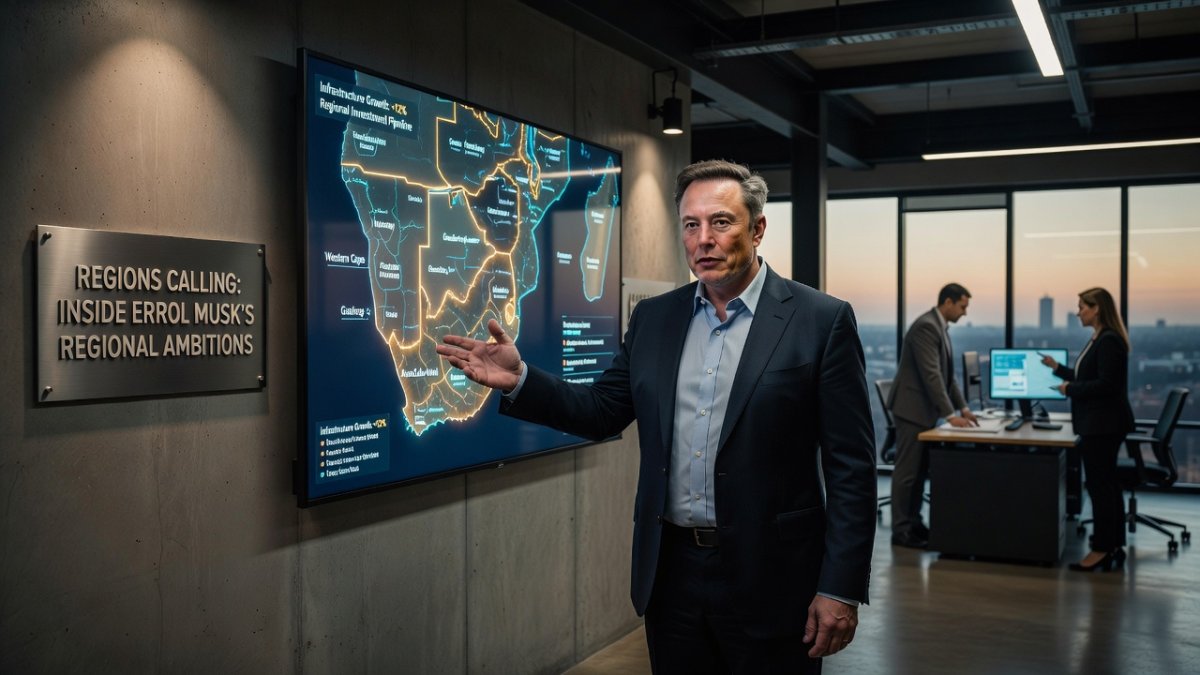
Regions Calling: Inside Errol Musk’s Regional Ambitions
In the frostbitten corridors of power stretching from Kazan to Novosibirsk, whispers have turned into formal overtures. Errol Musk, father of Tesla and SpaceX founder Elon Musk, is advancing plans to establish a Musk Institute, anchor a Tesla manufacturing facility, and facilitate the resettlement of Afrikaner families designated as “refugees” across several Russian federal subjects. The moves, if realised, would mark one of the most unconventional foreign investment proposals to reach Russia’s regions since the imposition of Western sanctions in 2022.
From Pretoria to the Volga: Errol Musk’s Pivot East
Errol Musk, an engineer and property developer long overshadowed by his son’s global enterprises, has spent recent months shuttling between South Africa, the United Arab Emirates and, crucially, Russian regional capitals. Sources close to the administration of Tatarstan confirm that a memorandum of understanding was initialled in Kazan in late October for the creation of the Musk Institute—an applied-research centre focused on sustainable energy systems and advanced materials. The proposed site lies within the Kama Industrial Cluster, where existing automotive supply chains could be repurposed.
“We are not talking about charity,” Errol Musk told a closed-door meeting of regional governors last month, according to a transcript obtained by Global1 News. “We are talking about technology transfer that respects sovereignty and delivers measurable returns.” Russian participants described the 77-year-old as direct, technically fluent and notably less publicity-conscious than his son.
The Tesla Footprint: Beyond Moscow’s Ring Road
While Tesla maintains no official manufacturing presence in Russia, Errol Musk’s team has scoped locations in the Samara and Sverdlovsk regions. Both areas offer under-utilised assembly plants, skilled welders and access to nickel and lithium feedstock from the Urals and Siberian deposits. Preliminary costings shared with regional investment agencies project a 4-billion-rouble initial outlay for a 120,000-unit annual capacity plant focused on the Model Y and a yet-to-be-named utility vehicle suited to harsh climates.
Data from Russia’s Ministry of Industry and Trade show that domestic electric-vehicle production stood at just 11,200 units in 2023, almost entirely concentrated in Moscow and Kaliningrad. A regional Tesla facility would immediately alter that geography and test the limits of parallel import regimes currently sustaining the Russian EV fleet.
Resettling Afrikaners: Numbers, Logistics and Politics
Perhaps the most sensitive strand of Errol Musk’s proposal involves the organised relocation of several thousand Afrikaner families. South African government statistics record a steady emigration of white commercial farmers since 2018, citing farm attacks and land-expropriation debates. Errol Musk has framed the Russian option as a humanitarian corridor rather than a political statement.
Under the draft framework, selected families would receive fast-track residency permits and agricultural land leases in the Stavropol and Altai territories—regions already hosting state-sponsored programmes for “compatriots” from the former Soviet space. Internal documents indicate an initial tranche of 2,500 families over three years, with priority given to those possessing agronomic or mechanical engineering expertise.
Demographers caution that cultural integration will not be automatic. Afrikaner communities have maintained distinct Calvinist traditions and Afrikaans-language schooling for generations. Russian officials privately acknowledge the experiment carries political risk, particularly amid heightened scrutiny of migration policy ahead of the 2026 regional elections.
Expert Perspectives: Between Opportunity and Overstretch
Dr. Sergei Karaganov, honorary chairman of the Presidium of the Council on Foreign and Defence Policy, offered a measured assessment. “Russia’s regions need capital and know-how that do not come with political conditionalities,” he told Global1 News. “Yet any project tied to the Musk name will attract Western media scrutiny and possible secondary sanctions. The regions must weigh visibility against viability.”
From the South African side, Professor Anthea Jeffery of the Institute of Race Relations warned that organised emigration could accelerate the very skills flight the country can ill afford. “Commercial farmers still produce the bulk of South Africa’s maize and wheat surplus,” she noted. “Losing several thousand experienced operators would have measurable food-security consequences within five years.”
Geopolitical and Economic Implications
Should the Musk Institute and associated manufacturing commitments materialise, they would constitute one of the largest single foreign direct investments in Russia’s automotive sector since 2014. Regional GDP multipliers, modelled by the Higher School of Economics, suggest an additional 0.7–1.2 percentage points of annual growth in host territories over a decade, driven primarily by supplier networks rather than the anchor plant itself.
More broadly, the initiative tests Moscow’s willingness to accept high-profile Western-linked projects while maintaining its current foreign-policy trajectory. The juxtaposition of an American technology brand with Afrikaner resettlement also creates an unusual narrative vector—one that both Russian state media and Western outlets are likely to weaponise.
Regional governors, however, appear pragmatic. “We evaluate projects on kilowatts, jobs and tax receipts,” one administration source in Yekaterinburg stated. “The Musk surname is secondary to the balance sheet.”
Negotiations continue under strict non-disclosure agreements. No binding contracts have yet been signed, and financing structures—rumoured to involve Gulf sovereign funds alongside Russian development institutions—remain opaque. What is clear is that Errol Musk has placed his own reputational capital behind an ambitious regional bet that could reshape both Russia’s technological landscape and its demographic experiments for years to come.
This is Irina Volkov for Global1 News, reporting from Moscow. 🇷🇺
This article was produced with AI-assisted research and editorial support. Reporting is based on sources cited in the article.
What's Your Reaction?
 Like
0
Like
0
 Dislike
0
Dislike
0
 Love
0
Love
0
 Funny
0
Funny
0
 Wow
0
Wow
0
 Sad
0
Sad
0
 Angry
0
Angry
0
Russia/Eastern Europe Correspondent at Global1.News. Covering Russian politics, energy, security, and the shifting dynamics of the post-Soviet space. Provides clear-eyed analysis on one of the world's most opaque regions.










Comments (0)