
Palace Blasts 'Lowest Class' Argument That Marcos...
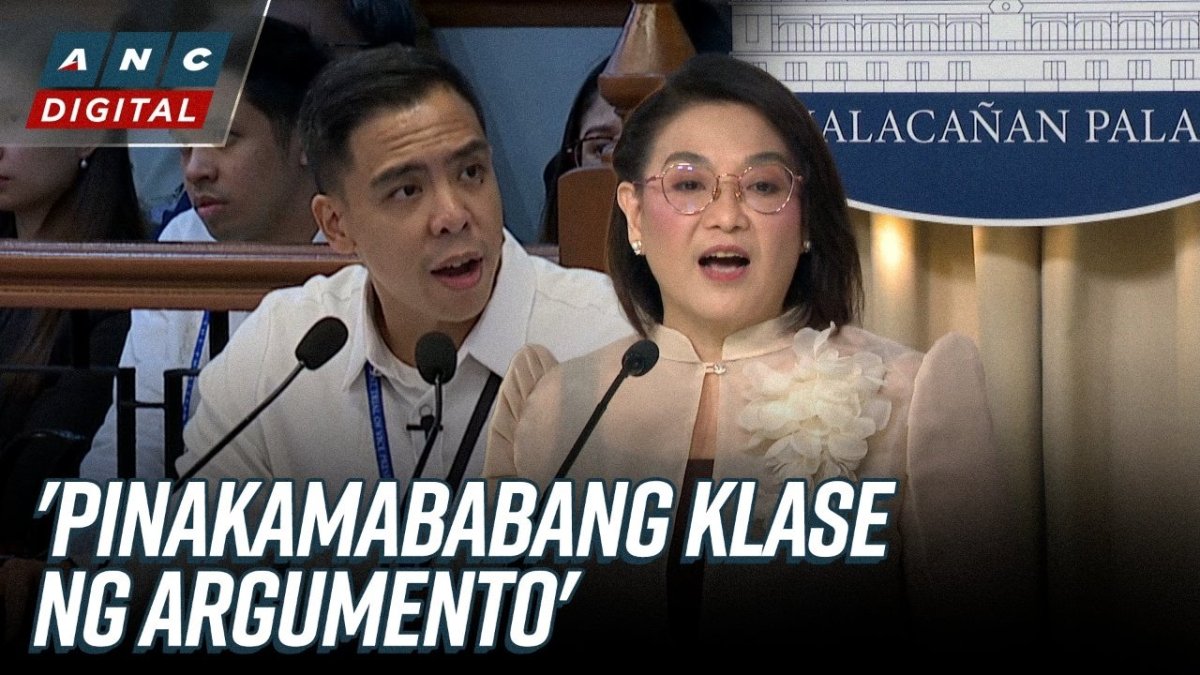
As the ANC 24/7 video report detailed the latest developments from Malacañang, Presidential Communications Office Undersecretary and Palace Press Officer Atty. Claire Castro addressed the Malacañang Press Corps on Thursday and firmly rejected any suggestion that President Ferdinand Marcos Jr. had directed the National Bureau of Investigation's inquiry into Vice President Sara D
As the ANC 24/7 video report detailed the latest developments from Malacañang, Presidential Communications Office Undersecretary and Palace Press Officer Atty. Claire Castro addressed the Malacañang Press Corps on Thursday and firmly rejected any suggestion that President Ferdinand Marcos Jr. had directed the National Bureau of Investigation's inquiry into Vice President Sara Duterte's statements.
Palace Rejects Claims of Executive Interference
Atty. Claire Castro told reporters gathered at the Palace briefing room that defense counsel Atty. Narvasa’s remarks represented the lowest class of argument. She emphasized that the NBI investigation into the alleged death threats remained independent of any directive from President Marcos Jr. Castro stated that the probe followed standard procedures after the House of Representatives transmitted impeachment articles to the Senate.
The NBI had already authenticated video clips submitted by House prosecutors, and Castro noted that no sworn statements from the three named targets were required for the agency to begin its work. She added that the investigation centered on public statements made by Vice President Duterte herself rather than private complaints.
Specific Threats Cited in the NBI Probe
House prosecutors presented evidence that Vice President Sara Duterte had threatened to kill President Ferdinand Marcos Jr., First Lady Liza Araneta-Marcos, and former Speaker Martin Romualdez. The threats were captured in video recordings that the NBI authenticated during the first day of the evidentiary phase in the Senate.
These statements emerged amid heightened political tensions between the Marcos and Duterte camps following the 2022 elections. Residents in Quezon City and Davao City reported increased anxiety in their barangays as news of the threats circulated through sari-sari stores and community gatherings.
Senate Impeachment Trial Enters Evidentiary Phase
The Senate, acting as the impeachment court, opened the evidentiary phase this week with an NBI official as the first witness. House prosecutors plan to call additional witnesses, including one who will testify about an alleged hitman supposedly hired by the Vice President. The trial marks only the third impeachment proceeding against a sitting vice president in Philippine history.
Senators from both the majority and minority blocs have attended daily sessions at the Senate building along Roxas Boulevard in Manila. The proceedings test whether grave threats issued by a sitting vice president carry constitutional consequences under the 1987 Charter.
Defense Arguments on Hypotheticals and Operation Romanov
Atty. Narvasa argued before the Senate that the statements were hypothetical and therefore protected under freedom of expression. The defense team also invoked Operation Romanov, an alleged plot to eliminate members of the Duterte family, as justification for the Vice President’s remarks. Narvasa questioned why the NBI proceeded without sworn statements from President Marcos Jr., First Lady Liza Araneta-Marcos, and former Speaker Martin Romualdez.
These arguments echo earlier legal strategies used during the 2001 impeachment of President Joseph Estrada, when defense lawyers similarly challenged the sufficiency of evidence presented by House prosecutors. Students at the University of the Philippines Diliman have discussed these parallels in political science classes this semester.
Palace Counterarguments and Cultural Message
Atty. Claire Castro rejected the hypothetical defense outright, declaring that no joke means no joke and that Vice President Duterte’s statements were deliberate. She stated that Operation Romanov cannot justify any death threat and dared the Vice President to prove the plot exists with concrete evidence submitted to the proper authorities.
Castro reminded the public that the new Filipino does not order the taking of a life, a phrase that resonated with jeepney drivers along EDSA who said they teach their children the same value of rejecting violence. The Palace also pointed out that the Office of the Ombudsman and the Department of Justice maintain separate jurisdictions that prevent any single official from controlling all investigations.
Human Impact on Families and Communities
Families in Cebu and Baguio expressed concern that prolonged political conflict could affect remittances from OFWs who worry about instability back home. Teachers at public schools under DepEd reported that students asked questions about the impeachment during current events discussions, prompting lessons on constitutional accountability.
Barangay officials in Davao del Sur noted that community meetings now include reminders about peaceful dispute resolution, reflecting the bayanihan spirit that has long defined Filipino responses to national crises. Workers at the Department of Budget and Management said they continue to process agency budgets regardless of the political drama unfolding in the Senate.
Broader Implications for 2028 and Democratic Norms
Vice President Sara Duterte has publicly stated her intention to run for president in 2028, making the current impeachment trial a potential precedent for how future candidates are vetted. COMELEC officials have already begun reviewing rules on candidate qualifications in light of the Senate proceedings.
The Supreme Court may eventually receive appeals on procedural questions, continuing a pattern seen after the 2012 impeachment of Chief Justice Renato Corona. Political analysts in Manila note that the case will shape how the next generation of leaders approaches public rhetoric and accountability.
Historical Context and Institutional Balance
Philippine political history shows repeated tests of institutional independence, from the 1986 People Power Revolution that restored democratic checks to the 2017 declaration of martial law in Mindanao. The current clash between the Palace and the Vice President’s defense team follows this pattern of competing branches asserting their roles under the Constitution.
The National Bureau of Investigation, the Senate, and the Office of the Ombudsman each operate with distinct mandates that prevent any one branch from dominating the process. This separation remains central to the stability that Filipino communities across the archipelago rely upon for daily governance.
This article was produced with AI-assisted research and editorial support. Reporting is based on sources cited in the article.
What's Your Reaction?
 Like
0
Like
0
 Dislike
0
Dislike
0
 Love
0
Love
0
 Funny
0
Funny
0
 Wow
0
Wow
0
 Sad
0
Sad
0
 Angry
0
Angry
0

Philippines/Southeast Asia Correspondent at Global1.News. Manila-based journalist covering Philippine politics, environment, maritime security, and social issues. Passionate about marine conservation and the communities protecting the Philippines' natural heritage.















Comments (0)