
Russia Lets Private Firms Buy Heavy Weapons to Defend Sites From Drone Attacks – RBC
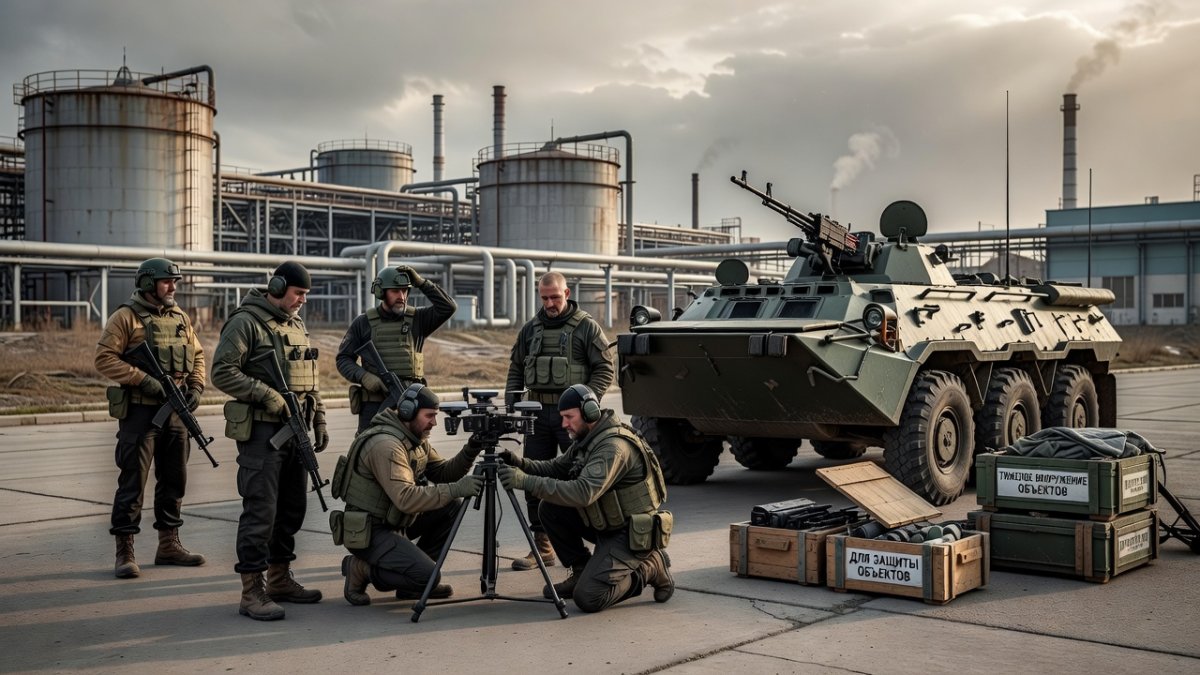
Russia Authorizes Private Companies to Acquire Heavy Air Defense Systems as Drone Strikes Target Critical Infrastructure
Regulatory Shift Expands Access to Military-Grade Equipment
The Russian government has introduced a streamlined procurement framework allowing private enterprises to purchase anti-aircraft artillery systems, automated turrets, mobile radar installations, specialized armored vehicles, and electronic warfare suites. The measure, first reported by RBC, responds directly to repeated Ukrainian drone incursions against oil refineries, power plants, and logistics hubs inside Russia. Under the new rules, qualifying firms must obtain licenses from the Ministry of Industry and Trade and coordinate deployments with regional defense councils, yet the threshold for approval has been lowered compared with previous civilian arms restrictions.
Officials describe the change as a pragmatic adjustment to wartime realities rather than a broad liberalization of weapons ownership. Companies operating strategic assets now face fewer bureaucratic hurdles when requesting equipment previously reserved for state forces. The Ministry of Defense confirmed that deliveries will occur through authorized state intermediaries, preserving oversight of serial numbers and ammunition stocks.
Scale of Drone Attacks Driving Policy Change
Since early 2024, Russian authorities have recorded more than 180 drone strikes or attempted incursions against energy facilities alone. In September, a swarm damaged distillation units at the Ryazan refinery, forcing a 40 percent cut in output for ten days. Similar incidents hit the Kirishi and Yaroslavl plants, contributing to a documented 12 percent year-on-year decline in domestic diesel exports. Independent estimates place direct repair costs above 85 billion rubles, excluding lost revenue.
Regional governors in Belgorod, Kursk, and Voronezh oblasts have repeatedly petitioned Moscow for permission to arm local enterprises. The new decree effectively grants those requests while embedding them within a national coordination mechanism. Data compiled by the state statistics agency Rosstat shows that 67 percent of all drone-related incidents since March targeted privately operated infrastructure rather than purely military sites.
Equipment Categories Now Available to Licensed Operators
The approved list includes 23 mm and 30 mm anti-aircraft cannons, remote weapon stations with integrated fire-control radars, vehicle-mounted electronic warfare jammers operating in the 2–6 GHz and 8–18 GHz bands, and short-range surveillance radars with 40-kilometer detection radii. Procurement is limited to systems manufactured domestically or by Belarusian partners, ensuring compatibility with existing Russian air-defense networks.
Each acquisition requires a technical assessment by Rosoboronexport and a mandatory training program for company security personnel. Ammunition allotments are capped at 200 rounds per gun barrel per quarter unless additional justification is provided. These controls aim to prevent diversion while still enabling rapid response to low-altitude threats that often evade centralized air-defense coverage.
Industry Reaction and Implementation Timeline
Major energy conglomerates including Rosneft, Gazprom Neft, and Lukoil have already formed internal working groups to evaluate equipment packages. A Lukoil security director, speaking on condition of anonymity, stated that the company expects to deploy its first mobile radar and jamming units at three Volga-region terminals within 90 days. Smaller midstream operators have formed consortia to share procurement costs and maintenance crews.
Defense analysts note that the policy also creates new revenue streams for domestic manufacturers. Rostec subsidiaries report a 35 percent increase in order backlogs for Pantsir-S1 components and R-330Zh Zhitel electronic warfare systems since the decree was signed. Production lines in Tula and Izhevsk have added shifts to meet anticipated demand.
Legal and Oversight Framework
The regulation amends Federal Law No. 150-FZ on Weapons by carving out an explicit exception for “objects of critical infrastructure under private management.” Oversight remains with the Federal Service for Military-Technical Cooperation, which must approve each transfer. Private security detachments operating the systems will receive status equivalent to paramilitary units, subjecting them to the same criminal liability standards applied to National Guard personnel.
Legal experts highlight that the change stops short of permitting companies to maintain standing private armies. Weapon systems must remain fixed to specific sites or designated patrol routes, and operators cannot conduct offensive operations beyond their immediate perimeter. Violations carry fines up to 5 million rubles and potential license revocation.
Strategic Implications for Russia’s Rear-Area Defense
Military theorists have long argued that centralized air-defense assets cannot cover every kilometer of Russia’s vast territory. The new policy effectively decentralizes a portion of low-altitude protection to the entities with the strongest incentive to safeguard their own assets. This mirrors practices observed in conflict zones where commercial operators assume responsibility for point defense.
However, integration challenges persist. Private systems must feed targeting data into the national air-defense network to avoid fratricide incidents. The Ministry of Defense has mandated installation of standardized data links within 60 days of equipment receipt. Failure to comply results in immediate suspension of operational authority.
Expert Perspectives on Risks and Effectiveness
Retired Colonel Viktor Murakhovsky, editor of the journal Arsenal Otechestva, observed that “the measure closes a dangerous gap between the speed of bureaucratic procurement and the tempo of drone attacks.” He cautioned, however, that private operators lack the layered redundancy of state regiments and may become high-value targets themselves.
Independent defense analyst Pavel Felgenhauer noted that electronic warfare systems now entering private hands could inadvertently interfere with civilian aviation frequencies if calibration protocols are not strictly followed. The Federal Air Transport Agency has therefore required all new installations to undergo electromagnetic compatibility testing before activation.
Western sanctions have complicated spare-parts logistics for certain imported components, yet Russian designers have substituted domestic alternatives in most cases. Industry sources indicate that 82 percent of the equipment on the approved list is now produced entirely within Russia or Belarus.
Longer-term questions concern proliferation. Once private firms own and operate sophisticated air-defense assets, reversing the policy after the conflict ends may prove politically difficult. Lawmakers have already signaled that the framework will be reviewed annually rather than treated as a temporary wartime expedient.
The decree also raises questions about equity. Smaller enterprises lacking connections in Moscow may struggle to navigate the licensing process, potentially widening the security gap between large conglomerates and regional operators. The Ministry of Industry and Trade has promised to publish simplified application templates by November to address these concerns.
Overall, the policy represents a calculated transfer of defensive responsibility from the state to the private sector, driven by the persistent threat of long-range drones. Its success will depend on rigorous oversight, rapid integration with existing command structures, and sustained domestic production capacity.
This is Irina Volkov for Global1 News, reporting from Moscow. 🇷🇺
This article was produced with AI-assisted research and editorial support. Reporting is based on sources cited in the article.
What's Your Reaction?
 Like
0
Like
0
 Dislike
0
Dislike
0
 Love
0
Love
0
 Funny
0
Funny
0
 Wow
0
Wow
0
 Sad
0
Sad
0
 Angry
0
Angry
0
Russia/Eastern Europe Correspondent at Global1.News. Covering Russian politics, energy, security, and the shifting dynamics of the post-Soviet space. Provides clear-eyed analysis on one of the world's most opaque regions.














Comments (0)